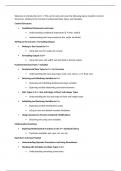
Welcome to the notes on Best Practices for Coding Standards, Error Handling, and Debugging in the
context of Control Structures, specifically Conditional Statements and Loops, in C++.
Control Structures
Conditional Statements and Loops
Follow consistent and clear naming conventions for identifiers.
Use braces {} to enclose the statements in the body of conditional statements and loops,
even for single-statement blocks.
Order conditional tests for clarity and efficiency, testing simple conditions before complex
ones and avoiding unnecessary nested conditionals.
Prefer switch statements over complex nested if-else statements for multiple-condition tests.
Use loops for repetitive tasks, choosing the appropriate loop construct (for, while, do-while)
based on the specific use case.
Ensure that loop conditions are evaluated correctly and that loops terminate properly.
Writing to the Console and Formatting Output
Use std::cout to write output to the console, and follow formatting conventions for clear and
readable output.
Use manipulators (e.g., std::setw, std::setprecision) to format output as needed.
Fundamental Data Types in C++
Understand the fundamental data types in C++, including their sizes and ranges.
Choose the appropriate data type based on the specific use case, considering factors such as
size and range.
Declaring and Initializing Variables
Declare variables at the point of first use, following the "declare-when-needed" principle.
Use initialization to set the initial value of a variable, avoiding uninitialized variables and
ensuring predictable behavior.
Using Constants to Prevent Accidental Modifications
Use constants (const or constexpr) to prevent accidental modifications to important values.
Mathematical Functions in the C++ Standard Library
Use functions from the C++ Standard Library (e.g., std::abs, std::pow) to perform
mathematical operations.
Best Practices: Coding Standards, Error Handling, and Debugging
Follow consistent and clear coding standards, including naming conventions and formatting
conventions, for readability and maintainability.
context of Control Structures, specifically Conditional Statements and Loops, in C++.
Control Structures
Conditional Statements and Loops
Follow consistent and clear naming conventions for identifiers.
Use braces {} to enclose the statements in the body of conditional statements and loops,
even for single-statement blocks.
Order conditional tests for clarity and efficiency, testing simple conditions before complex
ones and avoiding unnecessary nested conditionals.
Prefer switch statements over complex nested if-else statements for multiple-condition tests.
Use loops for repetitive tasks, choosing the appropriate loop construct (for, while, do-while)
based on the specific use case.
Ensure that loop conditions are evaluated correctly and that loops terminate properly.
Writing to the Console and Formatting Output
Use std::cout to write output to the console, and follow formatting conventions for clear and
readable output.
Use manipulators (e.g., std::setw, std::setprecision) to format output as needed.
Fundamental Data Types in C++
Understand the fundamental data types in C++, including their sizes and ranges.
Choose the appropriate data type based on the specific use case, considering factors such as
size and range.
Declaring and Initializing Variables
Declare variables at the point of first use, following the "declare-when-needed" principle.
Use initialization to set the initial value of a variable, avoiding uninitialized variables and
ensuring predictable behavior.
Using Constants to Prevent Accidental Modifications
Use constants (const or constexpr) to prevent accidental modifications to important values.
Mathematical Functions in the C++ Standard Library
Use functions from the C++ Standard Library (e.g., std::abs, std::pow) to perform
mathematical operations.
Best Practices: Coding Standards, Error Handling, and Debugging
Follow consistent and clear coding standards, including naming conventions and formatting
conventions, for readability and maintainability.