HLSC 120 – Human Anatomy
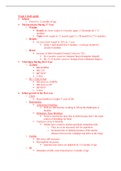
Chapter 10: Muscular System
made up of over 700 skeletal muscles
Myology – study of muscles Deep fascia – visceral / muscular fascia; ensheathes these 3 connective tissue
Muscular tissue accounts for 40-50% of total body mass. layers; expansive sheet of dense irregular connective tissue that separates
PROPERTIES OF MUSCLE TISSUE individual muscles, binds together muscles w/ similar functions, forms sheaths
Excitability - electrical excitability / irritability; responsiveness to a certain to help distribute nerves, blood vessels, and lymphatic vessels, fill spaces b/w
stimulus muscles
Contractility –creates tension w/n the cell (contraction) w/c may cause the cell o Superficial fascia – subcutaneous layer / hypodermis; composed of
to shorten w/c results in either a pull on bones of the skeleton or the areolar connective tissue and adipose connective tissue that separates
movement of specific body parts muscle from skin; underneath is where the deep fascia is found
Extensibility – ability to extend in length in response to the contraction of MUSCLE ATTACHMENTS
opposing muscle cells Tendon – at the ends of a muscle, connective tissue layers merge to form a
Elasticity – ability of the contracted muscle cell to recoil to its resting length fibrous tendon; connects the muscle to the bone, skin, or another muscle; have
when the applied tension is removed thick, cordlike structure; forms an aponeurosis
SKELETAL MUSCLE TISSUE o Aponeuroses – a flat sheet-like fibrous-membrane that aids in the
composed of 4 types of tissue: epithelial, connective, muscle, nervous connection to the bone
striated and usually attached to one or more bones Upon contraction, one of the bones moves while the other bone usually remains
often referred to as muscle fibers fixed.
FUNCTIONS OF SKELETAL MUSCLE TISSUE Origin – less movable attachment of a muscle; typically lies proximal to the
Responsible for producing body movements insertion
Stabilizing body positions / maintains posture Insertion – more movable attachment of the muscle; pulled toward the origin
Storage and movement of materials (i.e. nutrients, glycogen, fats) BLOOD VESSELS AND NERVES
Producing heat / temperature regulation extensive network extends through both the epimysium and perimysium
Expressions of emotions Blood vessels – deliver to the muscle fibers both nutrients and oxygen needed
Support and protection of organs for the production of ATP; remove waste products produced by the muscle
STRUCTURE OF A SKELETAL MUSCLE TISSUE fibers
CONNECTIVE TISSUE COVERINGS Somatic nervous system – allows the voluntary movements of the skeletal
Endomysium – innermost connective tissue layer; delicate, areolar tissue layer; muscles
surrounds each muscle fiber; has reticular fibers to help bind together Motor neurons – stimulate muscle contraction; innervate muscle fibers w/n the
neighboring muscle fibers and support capillaries near these fibers muscle; has an axon
Perimysium – surrounds the fascicles; its dense irregular connective tissue o Axon – long extension; nerve fiber; transmits a nerve impulse to a
sheath contains extensive arrays of blood vessels and nerves that branch to muscle fiber; travels through the epimysium and perimysium and
supply each individual fascicle enters the endomysium where it sends a nerve impulse to an
o Fascicles – bundles of muscle fibers individual muscle fiber
Epimysium – layer of dense irregular connective tissue; surrounds the entire o Neuromuscular junction – junction b/w the axon and the muscle fiber
skeletal muscle itself
, MICROSCOPIC ANATOMY filament resembling a string of beads; each spherical
Skeletal muscles are multinucleated. molecule has a binding site for:
o Myoblasts – groups of embryonic cells; fuse to form single skeletal myosin – protein that makes up thick filaments
muscle fibers wherein each myoblast nucleus contributes to the tropomyosin - regulatory protein; resembles a shorter,
eventual total number of nuclei thinner, twisted filament that covers small sections of the
o Satellite cells – embryonic-like cells that remain in adult skeletal actin strands
muscle tissue; may be stimulated to differentiate and assist in the troponin – regulatory protein; attach to actin to anchor the
repair and regeneration of a muscle if a skeletal muscle is injured troponin in place; attach to tropomyosin to hold it in place
Sarcolemma – plasma membrane of a skeletal muscle over the surface of the actin
Sarcoplasm – cytoplasm of the muscle fiber o thick filaments – 2x as large as thin filaments (11nm); assembled form
Mitochondria – contains approx 300 mitochondria per muscle fiber since the bundles of the protein myosin
fibers have a great demand for energy myosin – consists of 2 strands, each has a free, globular head
Lysosomes and other organelles are also present. and an attached, elongated tail; myosin molecules are
2 main structures unique to muscle fibers: oriented on either end of the thick filament; myosin heads
o T-tubules – transverse tubules; deep invaginations of the sarcolemma are also referred to as
that extend into the sarcoplasm of skeletal muscle fibers as a network crossbridges – bec during a contraction they bind
of narrow membrane tubules; helps stimulate and coordinate muscle thick filaments to thin filaments, thus forming a
contractions bridge between them
o Sacroplasmic reticulum (SR) – internal membrane complex; similar to Striated appearance of the skeletal muscle is due to size and density differences bw
smooth ER; reservoir for calcium ions needed to initiate muscle thick and thin filaments.
contraction A bands – dark bands; contain the entire thick filament
Terminal cisternae – blind sacs of sarcoplasmic reticulum; I bands – lighter than A bands; contain thin filaments only
pairs immediately adjacent to each T-tubule; reservoirs of H zone – light, central region in A band
calcium ions; interact w/ T-tubulues during muscle o when muscle fiber is relaxed – no thin filaments are present
contraction o at maximal contraction – thin filaments are pulled into this zone, H
Triad – structure formed by 2 terminal cisternae and the zone disappears
centrally placed T-tubule M line – thin protein meshwork structure in the center of the H zone of a
MYOFIBRILS AND MYOFILAMENTS relaxed fiber; serves as an attachment site for thick filaments; keeps the thick
Myofibrils – long cylindrical structures in the sarcoplasm; 1-2 micrometers in filaments aligned during contraction and relaxation events
diameter; extends the length of the entire muscle fiber; consists myofilaments Z disc / Z line – thin protein structure in the center of the I band; serves as an
o During contraction – shorten as their component proteins change attachment site for thin filament ends; circular but only the edge is visible so it
position; causes the fiber to shorten looks like a line
Myofilaments – short bundles; may take many successive groupings of o Connectins – z-disc proteins; anchor and interconnect the thin
myofilaments to run the entire length of the myofibril; classifications: filament ends at either end of a sacromere
o thin filaments – 5-6 nm in diameter; composed of actin o Titin – elastic proteins; attach thin and thick filaments and M-line
actin – 2 strands of protein twisted around each other to proteins to the z-disc to maintain their organization and order
form a helical shape; in each helical strand, many small, ORGANIZATION OF A SACROMERE
spherical molecules connect to teach other to form a long sacromere – functional contractile unit of a skeletal muscle fiber; defined as one
Chapter 10: Muscular System
made up of over 700 skeletal muscles
Myology – study of muscles Deep fascia – visceral / muscular fascia; ensheathes these 3 connective tissue
Muscular tissue accounts for 40-50% of total body mass. layers; expansive sheet of dense irregular connective tissue that separates
PROPERTIES OF MUSCLE TISSUE individual muscles, binds together muscles w/ similar functions, forms sheaths
Excitability - electrical excitability / irritability; responsiveness to a certain to help distribute nerves, blood vessels, and lymphatic vessels, fill spaces b/w
stimulus muscles
Contractility –creates tension w/n the cell (contraction) w/c may cause the cell o Superficial fascia – subcutaneous layer / hypodermis; composed of
to shorten w/c results in either a pull on bones of the skeleton or the areolar connective tissue and adipose connective tissue that separates
movement of specific body parts muscle from skin; underneath is where the deep fascia is found
Extensibility – ability to extend in length in response to the contraction of MUSCLE ATTACHMENTS
opposing muscle cells Tendon – at the ends of a muscle, connective tissue layers merge to form a
Elasticity – ability of the contracted muscle cell to recoil to its resting length fibrous tendon; connects the muscle to the bone, skin, or another muscle; have
when the applied tension is removed thick, cordlike structure; forms an aponeurosis
SKELETAL MUSCLE TISSUE o Aponeuroses – a flat sheet-like fibrous-membrane that aids in the
composed of 4 types of tissue: epithelial, connective, muscle, nervous connection to the bone
striated and usually attached to one or more bones Upon contraction, one of the bones moves while the other bone usually remains
often referred to as muscle fibers fixed.
FUNCTIONS OF SKELETAL MUSCLE TISSUE Origin – less movable attachment of a muscle; typically lies proximal to the
Responsible for producing body movements insertion
Stabilizing body positions / maintains posture Insertion – more movable attachment of the muscle; pulled toward the origin
Storage and movement of materials (i.e. nutrients, glycogen, fats) BLOOD VESSELS AND NERVES
Producing heat / temperature regulation extensive network extends through both the epimysium and perimysium
Expressions of emotions Blood vessels – deliver to the muscle fibers both nutrients and oxygen needed
Support and protection of organs for the production of ATP; remove waste products produced by the muscle
STRUCTURE OF A SKELETAL MUSCLE TISSUE fibers
CONNECTIVE TISSUE COVERINGS Somatic nervous system – allows the voluntary movements of the skeletal
Endomysium – innermost connective tissue layer; delicate, areolar tissue layer; muscles
surrounds each muscle fiber; has reticular fibers to help bind together Motor neurons – stimulate muscle contraction; innervate muscle fibers w/n the
neighboring muscle fibers and support capillaries near these fibers muscle; has an axon
Perimysium – surrounds the fascicles; its dense irregular connective tissue o Axon – long extension; nerve fiber; transmits a nerve impulse to a
sheath contains extensive arrays of blood vessels and nerves that branch to muscle fiber; travels through the epimysium and perimysium and
supply each individual fascicle enters the endomysium where it sends a nerve impulse to an
o Fascicles – bundles of muscle fibers individual muscle fiber
Epimysium – layer of dense irregular connective tissue; surrounds the entire o Neuromuscular junction – junction b/w the axon and the muscle fiber
skeletal muscle itself
, MICROSCOPIC ANATOMY filament resembling a string of beads; each spherical
Skeletal muscles are multinucleated. molecule has a binding site for:
o Myoblasts – groups of embryonic cells; fuse to form single skeletal myosin – protein that makes up thick filaments
muscle fibers wherein each myoblast nucleus contributes to the tropomyosin - regulatory protein; resembles a shorter,
eventual total number of nuclei thinner, twisted filament that covers small sections of the
o Satellite cells – embryonic-like cells that remain in adult skeletal actin strands
muscle tissue; may be stimulated to differentiate and assist in the troponin – regulatory protein; attach to actin to anchor the
repair and regeneration of a muscle if a skeletal muscle is injured troponin in place; attach to tropomyosin to hold it in place
Sarcolemma – plasma membrane of a skeletal muscle over the surface of the actin
Sarcoplasm – cytoplasm of the muscle fiber o thick filaments – 2x as large as thin filaments (11nm); assembled form
Mitochondria – contains approx 300 mitochondria per muscle fiber since the bundles of the protein myosin
fibers have a great demand for energy myosin – consists of 2 strands, each has a free, globular head
Lysosomes and other organelles are also present. and an attached, elongated tail; myosin molecules are
2 main structures unique to muscle fibers: oriented on either end of the thick filament; myosin heads
o T-tubules – transverse tubules; deep invaginations of the sarcolemma are also referred to as
that extend into the sarcoplasm of skeletal muscle fibers as a network crossbridges – bec during a contraction they bind
of narrow membrane tubules; helps stimulate and coordinate muscle thick filaments to thin filaments, thus forming a
contractions bridge between them
o Sacroplasmic reticulum (SR) – internal membrane complex; similar to Striated appearance of the skeletal muscle is due to size and density differences bw
smooth ER; reservoir for calcium ions needed to initiate muscle thick and thin filaments.
contraction A bands – dark bands; contain the entire thick filament
Terminal cisternae – blind sacs of sarcoplasmic reticulum; I bands – lighter than A bands; contain thin filaments only
pairs immediately adjacent to each T-tubule; reservoirs of H zone – light, central region in A band
calcium ions; interact w/ T-tubulues during muscle o when muscle fiber is relaxed – no thin filaments are present
contraction o at maximal contraction – thin filaments are pulled into this zone, H
Triad – structure formed by 2 terminal cisternae and the zone disappears
centrally placed T-tubule M line – thin protein meshwork structure in the center of the H zone of a
MYOFIBRILS AND MYOFILAMENTS relaxed fiber; serves as an attachment site for thick filaments; keeps the thick
Myofibrils – long cylindrical structures in the sarcoplasm; 1-2 micrometers in filaments aligned during contraction and relaxation events
diameter; extends the length of the entire muscle fiber; consists myofilaments Z disc / Z line – thin protein structure in the center of the I band; serves as an
o During contraction – shorten as their component proteins change attachment site for thin filament ends; circular but only the edge is visible so it
position; causes the fiber to shorten looks like a line
Myofilaments – short bundles; may take many successive groupings of o Connectins – z-disc proteins; anchor and interconnect the thin
myofilaments to run the entire length of the myofibril; classifications: filament ends at either end of a sacromere
o thin filaments – 5-6 nm in diameter; composed of actin o Titin – elastic proteins; attach thin and thick filaments and M-line
actin – 2 strands of protein twisted around each other to proteins to the z-disc to maintain their organization and order
form a helical shape; in each helical strand, many small, ORGANIZATION OF A SACROMERE
spherical molecules connect to teach other to form a long sacromere – functional contractile unit of a skeletal muscle fiber; defined as one