Topics to Review Diana Revilla
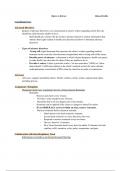
Coordinated care
Advanced Directives
- purpose of advance directives is to communicate a client’s wishes regarding end-of-life care
should the client become unable to do so.
- Staff should give clients who do not have advance directives written information that
outlines their rights related to health care decisions and how to formulate advance
directives
- Types of advance directives
- Living will: legal document that expresses the client’s wishes regarding medical
treatment in the event the client becomes incapacitated and is facing end-of-life issues.
- Durable power of attorney: a document in which clients designate a health care proxy
to make health care decisions for them if they are unable to do so.
- Provider’s orders: Unless a provider writes a “do not resuscitate” (DNR) or “allow
natural death” (AND) prescription in the client’s medical record, the nurse initiates
cardiopulmonary resuscitation (CPR) when the client has no pulse or respirations.
Advocacy
- Advocacy: support and defend clients’ health, wellness, safety, wishes, and personal rights,
including privacy.
Assignment / Delegation
- Managing Client Care: Assigning Care for a Client who has Restraints
- Restraints:
- Remove and check every 2 hours.
- Provider’s order needed every 24 hours.
- Should be able to fit two fingers into wrist restraint.
- Restraints can be applied if the client is a danger to himself or others
- IF an ORDER isn’t received within an hour, remove restraints.
- Physical restraints before chemical restraint.
- Hand mitten is the least restrictive restraint.
- Second least restrictive is wrist, then belt, then vest.
- Required to remove restraints every two hours.
- One at a time for 15 minutes.
- Do a NeuroVascular check every hour for adults, 30 minutes for kids,
capillary refill, sensation, color, pulse, temperature, and pain.
Collaboration with Interdisciplinary Team
Information to include in an Interprofessional Meeting
, - The interprofessional healthcare team works collaboratively to provide holistic
care to clients. Holistic: characterized by the treatment of the whole person, taking
into account mental and social factors, rather than just the symptoms of an illness.
- Share appropriate information among team members
- Initiate referrals for client assistance
- Including health education
- And identify community resources
- The nurse is most often the care manager and must understand the roles and
responsibilities of other healthcare team members to collaborate and make appropriate
referrals.
- Occupational therapist: Assesses and plans for clients to regain activities of daily living
(ADL) skills, especially motor skills of the upper extremities.
- Example of when to refer: A client has difficulties using an eating utensil with their
dominant hand following a stroke.
- Physical therapist: Assesses and plans for clients to increase musculoskeletal function,
especially of the lower extremities, to maintain mobility.
- Example of when to refer: Following hip arthroplasty, a client requires assistance learning
to ambulate and regain strength.
Managing Client Care: Intervention When Supervising an Assistive Personnel
• A licensed nurse is responsible for providing clear directions when a task is initially delegated
• Must provide supervision either directly or indirectly
• Monitor performance
• Intervene if unsafe
• Provide feed back
- Basic Mental Health Nursing Concepts: Making Referrals using the Interdisciplinary
Team
- Case management: coordinating holistic care to include medical, mental health,
and social services
- Collaboration with peers and the clinical interdisciplinary team enhances the nurse’s
ability to examine their own thoughts and feelings, maintain boundaries, and continue to
learn from nurse-client relationships.
- Coordinating care, particularly for clients who have complex health care needs
- Facilitating continuity of care
- Improving efficiency of care and utilization of resources QTC
- Enhancing quality of care provided
- Limiting unnecessary costs and lengthy stays
- Advocating for the client and family
Concepts of Management and supervision
, - Bowel Elimination: Reinforcing Teaching about Ostomy Care
- Foods that cause odor: fish, eggs, asparagus, garlic, beans, and dark green leafy
vegetables
- Foods that cause gas: dark green leafy vegetables, beer, carbonated beverages,
dairy products, and corn, chewing gum, skipping meals, and smoking can also
cause gas.
- Yogurt, crackers, and toast can be ingested to decrease gas
Managing Client care: supervising an Assistive Personnel
- AP can do ADL’s, bathing, grooming, dressing, toileting, ambulating, feeding, Blood
sugar checks and changing simple dressings.
- The delegating nurse must…
- provide supervision, either directly or indirectly.
- Provide clear direction and expectations of the tasks to be performed (time frame /
what to report)
- Monitor performance
- Provide feedback
- Intervene if necessary
- Evaluate client to determine if outcomes were met
- Evaluate client care test and idenitify
Continuity of Care
- Information Technology: Change-of-shift-Report
- Formats include face-to-face, audiotaping, or during rounds (unless the
client has a roommate or visitors are present).
- An effective report should:
- Include significant objective information about the client’s health
problems.
- Proceed in a logical sequence
- Include no gossip or personal opinion.
- Relate recent changes in medications, treatments, procedures, and
the discharge plan.
- Arthroplasty: Reinforcing Discharge Teaching following a Total Hip Arthroplasty
- Extensive physical therapy is required to regain mobility. If discharged home,
outpatient or in-home therapy is provided.
- Monitor for evidence of incisional infection (fever, increased redness, swelling,
purulent drainage).
- Care for the incision (clean daily with soap and water).
- Monitor for DVT (swelling, redness, pain in calf)
, - Monitor for Pulmonary Embolism (SOB, chest pain), and bleeding (if taking an
anticoagulant).
Keep abductor pillow in place while in bed or while turning
• Do not flex hip more than 90 degrees
• Do not position the client on the operative site
• Use elevated seating and a raised toilet seat
• Use straight chairs with arms
• Externally rotate the toes
• Use extended handles on shoehorn and dressing sticks
• Avoid low chairs
• Do not cross legs for at least 3 months
• Do not internally rotate toes
• Follow exercise program at home
- Medications Affecting Blood Pressure: Addressing A/E of ACE inhibitors “-pril”
- Orthostatic Hypotension - change positions slowly
- Report a cough
- Monitor for hyperkalemia
- Report angioedema (swelling of the tissues under the skin) that affects the lips,
tongue and glottis, and can progress to a life-threatening obstruction).
- Report manifestations of heart failure (edema).
Establishing Priorities
- Managing client care: Prioritizing Care for a group of Clients
- The three-level system of triage consist of these categories:
- emergent (life-threatening),
- urgent (treat within 2 hr), and
- nonurgent (can delay treatment).
- resuscitation (level one), emergent (level two), urgent (level three), less urgent
(level four), and nonurgent (level five).
- Resuscitation triage requires immediate treatment to prevent death. Nonurgent is
a non-life-threatening condition requiring simple evaluation and care
management.
• Prioritize by:
o Systemic before localo Acute before chronic
o Actual problems before potential problems
Ethical Practice
Coordinated care
Advanced Directives
- purpose of advance directives is to communicate a client’s wishes regarding end-of-life care
should the client become unable to do so.
- Staff should give clients who do not have advance directives written information that
outlines their rights related to health care decisions and how to formulate advance
directives
- Types of advance directives
- Living will: legal document that expresses the client’s wishes regarding medical
treatment in the event the client becomes incapacitated and is facing end-of-life issues.
- Durable power of attorney: a document in which clients designate a health care proxy
to make health care decisions for them if they are unable to do so.
- Provider’s orders: Unless a provider writes a “do not resuscitate” (DNR) or “allow
natural death” (AND) prescription in the client’s medical record, the nurse initiates
cardiopulmonary resuscitation (CPR) when the client has no pulse or respirations.
Advocacy
- Advocacy: support and defend clients’ health, wellness, safety, wishes, and personal rights,
including privacy.
Assignment / Delegation
- Managing Client Care: Assigning Care for a Client who has Restraints
- Restraints:
- Remove and check every 2 hours.
- Provider’s order needed every 24 hours.
- Should be able to fit two fingers into wrist restraint.
- Restraints can be applied if the client is a danger to himself or others
- IF an ORDER isn’t received within an hour, remove restraints.
- Physical restraints before chemical restraint.
- Hand mitten is the least restrictive restraint.
- Second least restrictive is wrist, then belt, then vest.
- Required to remove restraints every two hours.
- One at a time for 15 minutes.
- Do a NeuroVascular check every hour for adults, 30 minutes for kids,
capillary refill, sensation, color, pulse, temperature, and pain.
Collaboration with Interdisciplinary Team
Information to include in an Interprofessional Meeting
, - The interprofessional healthcare team works collaboratively to provide holistic
care to clients. Holistic: characterized by the treatment of the whole person, taking
into account mental and social factors, rather than just the symptoms of an illness.
- Share appropriate information among team members
- Initiate referrals for client assistance
- Including health education
- And identify community resources
- The nurse is most often the care manager and must understand the roles and
responsibilities of other healthcare team members to collaborate and make appropriate
referrals.
- Occupational therapist: Assesses and plans for clients to regain activities of daily living
(ADL) skills, especially motor skills of the upper extremities.
- Example of when to refer: A client has difficulties using an eating utensil with their
dominant hand following a stroke.
- Physical therapist: Assesses and plans for clients to increase musculoskeletal function,
especially of the lower extremities, to maintain mobility.
- Example of when to refer: Following hip arthroplasty, a client requires assistance learning
to ambulate and regain strength.
Managing Client Care: Intervention When Supervising an Assistive Personnel
• A licensed nurse is responsible for providing clear directions when a task is initially delegated
• Must provide supervision either directly or indirectly
• Monitor performance
• Intervene if unsafe
• Provide feed back
- Basic Mental Health Nursing Concepts: Making Referrals using the Interdisciplinary
Team
- Case management: coordinating holistic care to include medical, mental health,
and social services
- Collaboration with peers and the clinical interdisciplinary team enhances the nurse’s
ability to examine their own thoughts and feelings, maintain boundaries, and continue to
learn from nurse-client relationships.
- Coordinating care, particularly for clients who have complex health care needs
- Facilitating continuity of care
- Improving efficiency of care and utilization of resources QTC
- Enhancing quality of care provided
- Limiting unnecessary costs and lengthy stays
- Advocating for the client and family
Concepts of Management and supervision
, - Bowel Elimination: Reinforcing Teaching about Ostomy Care
- Foods that cause odor: fish, eggs, asparagus, garlic, beans, and dark green leafy
vegetables
- Foods that cause gas: dark green leafy vegetables, beer, carbonated beverages,
dairy products, and corn, chewing gum, skipping meals, and smoking can also
cause gas.
- Yogurt, crackers, and toast can be ingested to decrease gas
Managing Client care: supervising an Assistive Personnel
- AP can do ADL’s, bathing, grooming, dressing, toileting, ambulating, feeding, Blood
sugar checks and changing simple dressings.
- The delegating nurse must…
- provide supervision, either directly or indirectly.
- Provide clear direction and expectations of the tasks to be performed (time frame /
what to report)
- Monitor performance
- Provide feedback
- Intervene if necessary
- Evaluate client to determine if outcomes were met
- Evaluate client care test and idenitify
Continuity of Care
- Information Technology: Change-of-shift-Report
- Formats include face-to-face, audiotaping, or during rounds (unless the
client has a roommate or visitors are present).
- An effective report should:
- Include significant objective information about the client’s health
problems.
- Proceed in a logical sequence
- Include no gossip or personal opinion.
- Relate recent changes in medications, treatments, procedures, and
the discharge plan.
- Arthroplasty: Reinforcing Discharge Teaching following a Total Hip Arthroplasty
- Extensive physical therapy is required to regain mobility. If discharged home,
outpatient or in-home therapy is provided.
- Monitor for evidence of incisional infection (fever, increased redness, swelling,
purulent drainage).
- Care for the incision (clean daily with soap and water).
- Monitor for DVT (swelling, redness, pain in calf)
, - Monitor for Pulmonary Embolism (SOB, chest pain), and bleeding (if taking an
anticoagulant).
Keep abductor pillow in place while in bed or while turning
• Do not flex hip more than 90 degrees
• Do not position the client on the operative site
• Use elevated seating and a raised toilet seat
• Use straight chairs with arms
• Externally rotate the toes
• Use extended handles on shoehorn and dressing sticks
• Avoid low chairs
• Do not cross legs for at least 3 months
• Do not internally rotate toes
• Follow exercise program at home
- Medications Affecting Blood Pressure: Addressing A/E of ACE inhibitors “-pril”
- Orthostatic Hypotension - change positions slowly
- Report a cough
- Monitor for hyperkalemia
- Report angioedema (swelling of the tissues under the skin) that affects the lips,
tongue and glottis, and can progress to a life-threatening obstruction).
- Report manifestations of heart failure (edema).
Establishing Priorities
- Managing client care: Prioritizing Care for a group of Clients
- The three-level system of triage consist of these categories:
- emergent (life-threatening),
- urgent (treat within 2 hr), and
- nonurgent (can delay treatment).
- resuscitation (level one), emergent (level two), urgent (level three), less urgent
(level four), and nonurgent (level five).
- Resuscitation triage requires immediate treatment to prevent death. Nonurgent is
a non-life-threatening condition requiring simple evaluation and care
management.
• Prioritize by:
o Systemic before localo Acute before chronic
o Actual problems before potential problems
Ethical Practice