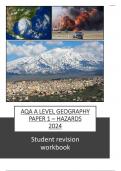
AQA A LEVEL GEOGRAPHY
PAPER 1 – HAZARDS
2024
Student revision
workbook
,Specification content
:
The concept of hazard in a geographical context
Nature, forms and potential impacts of natural hazards (geophysical, atmospheric and
hydrological). Hazard perception and its economic and cultural determinants. Characteristic
human responses – fatalism, prediction, adjustment/adaptation, mitigation, management,
risk sharing – and their relationship to hazard incidence, intensity, magnitude, distribution
and level of development. The Park model of human response to hazards. The Hazard
Management Cycle.
Plate tectonics
Earth structure and internal energy sources. Plate tectonic theory of crustal evolution:
tectonic plates; plate movement; gravitational sliding; ridge push, slab pull; convection
currents and sea-floor spreading.
Destructive, constructive and conservative plate margins. Characteristic processes:
seismicity and vulcanicity. Associated landforms: young fold mountains, rift valleys, ocean
ridges, deep sea trenches and island arcs, volcanoes.
Magma plumes and their relationship to plate movement.
Volcanic hazards
The nature of vulcanicity and its relation to plate tectonics: forms of volcanic hazard: nuées
ardentes, lava flows, mudflows, pyroclastic and ash fallout, gases/acid rain, tephra. Spatial
distribution, magnitude, frequency, regularity and predictability of hazard events.
Impacts: primary/secondary, environmental, social, economic, political. Short and long-term
responses: risk management designed to reduce the impacts of the hazard through
preparedness, mitigation, prevention and adaptation.
Impacts and human responses as evidenced by a recent volcanic event.
Seismic hazards
The nature of seismicity and its relation to plate tectonics: forms of seismic hazard:
earthquakes, shockwaves, tsunamis, liquefaction, landslides. Spatial distribution,
randomness, magnitude, frequency, regularity, predictability of hazard events.
Impacts: primary/secondary; environmental, social, economic, political. Short and long-term
responses; risk management designed to reduce the impacts of the hazard through
preparedness, mitigation, prevention and adaptation.
Impacts and human responses as evidenced by a recent seismic event.
Storm hazards
The nature of tropical storms and their underlying causes. Forms of storm hazard: high
winds, storm surges, coastal flooding, river flooding and landslides. Spatial distribution,
magnitude, frequency, regularity, predictability of hazard events.
Impacts: primary/secondary, environmental, social, economic, political. Short and long-term
responses: risk management designed to reduce the impacts of the hazard through
preparedness, mitigation, prevention and adaptation.
Impacts and human responses as evidenced by two recent tropical storms in contrasting
areas of the world.
Fires in nature
Nature of wildfires. Conditions favouring intense wild fires: vegetation type, fuel
characteristics, climate and recent weather and fire behaviour. Causes of fires: natural and
human agency. Impacts: primary/secondary, environmental, social, economic, political.
Short and long-term responses; risk management designed to reduce the impacts of the
hazard through preparedness, mitigation, prevention and adaptation.
Impact and human responses as evidenced by a recent wild fire event.
Case studies
Case study of a multi-hazardous environment beyond the UK to illustrate and analyse the
nature of the hazards and the social, economic and environmental risks presented, and how
human qualities and responses such as resilience, adaptation, mitigation and management
contribute to its continuing human occupation.
Case study at a local scale of a specified place in a hazardous setting to illustrate the
physical nature of the hazard and analyse how the economic, social and political character of
its community reflects the presence and impacts of the hazard and the community’s
response to the risk.
, 1. The concept of hazard in a geographical context
Specification content:
a) The different types of hazards:
1) A hazard is something that’s a potential threat to human life or property.
2) Natural hazards are caused by natural processes, e.g. a lava flow from a volcanic eruption.
3) 3) Natural hazards can be divided into three types:
Type of hazard Description Examples
Geophysical hazards
Atmospheric hazards
Hydrological hazards
Define the terms below:
1. Disaster —
2. Risk —
3. Vulnerability —
Hazards can have significant impacts while they are occurring, and often need an emergency
response (e.g. evacuating an area). The impacts can also go on for a long time after the hazard itself
has passed.
, b) Hazard perception
People view hazards in different ways — for example, some people believe they will never experience a
particular hazard, others adapt their lifestyle to minimise risk, and others accept hazards as being
beyond their control. People’s perception of hazards is affected by their economic, social and cultural
background.
Wealth —
Education —
Why do people
Religion —
perceive hazards Past experience —
differently?
Personality –
.
.
c) Responses to hazards
Individuals and governments might respond to a hazard to try to reduce their vulnerability, or to reduce
its impacts:
❑ People might try to prevent a hazard or reduce its magnitude. For some hazards (e.g. volcanic
eruptions), this isn’t possible, but for others (e.g. floods) it may be, e.g. by building flood defences.
❑ Risk sharing involves sharing the costs of reducing a hazard, the benefits of preventing it or the costs
of not preventing it — e.g. people buy insurance to help them repair their property after a disaster.
Most people won’t be affected by a particular event, so they won’t claim on the insurance — this
means lots of people contribute, so the cost is shared.
❑ People might try to reduce (mitigate) the impacts of a hazard. This could be by prediction — working
out when and where a hazard is likely to occur, which allows people to respond to it (e.g. by
evacuating an area). It could also be by adaptation — e.g. adding earthquake-resistant features to
buildings.
❑ Governments may coordinate responses to a hazard to manage it effectively.
❑ Some people believe that hazards cannot be avoided, so they must just be accepted — this is
fatalism.
The success of attempts to manage hazards depends on hazard incidence (how often a hazard occurs),
magnitude or intensity (how powerful the hazard is) and distribution (the areal extent of the hazard).
Generally, hazards with low incidence and high magnitude are most destructive. Level of development is
also important — less developed countries may lack the wealth and technology to manage hazards
effectively.
PAPER 1 – HAZARDS
2024
Student revision
workbook
,Specification content
:
The concept of hazard in a geographical context
Nature, forms and potential impacts of natural hazards (geophysical, atmospheric and
hydrological). Hazard perception and its economic and cultural determinants. Characteristic
human responses – fatalism, prediction, adjustment/adaptation, mitigation, management,
risk sharing – and their relationship to hazard incidence, intensity, magnitude, distribution
and level of development. The Park model of human response to hazards. The Hazard
Management Cycle.
Plate tectonics
Earth structure and internal energy sources. Plate tectonic theory of crustal evolution:
tectonic plates; plate movement; gravitational sliding; ridge push, slab pull; convection
currents and sea-floor spreading.
Destructive, constructive and conservative plate margins. Characteristic processes:
seismicity and vulcanicity. Associated landforms: young fold mountains, rift valleys, ocean
ridges, deep sea trenches and island arcs, volcanoes.
Magma plumes and their relationship to plate movement.
Volcanic hazards
The nature of vulcanicity and its relation to plate tectonics: forms of volcanic hazard: nuées
ardentes, lava flows, mudflows, pyroclastic and ash fallout, gases/acid rain, tephra. Spatial
distribution, magnitude, frequency, regularity and predictability of hazard events.
Impacts: primary/secondary, environmental, social, economic, political. Short and long-term
responses: risk management designed to reduce the impacts of the hazard through
preparedness, mitigation, prevention and adaptation.
Impacts and human responses as evidenced by a recent volcanic event.
Seismic hazards
The nature of seismicity and its relation to plate tectonics: forms of seismic hazard:
earthquakes, shockwaves, tsunamis, liquefaction, landslides. Spatial distribution,
randomness, magnitude, frequency, regularity, predictability of hazard events.
Impacts: primary/secondary; environmental, social, economic, political. Short and long-term
responses; risk management designed to reduce the impacts of the hazard through
preparedness, mitigation, prevention and adaptation.
Impacts and human responses as evidenced by a recent seismic event.
Storm hazards
The nature of tropical storms and their underlying causes. Forms of storm hazard: high
winds, storm surges, coastal flooding, river flooding and landslides. Spatial distribution,
magnitude, frequency, regularity, predictability of hazard events.
Impacts: primary/secondary, environmental, social, economic, political. Short and long-term
responses: risk management designed to reduce the impacts of the hazard through
preparedness, mitigation, prevention and adaptation.
Impacts and human responses as evidenced by two recent tropical storms in contrasting
areas of the world.
Fires in nature
Nature of wildfires. Conditions favouring intense wild fires: vegetation type, fuel
characteristics, climate and recent weather and fire behaviour. Causes of fires: natural and
human agency. Impacts: primary/secondary, environmental, social, economic, political.
Short and long-term responses; risk management designed to reduce the impacts of the
hazard through preparedness, mitigation, prevention and adaptation.
Impact and human responses as evidenced by a recent wild fire event.
Case studies
Case study of a multi-hazardous environment beyond the UK to illustrate and analyse the
nature of the hazards and the social, economic and environmental risks presented, and how
human qualities and responses such as resilience, adaptation, mitigation and management
contribute to its continuing human occupation.
Case study at a local scale of a specified place in a hazardous setting to illustrate the
physical nature of the hazard and analyse how the economic, social and political character of
its community reflects the presence and impacts of the hazard and the community’s
response to the risk.
, 1. The concept of hazard in a geographical context
Specification content:
a) The different types of hazards:
1) A hazard is something that’s a potential threat to human life or property.
2) Natural hazards are caused by natural processes, e.g. a lava flow from a volcanic eruption.
3) 3) Natural hazards can be divided into three types:
Type of hazard Description Examples
Geophysical hazards
Atmospheric hazards
Hydrological hazards
Define the terms below:
1. Disaster —
2. Risk —
3. Vulnerability —
Hazards can have significant impacts while they are occurring, and often need an emergency
response (e.g. evacuating an area). The impacts can also go on for a long time after the hazard itself
has passed.
, b) Hazard perception
People view hazards in different ways — for example, some people believe they will never experience a
particular hazard, others adapt their lifestyle to minimise risk, and others accept hazards as being
beyond their control. People’s perception of hazards is affected by their economic, social and cultural
background.
Wealth —
Education —
Why do people
Religion —
perceive hazards Past experience —
differently?
Personality –
.
.
c) Responses to hazards
Individuals and governments might respond to a hazard to try to reduce their vulnerability, or to reduce
its impacts:
❑ People might try to prevent a hazard or reduce its magnitude. For some hazards (e.g. volcanic
eruptions), this isn’t possible, but for others (e.g. floods) it may be, e.g. by building flood defences.
❑ Risk sharing involves sharing the costs of reducing a hazard, the benefits of preventing it or the costs
of not preventing it — e.g. people buy insurance to help them repair their property after a disaster.
Most people won’t be affected by a particular event, so they won’t claim on the insurance — this
means lots of people contribute, so the cost is shared.
❑ People might try to reduce (mitigate) the impacts of a hazard. This could be by prediction — working
out when and where a hazard is likely to occur, which allows people to respond to it (e.g. by
evacuating an area). It could also be by adaptation — e.g. adding earthquake-resistant features to
buildings.
❑ Governments may coordinate responses to a hazard to manage it effectively.
❑ Some people believe that hazards cannot be avoided, so they must just be accepted — this is
fatalism.
The success of attempts to manage hazards depends on hazard incidence (how often a hazard occurs),
magnitude or intensity (how powerful the hazard is) and distribution (the areal extent of the hazard).
Generally, hazards with low incidence and high magnitude are most destructive. Level of development is
also important — less developed countries may lack the wealth and technology to manage hazards
effectively.