Turning Points in modern European History
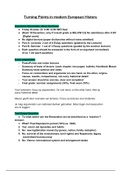
Important information about the Exam
● Friday October 25 9:00-12:00 IWO Geel
● (Resit 16 December, only if overall grade is BELOW 5,5) No admittance after 9:30!
[Digital exam]
● No digital devices (paper dictionaries without notes admitted)
● Part A: Lectures: 2 out of 4 Essay questions (graded by the Lecturer)
● Part B: Seminar: 1 out of 3 Essay questions (graded by the seminar lecturer)
● Each question should be answered in the form of an argument (no bullets!)
of ca. 1 A4 (each question)
Exam preparation
- PowerPoints and notes lectures
- Summary of texts of lecture (each chapter, two pages: bullets). Handbook Mason
- Summary texts seminar and notes
- Focus on connections and arguments (on one hand, on the other, origins,
causes, results, comparisons), not every historical detail!
- Your answer should be concise, clear and complete)!
- Final grade: seminar assignments (30%), final exam (70%)
Voor tentamen: focus op argumenten. On one hand, on the other hand. Niet op
every historical detail
Mason geeft clear overview van lectures. Focus op lectures voor tentamen.
Je mag argumenten van nationaal denken gebruiken. Maar begin met keerpunten
zou ik zeggen
Test Essay Question
● To what extent can the Restoration era be described as a ‘reaction’?
Answer:
1. What? Post Napoleonic period (1814-ca. 1848)
2. Yes: return old dynasties and habits
3. No: new legitimation monarchy (peace, nation, family metaphor)
4. No: survival of the revolutionary (civil rights) and Napoleonic legacy
(centralized bureaucracy)
5. No: Vienna: international system and enlargement states
,Hoorcollege 1 | 3 sep. 2019 The beginning of European History
! Learn from summaries from high school.
18th c. - 1960s = European history is seen as the universal history, the history of
modernity.
Europe is seen as ‘the place’ with history compared to Asia and Africa.
Turning points = moments in the history where new times start
Are they invented by historians or contemporaries?
We study European History because the past in the present/historical turn social &
legal economic sciences.
The humanist invented the periodisation of european history like the middle ages.
The beginning of European history? = European Narratives
Pluralist narrative = political, economic, religious fragmentation as cause of
European dynamism (‘Rise of West’)
The idea of what Europe is changes all the time. Some examples; christianity,
science, freedom, racial..
Europe is seen a lot as a fragmented continent.
!Blockmans text, look and try to see if you agree with him. Is the fragmentation
unique for Europe or not? Is it a myth?
Turning point 476: The structure of the roman empire being destroyed by barbars. ??
barbaren ofs
The roman empire wasn’t a European empire. Europe didn’t have a identity. In the
roman time they didn’t see themselves as ‘roman’ or ‘european’
The greeks did have a idea of Europe but is was all centered around themselves.
! you do not have to know about the dates
Rome had a long of phases:
, 1. roman republic becomes empire
2. conversion emperor constantine
3. division eastern and western empire
4. Deposition (Western-) Roman emperor by German army leader Od
Deposition (Western-) Roman emperor by German army leader Odoacer
The fall of the (west) roman empire was a huge turning point
When you ask people in the 5th century what the turning points were in their lives
they would probably tell:
476 Deposition Roman Emperor by Odoacer
Not seen as a turning points by contemporaries: alternative dates
410: Sack of Roman
439: Conquest of Africa by the ‘Vandals’ (cut off grain supply to Rome)
Turning points change all the time. People from years ago would see different things
as ‘turning points’ as we do nowadays
Beginning of the middle ages?
● West: Continuity of rupture? The survival of Roman Culture
● East: the transformation of the Byzantine Empire and renovato imperii
Justinian
● Mediterranean: The Islamic conquest: ‘Mohammed and Charlemagne’. Is
often seen as a border right now. But in the middle ages it was not seen as a
border.
● Discontinuity: de-urbanisation and declining literacy
Charlemagne (800) = Karel de grote : Roman Emperor or Father of Europe?
Legacies East Roman Empire = Aya Sophia Istanbul / Moscow as Third Rome
The appropriation of the Roman Legacy:
1. The ideal of Empire
2. Roman law: the legal unity of Europe
3. The catholic church (language, administration and clothing)
4. Cities
5. Criticism: J. Goody: The invention of antiquity & a balance.
! The questions for the text are not assignments but you can use them to read and
understand the text
, Hoorcollege 2 | 10 sep. 2019 Modern renaissance & Reformation (1200-1550)
The Sixteenth century: Many people believed different religions could not go together
because it was a very religious century. It was a century with a lot of violence and
wars.
Periodisation 1500-1800: problems
- Concept ‘Early Modern Europe’ : Foundation of
(secular, individual Europe of territorial state)
(19th century historians): criticism but still widely
used
- Alternative (social-economic) periodisation 1000-
1800 (1500 not a rupture: continuation agricultural
-commercial society until 19th (16th not a turning
point?) The 16th century didn’t brought modernity, it was the middle ages. (12th or
13th century), because at that time the whole society changes from agricultural to
urbanisation.
- Robert Bartlett: periode 950-1350: ‘The making
of Europe’: prelude later colonialism?
What a turning point is depends on your perspectives
1000-1300: Expansion Europe
● Population growth (40 million (1000) – 80 million (1300) and growth
agricultural production
● Commercial capitalism and growth cities
● Growing literacy (Universities, (Re)introduction Roman Law)
● Ambitions Catholic Church and clerical reforms
● Feudal revolution and Early State formation
● Internal and external colonisation: frontier society
Latin expansion/ colonisation in the Balticum: Teutonic knights
→ crusades. For expansion, growth. Not only to free the holy land
We see a continuity of crusading to israel holy land and later to the extra European
land
Knights Templar (Tomar): from European crusades to extra- European colonisation
Opposite view: some things did change in 16th century.
Important information about the Exam
● Friday October 25 9:00-12:00 IWO Geel
● (Resit 16 December, only if overall grade is BELOW 5,5) No admittance after 9:30!
[Digital exam]
● No digital devices (paper dictionaries without notes admitted)
● Part A: Lectures: 2 out of 4 Essay questions (graded by the Lecturer)
● Part B: Seminar: 1 out of 3 Essay questions (graded by the seminar lecturer)
● Each question should be answered in the form of an argument (no bullets!)
of ca. 1 A4 (each question)
Exam preparation
- PowerPoints and notes lectures
- Summary of texts of lecture (each chapter, two pages: bullets). Handbook Mason
- Summary texts seminar and notes
- Focus on connections and arguments (on one hand, on the other, origins,
causes, results, comparisons), not every historical detail!
- Your answer should be concise, clear and complete)!
- Final grade: seminar assignments (30%), final exam (70%)
Voor tentamen: focus op argumenten. On one hand, on the other hand. Niet op
every historical detail
Mason geeft clear overview van lectures. Focus op lectures voor tentamen.
Je mag argumenten van nationaal denken gebruiken. Maar begin met keerpunten
zou ik zeggen
Test Essay Question
● To what extent can the Restoration era be described as a ‘reaction’?
Answer:
1. What? Post Napoleonic period (1814-ca. 1848)
2. Yes: return old dynasties and habits
3. No: new legitimation monarchy (peace, nation, family metaphor)
4. No: survival of the revolutionary (civil rights) and Napoleonic legacy
(centralized bureaucracy)
5. No: Vienna: international system and enlargement states
,Hoorcollege 1 | 3 sep. 2019 The beginning of European History
! Learn from summaries from high school.
18th c. - 1960s = European history is seen as the universal history, the history of
modernity.
Europe is seen as ‘the place’ with history compared to Asia and Africa.
Turning points = moments in the history where new times start
Are they invented by historians or contemporaries?
We study European History because the past in the present/historical turn social &
legal economic sciences.
The humanist invented the periodisation of european history like the middle ages.
The beginning of European history? = European Narratives
Pluralist narrative = political, economic, religious fragmentation as cause of
European dynamism (‘Rise of West’)
The idea of what Europe is changes all the time. Some examples; christianity,
science, freedom, racial..
Europe is seen a lot as a fragmented continent.
!Blockmans text, look and try to see if you agree with him. Is the fragmentation
unique for Europe or not? Is it a myth?
Turning point 476: The structure of the roman empire being destroyed by barbars. ??
barbaren ofs
The roman empire wasn’t a European empire. Europe didn’t have a identity. In the
roman time they didn’t see themselves as ‘roman’ or ‘european’
The greeks did have a idea of Europe but is was all centered around themselves.
! you do not have to know about the dates
Rome had a long of phases:
, 1. roman republic becomes empire
2. conversion emperor constantine
3. division eastern and western empire
4. Deposition (Western-) Roman emperor by German army leader Od
Deposition (Western-) Roman emperor by German army leader Odoacer
The fall of the (west) roman empire was a huge turning point
When you ask people in the 5th century what the turning points were in their lives
they would probably tell:
476 Deposition Roman Emperor by Odoacer
Not seen as a turning points by contemporaries: alternative dates
410: Sack of Roman
439: Conquest of Africa by the ‘Vandals’ (cut off grain supply to Rome)
Turning points change all the time. People from years ago would see different things
as ‘turning points’ as we do nowadays
Beginning of the middle ages?
● West: Continuity of rupture? The survival of Roman Culture
● East: the transformation of the Byzantine Empire and renovato imperii
Justinian
● Mediterranean: The Islamic conquest: ‘Mohammed and Charlemagne’. Is
often seen as a border right now. But in the middle ages it was not seen as a
border.
● Discontinuity: de-urbanisation and declining literacy
Charlemagne (800) = Karel de grote : Roman Emperor or Father of Europe?
Legacies East Roman Empire = Aya Sophia Istanbul / Moscow as Third Rome
The appropriation of the Roman Legacy:
1. The ideal of Empire
2. Roman law: the legal unity of Europe
3. The catholic church (language, administration and clothing)
4. Cities
5. Criticism: J. Goody: The invention of antiquity & a balance.
! The questions for the text are not assignments but you can use them to read and
understand the text
, Hoorcollege 2 | 10 sep. 2019 Modern renaissance & Reformation (1200-1550)
The Sixteenth century: Many people believed different religions could not go together
because it was a very religious century. It was a century with a lot of violence and
wars.
Periodisation 1500-1800: problems
- Concept ‘Early Modern Europe’ : Foundation of
(secular, individual Europe of territorial state)
(19th century historians): criticism but still widely
used
- Alternative (social-economic) periodisation 1000-
1800 (1500 not a rupture: continuation agricultural
-commercial society until 19th (16th not a turning
point?) The 16th century didn’t brought modernity, it was the middle ages. (12th or
13th century), because at that time the whole society changes from agricultural to
urbanisation.
- Robert Bartlett: periode 950-1350: ‘The making
of Europe’: prelude later colonialism?
What a turning point is depends on your perspectives
1000-1300: Expansion Europe
● Population growth (40 million (1000) – 80 million (1300) and growth
agricultural production
● Commercial capitalism and growth cities
● Growing literacy (Universities, (Re)introduction Roman Law)
● Ambitions Catholic Church and clerical reforms
● Feudal revolution and Early State formation
● Internal and external colonisation: frontier society
Latin expansion/ colonisation in the Balticum: Teutonic knights
→ crusades. For expansion, growth. Not only to free the holy land
We see a continuity of crusading to israel holy land and later to the extra European
land
Knights Templar (Tomar): from European crusades to extra- European colonisation
Opposite view: some things did change in 16th century.