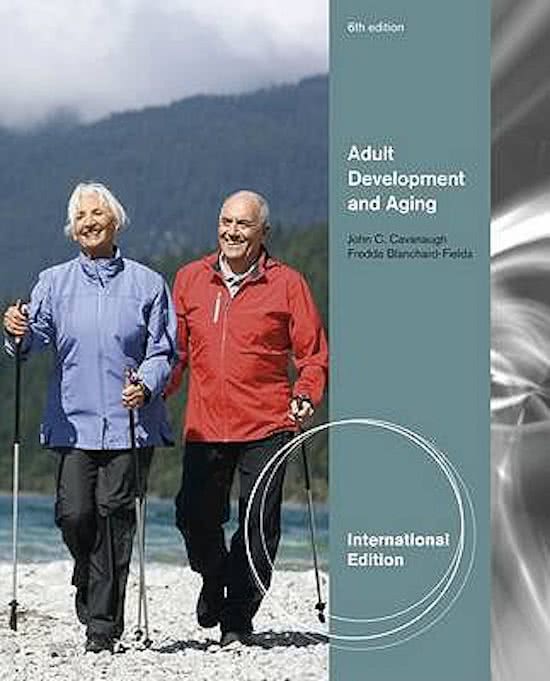
Test Bank For Adult Development and Aging 8th Edition By
John C. Cavanaugh; Fredda Blanchard-Fields
The biopsychosocial model - ANSWER:a view of aging as a complex interaction
between biological, psychological and sociocultural processes:
o Biological: physiological factors, genetics
o Psychological: cognition, emotions, personality
o Social: social context, history, culture
Gerontology - ANSWER:the scientific study of the aging process; an interdisciplinary
field
Four principles of aging: - ANSWER:o Change is continuous over the lifespan - hence
people remain the same even as they change, which should also be reflected in
healthcare treatment.
o Only the survivors grow old - hence aging individuals are increasingly self-selected;
based on the survivor principle; this means that the group that is old people is only a
subgroup in the young population
o Individuality matters - within and between age groups; do intragroup differences
magnify because the age span between individuals increases?
o Normal aging is different from disease - the process looks different for the two
Five ways to shorten your life: - ANSWER:o Being overweight
o Not eating enough fruit/vegetables
o Not enough physical exercise
o Drinking and driving
o Smoking
Inter-individual differences - ANSWER:differences between people (also in different
age groups). E.g. hippocampus size can be more similar between a 70yo and a 20yo
than two 70yo's.
Intra-individual differences - ANSWER:the processes within a single person develop
at different paces.
Multidirectionality - ANSWER:processes can develop simultaneously in many
different directions within the same person
Stages of ageing - ANSWER:o Primary/normal aging - the normal changes over time
that occur due to universal, intrinsic, and progressive alterations in the body's
systems.
,o Secondary/impaired aging - changes over time leading to impairment due to
disease rather than normal aging
o Tertiary aging - towards the very end of life; rapid loss of function across multiple
areas of functioning; due to the organism reaching its limit
Optimal ageing - ANSWER:age-related changes that improve the individual's
functioning; e.g. acquiring wisdom. May counter the psychological/physical toll of
aging.
Emerging adulthood - ANSWER:the first years of being an adult (however you define
it), which includes a transition prior to assuming the full responsibilities associated
with adulthood.
Common subgroups of the "old" (above 65) population: - ANSWER:o Young-old (65-
74)
o Old-old (75-84)
o Oldest-old (85+)
o Centenarians (100+)
o Supercentenarians (110+)
Types of age: - ANSWER:Social age
Psychological age
Biological age
Functional age
Chronological age
Chronological age - ANSWER:age in number of years; a shifty definition
Functional age - ANSWER:how people perform
Biological age - ANSWER:the state of an individual's bodily systems
Psychological age - ANSWER:cognitive performance (e.g. memory, reaction time,
learning ability, intelligence)
Social age - ANSWER:where you are compared to the "typical" ages of certain
positions in life (e.g. grandfather, house-owner, high school student, etc.)
Personal ageing - ANSWER:changes that occur within the individual due to time's
passing and its subsequent influence on the body's functioning and structure.
Social ageing - ANSWER:the effect of a person's exposure to a changing environment
Normative age-graded influences - ANSWER:lead people to choose experiences that
their culture and historical period attach to certain ages or points in the life span.
, Normative history-graded influences - ANSWER:events that occur to everyone within
a certain culture or geopolitical unit (regardless of age) and include large-scale
occurrences, such as world wars, economic trends, or sociocultural changes in
attitudes and values. Impact of the events may be felt immediately + continue to
have a lasting impact for many years on work/family/quality of life for those
affected. For example, World War II veterans who entered the military after their
families were already established were more likely upon their return to get divorced
or separated, to suffer career setbacks, and experience poorer physical health after
they turned 50.
Health expectancy - ANSWER:the number of years a person can expect to live in
good health and with relatively little disability if current mortality and morbidity
rates persist.
Compression of morbidity - ANSWER:to make the time of serious illness between
death as short as possible; a way to ease the burden of increased lifespan
expectancy.
The lifespan perspective - ANSWER:views development as continuous from
childhood through old age.
Contextual influences on development - ANSWER:the effects of race, gender, sex,
social class, religion, ethnicity and culture.
Developmental science - ANSWER:is gradually replacing the term developmental
psychology as the focus continues to incorporate more than the psychological aspect
of aging.
Models for nature vs nurture (3): - ANSWER:o Organismic model - heredity drives the
course of development over the lifetime
o Mechanistic model - behavior changes radically over times, in response to external
forces that require adaptation
o Interactionist model - environment and individual influence each other
Reciprocity in development - ANSWER:people both influence and are influenced by
events in their lives.
The ecological perspective - ANSWER:identifies multiple levels of the environment
that affects the individual over time. Micro, exo, macro.
o Mesosystem - where two or more systems interact, e.g. you have trouble at home
and therefore trouble in school.
o Chronosystem - changes that take place over time
The life course perspective - ANSWER:norms, attitudes and roles connected to a
certain age have an impact on each person's life.
John C. Cavanaugh; Fredda Blanchard-Fields
The biopsychosocial model - ANSWER:a view of aging as a complex interaction
between biological, psychological and sociocultural processes:
o Biological: physiological factors, genetics
o Psychological: cognition, emotions, personality
o Social: social context, history, culture
Gerontology - ANSWER:the scientific study of the aging process; an interdisciplinary
field
Four principles of aging: - ANSWER:o Change is continuous over the lifespan - hence
people remain the same even as they change, which should also be reflected in
healthcare treatment.
o Only the survivors grow old - hence aging individuals are increasingly self-selected;
based on the survivor principle; this means that the group that is old people is only a
subgroup in the young population
o Individuality matters - within and between age groups; do intragroup differences
magnify because the age span between individuals increases?
o Normal aging is different from disease - the process looks different for the two
Five ways to shorten your life: - ANSWER:o Being overweight
o Not eating enough fruit/vegetables
o Not enough physical exercise
o Drinking and driving
o Smoking
Inter-individual differences - ANSWER:differences between people (also in different
age groups). E.g. hippocampus size can be more similar between a 70yo and a 20yo
than two 70yo's.
Intra-individual differences - ANSWER:the processes within a single person develop
at different paces.
Multidirectionality - ANSWER:processes can develop simultaneously in many
different directions within the same person
Stages of ageing - ANSWER:o Primary/normal aging - the normal changes over time
that occur due to universal, intrinsic, and progressive alterations in the body's
systems.
,o Secondary/impaired aging - changes over time leading to impairment due to
disease rather than normal aging
o Tertiary aging - towards the very end of life; rapid loss of function across multiple
areas of functioning; due to the organism reaching its limit
Optimal ageing - ANSWER:age-related changes that improve the individual's
functioning; e.g. acquiring wisdom. May counter the psychological/physical toll of
aging.
Emerging adulthood - ANSWER:the first years of being an adult (however you define
it), which includes a transition prior to assuming the full responsibilities associated
with adulthood.
Common subgroups of the "old" (above 65) population: - ANSWER:o Young-old (65-
74)
o Old-old (75-84)
o Oldest-old (85+)
o Centenarians (100+)
o Supercentenarians (110+)
Types of age: - ANSWER:Social age
Psychological age
Biological age
Functional age
Chronological age
Chronological age - ANSWER:age in number of years; a shifty definition
Functional age - ANSWER:how people perform
Biological age - ANSWER:the state of an individual's bodily systems
Psychological age - ANSWER:cognitive performance (e.g. memory, reaction time,
learning ability, intelligence)
Social age - ANSWER:where you are compared to the "typical" ages of certain
positions in life (e.g. grandfather, house-owner, high school student, etc.)
Personal ageing - ANSWER:changes that occur within the individual due to time's
passing and its subsequent influence on the body's functioning and structure.
Social ageing - ANSWER:the effect of a person's exposure to a changing environment
Normative age-graded influences - ANSWER:lead people to choose experiences that
their culture and historical period attach to certain ages or points in the life span.
, Normative history-graded influences - ANSWER:events that occur to everyone within
a certain culture or geopolitical unit (regardless of age) and include large-scale
occurrences, such as world wars, economic trends, or sociocultural changes in
attitudes and values. Impact of the events may be felt immediately + continue to
have a lasting impact for many years on work/family/quality of life for those
affected. For example, World War II veterans who entered the military after their
families were already established were more likely upon their return to get divorced
or separated, to suffer career setbacks, and experience poorer physical health after
they turned 50.
Health expectancy - ANSWER:the number of years a person can expect to live in
good health and with relatively little disability if current mortality and morbidity
rates persist.
Compression of morbidity - ANSWER:to make the time of serious illness between
death as short as possible; a way to ease the burden of increased lifespan
expectancy.
The lifespan perspective - ANSWER:views development as continuous from
childhood through old age.
Contextual influences on development - ANSWER:the effects of race, gender, sex,
social class, religion, ethnicity and culture.
Developmental science - ANSWER:is gradually replacing the term developmental
psychology as the focus continues to incorporate more than the psychological aspect
of aging.
Models for nature vs nurture (3): - ANSWER:o Organismic model - heredity drives the
course of development over the lifetime
o Mechanistic model - behavior changes radically over times, in response to external
forces that require adaptation
o Interactionist model - environment and individual influence each other
Reciprocity in development - ANSWER:people both influence and are influenced by
events in their lives.
The ecological perspective - ANSWER:identifies multiple levels of the environment
that affects the individual over time. Micro, exo, macro.
o Mesosystem - where two or more systems interact, e.g. you have trouble at home
and therefore trouble in school.
o Chronosystem - changes that take place over time
The life course perspective - ANSWER:norms, attitudes and roles connected to a
certain age have an impact on each person's life.