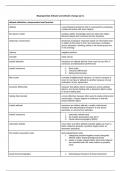
Begrippenlijst Attitude and attitude change part 1
attitude definition, measurement and function
attitude a psychological tendency that is expressed by evaluating
a particular entity with some degree
file drawer model existing, stable, knowledge structure about the object.
Memory based and consistent across situations
temporary construction temporary evaluative response based on information that
is salient at the point in time. Not necessary consistent
across situations “drinking coffee in the morning and not
in the evening”
valence negative-positive
strength weak-strong
explicit attitudes measures an attitude directly ‘how much do you like X’;
conscious and declarative preferences
explicit measures 1. likert scale
2. semantic differential
3. feeling thermometer
likert scale a simple straightforward measure, is hard to compare a
score to one type of attitude to another because of your
evaluation of your agreement
semantic differential measure that allows direct comparison across attitude
objects, and avoid starting with a statement (likert scale)
to avoid creating bias
feeling thermometer a more affective measure often used to study political and
social topics. Assess degree of coolness vs warmth
toward attitude object.
implicit attitude measures an indirect attitude, usually a behavioral
measure and physiological measure. it may asses
automatic or unconscious attitudes
implicit measures 1. automatic attitude task
2. the implicit association task (IAT)
3. Facial electromyography (EMG)
automatic attitude if you have a positive attitude towards apple you have a
faster response towards a positive target (same as
automatic prejudice)
the implicit association task dual categorization task
1. categorize positive/negative words alongside
attitude object (ingroup/outgroup faces)
2. easier to make categorization when liked objects
are classified with the same button as positive
word
facial electromyography 1. physiological measure of facial expression
, (muscle contractions)
2. micro expressions
EMG implicit prejudice results self report; greater liking for black faces BUT facial
emg; more negative facial activity for black faces
explanations for implicit-explicit discrepancies 1. implicit measures may reflect our true attitude
2. implicit attitudes may reflect knowledge of the
world, while explicit attitudes reflect our personal
views
3. explicit measures may reflect a controlled
response
the three witches inhoud, structuur en functie
inhoud: the tripartite model 1. cognitive (beliefs regarding the valence of an
object)
2. affective (refers to the feelings toward an object)
3. behavioral (actual behavior, tendencies, recalled
behavior)
Breckler study Proposed that a test of the tripartite model required
appropriate methods (SNAKE)
● C; self reported belief-based measures
● A: psychological and somatic measure
● B: seating distance, willingness to perform task
conclusion: weak evidence for 3-factor model
structuur one dimensional perspective and two dimensional
perspective
functie why do you have a attitude → motivation
attitude ambivalence extent to which one’s reaction to an attitude object are
evaluatively mixed in that both positive and negative
elements are included. they are:
● less certain and stable
● less predictive of behavior
● more strongly influenced by context
cog-cog conflict I have conflicting thoughts about ice cream
affect-affect conflict I have mixed feelings about ice cream
cog-aff conflict my thoughts and feelings about ice cream are conflicting
attitudes function ● guide our behaviors
● organize knowledge
● communicate preferences
● to signal identities
Influence of attitudes on cognition and behavior
process of how attitudes guide behavior attitude → attention → perception →
interpretation/memory → behavioral intentions →
behavior
Roskos-Ewoldsen & fazio subjects more likely to notice objects with high attitude
accessibility
attitude definition, measurement and function
attitude a psychological tendency that is expressed by evaluating
a particular entity with some degree
file drawer model existing, stable, knowledge structure about the object.
Memory based and consistent across situations
temporary construction temporary evaluative response based on information that
is salient at the point in time. Not necessary consistent
across situations “drinking coffee in the morning and not
in the evening”
valence negative-positive
strength weak-strong
explicit attitudes measures an attitude directly ‘how much do you like X’;
conscious and declarative preferences
explicit measures 1. likert scale
2. semantic differential
3. feeling thermometer
likert scale a simple straightforward measure, is hard to compare a
score to one type of attitude to another because of your
evaluation of your agreement
semantic differential measure that allows direct comparison across attitude
objects, and avoid starting with a statement (likert scale)
to avoid creating bias
feeling thermometer a more affective measure often used to study political and
social topics. Assess degree of coolness vs warmth
toward attitude object.
implicit attitude measures an indirect attitude, usually a behavioral
measure and physiological measure. it may asses
automatic or unconscious attitudes
implicit measures 1. automatic attitude task
2. the implicit association task (IAT)
3. Facial electromyography (EMG)
automatic attitude if you have a positive attitude towards apple you have a
faster response towards a positive target (same as
automatic prejudice)
the implicit association task dual categorization task
1. categorize positive/negative words alongside
attitude object (ingroup/outgroup faces)
2. easier to make categorization when liked objects
are classified with the same button as positive
word
facial electromyography 1. physiological measure of facial expression
, (muscle contractions)
2. micro expressions
EMG implicit prejudice results self report; greater liking for black faces BUT facial
emg; more negative facial activity for black faces
explanations for implicit-explicit discrepancies 1. implicit measures may reflect our true attitude
2. implicit attitudes may reflect knowledge of the
world, while explicit attitudes reflect our personal
views
3. explicit measures may reflect a controlled
response
the three witches inhoud, structuur en functie
inhoud: the tripartite model 1. cognitive (beliefs regarding the valence of an
object)
2. affective (refers to the feelings toward an object)
3. behavioral (actual behavior, tendencies, recalled
behavior)
Breckler study Proposed that a test of the tripartite model required
appropriate methods (SNAKE)
● C; self reported belief-based measures
● A: psychological and somatic measure
● B: seating distance, willingness to perform task
conclusion: weak evidence for 3-factor model
structuur one dimensional perspective and two dimensional
perspective
functie why do you have a attitude → motivation
attitude ambivalence extent to which one’s reaction to an attitude object are
evaluatively mixed in that both positive and negative
elements are included. they are:
● less certain and stable
● less predictive of behavior
● more strongly influenced by context
cog-cog conflict I have conflicting thoughts about ice cream
affect-affect conflict I have mixed feelings about ice cream
cog-aff conflict my thoughts and feelings about ice cream are conflicting
attitudes function ● guide our behaviors
● organize knowledge
● communicate preferences
● to signal identities
Influence of attitudes on cognition and behavior
process of how attitudes guide behavior attitude → attention → perception →
interpretation/memory → behavioral intentions →
behavior
Roskos-Ewoldsen & fazio subjects more likely to notice objects with high attitude
accessibility