1. Thriving in an increasingly digital ecosystem – Weill & Woerner (2015)
MIT Sloan Management Review
Digital disruption = process where the business world rapidly digitizes, breaking down industry barriers and
creating new opportunities while destroying long-successful business models
Digitization offers opportunities companies can leverage e.g. strong customer relationships, increase
cross-selling opportunities
Businesses focused narrowly on value chains are at a disadvantage – need to think more broadly about their
business ecosystems
Ecosystem = destination for customers in a specific domain (e.g. health care, retail, entertainment, finance)
Companies transform in 2 dimensions:
● Know more about end consumers
● Operate in increasingly digital ecosystem
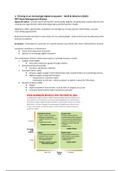
The combination of these 2 dimensions leads to 4 possible business models:
1. Supplier model (46%)
● Sony sells it electronic goods through retailers
2. Omnichannel business (24%)
● Carrefour, Nordstrom, Walmart
3. Ecosystem driver (12%)
● Amazon, Apple, Google create relationships with complementary (or competing) services
● Highest margins and growth because:
- Responsive to customer needs
- Destination to sell own + others products to address customers’ life events
4. Modular producer (18%)
● Paypal
● Hypercompetitive environment, must be best in category to survive
● Customer data limited to data transactions provides
,Smaller companies have increased knowledge of their customers and are becoming more networked seizing
digital disruption opportunities while larger counterparts are struggling to respond - because fewer legacy
systems, less global, more willing to take risks with business model and better collection and analysation of
consumer data
Successfulness in terms of revenue growth and margins: 1. Ecosystem driver 2. Modular producer 3.
Omnichannel business 4. Supplier
To prepare for the future, companies need to develop new capabilities in 2 areas:
Learning more about customers
● Use digital capabilities to obtain information about customer’s goals and life events
● Amplify the customer voice inside the company (customer satisfaction metric)
● Emphasize evidence-based decision making
● Develop an integrated, multiproduct channel customer experience
Become more of an ecosystem
● Become the first choice in your space (brand, customer recommendations etc.)
● Become great at building partnerships
● Create service-enabled interfaces that others can use
● Treat efficiency and compliance as a competence
,2. Competing on Customer Journeys – Edelman & Singer (2015)
Harvard Business Review, 88-100.
Shift: from companies reacting to journeys of customers – to shaping their paths
Classic journey: consumers engage in an extended consideration and evaluation phase before either entering
into the loyalty loop or proceeding into a new round of consideration and evaluation that may lead to the
subsequent purchase of a different brand
New journey: compresses the consider step and shortens or entirely eliminates the evaluate step, delivering
customers directly into the loyalty loop and locking them within it
● Problem: digital tools allow shoppers to research, compare, order – sellers react by positioning
themselves where customers can find them
● Solution: companies use technologies, processes and organizational structures to proactively lead
rather than follow customers on their digital journeys by making these compelling, customized and
open-ended experiences (customer journey as competitive advantage)
● Strategy: superior journeys feature automation, personalisation, context-based interaction and
ongoing innovation – treat journeys like products, built and supported by cross-functional team
4 key capabilities (of companies building effective journeys)
1. Automation
● Digitization and streamlining of steps in the journey
● E.g. Sonos Bluetooth connection instead of wires
2. Proactive personalization
● Use data to customize shopper’s (future) experience
● E.g. Amazon recommendation engine and reordering algorithm
3. Contextual interaction
● Knowledge on where (physically or virtually) a customer is within their journey
● E.g. walk into hotel – receive room number by text
4. Journey innovation
● Ongoing experimentation and active analysis of customer needs, technologies and services
3 core technology developments (that redefined company-customer interactions)
1. Continuous connection capability
● Smart products = data on customers
2. New journey analysis and management tools
● Track customer behaviour across touchpoints
● Analyse unstructured data + predict behaviours
3. Widespread adoption of API’s (Application Programming Interfaces)
● Permit different applications (from different companies) to communicate
● Build cross-company customer journeys (e.g. from airline to taxi-service)
, Journey Management members:
● Chief Experience officer
- Oversees all of firm’s interactions with customers
● Journey Strategist
- Guides decisions on which journey investments and customer segments to focus on
● Journey Product Manager (= Solution/ Experience/ Segment Manager
- Accountable for business performance (finances)
● Scrum teams
- Execution-oriented, fast, agile, constantly testing and iterating improvements
- Work to understand customers’ wants and needs at each step of the journey
MIT Sloan Management Review
Digital disruption = process where the business world rapidly digitizes, breaking down industry barriers and
creating new opportunities while destroying long-successful business models
Digitization offers opportunities companies can leverage e.g. strong customer relationships, increase
cross-selling opportunities
Businesses focused narrowly on value chains are at a disadvantage – need to think more broadly about their
business ecosystems
Ecosystem = destination for customers in a specific domain (e.g. health care, retail, entertainment, finance)
Companies transform in 2 dimensions:
● Know more about end consumers
● Operate in increasingly digital ecosystem
The combination of these 2 dimensions leads to 4 possible business models:
1. Supplier model (46%)
● Sony sells it electronic goods through retailers
2. Omnichannel business (24%)
● Carrefour, Nordstrom, Walmart
3. Ecosystem driver (12%)
● Amazon, Apple, Google create relationships with complementary (or competing) services
● Highest margins and growth because:
- Responsive to customer needs
- Destination to sell own + others products to address customers’ life events
4. Modular producer (18%)
● Paypal
● Hypercompetitive environment, must be best in category to survive
● Customer data limited to data transactions provides
,Smaller companies have increased knowledge of their customers and are becoming more networked seizing
digital disruption opportunities while larger counterparts are struggling to respond - because fewer legacy
systems, less global, more willing to take risks with business model and better collection and analysation of
consumer data
Successfulness in terms of revenue growth and margins: 1. Ecosystem driver 2. Modular producer 3.
Omnichannel business 4. Supplier
To prepare for the future, companies need to develop new capabilities in 2 areas:
Learning more about customers
● Use digital capabilities to obtain information about customer’s goals and life events
● Amplify the customer voice inside the company (customer satisfaction metric)
● Emphasize evidence-based decision making
● Develop an integrated, multiproduct channel customer experience
Become more of an ecosystem
● Become the first choice in your space (brand, customer recommendations etc.)
● Become great at building partnerships
● Create service-enabled interfaces that others can use
● Treat efficiency and compliance as a competence
,2. Competing on Customer Journeys – Edelman & Singer (2015)
Harvard Business Review, 88-100.
Shift: from companies reacting to journeys of customers – to shaping their paths
Classic journey: consumers engage in an extended consideration and evaluation phase before either entering
into the loyalty loop or proceeding into a new round of consideration and evaluation that may lead to the
subsequent purchase of a different brand
New journey: compresses the consider step and shortens or entirely eliminates the evaluate step, delivering
customers directly into the loyalty loop and locking them within it
● Problem: digital tools allow shoppers to research, compare, order – sellers react by positioning
themselves where customers can find them
● Solution: companies use technologies, processes and organizational structures to proactively lead
rather than follow customers on their digital journeys by making these compelling, customized and
open-ended experiences (customer journey as competitive advantage)
● Strategy: superior journeys feature automation, personalisation, context-based interaction and
ongoing innovation – treat journeys like products, built and supported by cross-functional team
4 key capabilities (of companies building effective journeys)
1. Automation
● Digitization and streamlining of steps in the journey
● E.g. Sonos Bluetooth connection instead of wires
2. Proactive personalization
● Use data to customize shopper’s (future) experience
● E.g. Amazon recommendation engine and reordering algorithm
3. Contextual interaction
● Knowledge on where (physically or virtually) a customer is within their journey
● E.g. walk into hotel – receive room number by text
4. Journey innovation
● Ongoing experimentation and active analysis of customer needs, technologies and services
3 core technology developments (that redefined company-customer interactions)
1. Continuous connection capability
● Smart products = data on customers
2. New journey analysis and management tools
● Track customer behaviour across touchpoints
● Analyse unstructured data + predict behaviours
3. Widespread adoption of API’s (Application Programming Interfaces)
● Permit different applications (from different companies) to communicate
● Build cross-company customer journeys (e.g. from airline to taxi-service)
, Journey Management members:
● Chief Experience officer
- Oversees all of firm’s interactions with customers
● Journey Strategist
- Guides decisions on which journey investments and customer segments to focus on
● Journey Product Manager (= Solution/ Experience/ Segment Manager
- Accountable for business performance (finances)
● Scrum teams
- Execution-oriented, fast, agile, constantly testing and iterating improvements
- Work to understand customers’ wants and needs at each step of the journey