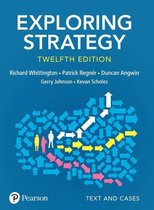
Solution Manual for Exploring Strategy Text And Cases
12th Edition Gerry Johnson, Richard Whittington
Discuss the following and answer the concepts correctly?
Purpose of reading - ANSWER:The reason behind reading a text, which can vary from
understanding an existing idea to identifying gaps in existing studies.
Features of academic texts - ANSWER:Characteristics of academic texts include a
formal structure, critical discussion of concepts, extensive knowledge, and research.
Critical reading strategy - ANSWER:A reading approach that helps identify key
arguments, analyze concepts, and employ strategies at each stage of reading.
Annotate academic texts - ANSWER:To mark or comment on essential information,
author's arguments, or new ideas related to the text.
Key ideas or information - ANSWER:The main concepts or details that are crucial to
understanding the text.
Synthesis of information - ANSWER:The process of combining information from
various academic texts to create a cohesive understanding or summary.
Formal publication vs. fictional story - ANSWER:Distinguishing whether a passage
originates from a formal publication or a fictional story.
Academic texts vs. nonacademic texts - ANSWER:Academic texts are formally
structured materials that critically discuss concepts using extensive knowledge and
research.
Reading goals - ANSWER:Objectives such as better understanding existing ideas,
supporting writing assignments, gaining information, identifying study gaps, and
connecting new ideas.
Structure of academic texts - ANSWER:Consists of an introduction, body, and
conclusion sections.
Content & style of academic texts - ANSWER:Involves including discipline-related
concepts, maintaining organization, unity, coherence, using precise language, and
adhering to critical writing guidelines.
Hedging expressions - ANSWER:Expressions used in academic texts to indicate
caution or uncertainty in claims or statements.
Critical reading strategies - ANSWER:Reading approach to identify key arguments,
analyze concepts, and employ strategies at each reading stage.
12th Edition Gerry Johnson, Richard Whittington
Discuss the following and answer the concepts correctly?
Purpose of reading - ANSWER:The reason behind reading a text, which can vary from
understanding an existing idea to identifying gaps in existing studies.
Features of academic texts - ANSWER:Characteristics of academic texts include a
formal structure, critical discussion of concepts, extensive knowledge, and research.
Critical reading strategy - ANSWER:A reading approach that helps identify key
arguments, analyze concepts, and employ strategies at each stage of reading.
Annotate academic texts - ANSWER:To mark or comment on essential information,
author's arguments, or new ideas related to the text.
Key ideas or information - ANSWER:The main concepts or details that are crucial to
understanding the text.
Synthesis of information - ANSWER:The process of combining information from
various academic texts to create a cohesive understanding or summary.
Formal publication vs. fictional story - ANSWER:Distinguishing whether a passage
originates from a formal publication or a fictional story.
Academic texts vs. nonacademic texts - ANSWER:Academic texts are formally
structured materials that critically discuss concepts using extensive knowledge and
research.
Reading goals - ANSWER:Objectives such as better understanding existing ideas,
supporting writing assignments, gaining information, identifying study gaps, and
connecting new ideas.
Structure of academic texts - ANSWER:Consists of an introduction, body, and
conclusion sections.
Content & style of academic texts - ANSWER:Involves including discipline-related
concepts, maintaining organization, unity, coherence, using precise language, and
adhering to critical writing guidelines.
Hedging expressions - ANSWER:Expressions used in academic texts to indicate
caution or uncertainty in claims or statements.
Critical reading strategies - ANSWER:Reading approach to identify key arguments,
analyze concepts, and employ strategies at each reading stage.