The Dream House Essay
Kate Jones
Class Test
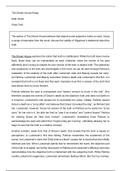
The author of The Dream House believes that objective and subjective truths co-exist. Using
a range of examples from the novel, discuss the validity of Higginson’s statement about the
truth.
The Dream House explores the notion that truth is multifaceted. While the truth does involve
facts, these facts can be manipulated as each character views the events of the past
differently and in doing so shapes his own version of the truth: a relative truth. The objectivity
and subjectivity of the truth are intermingled in the novel, as can be seen through Patricia’s
realisation of the relativity of the truth after Looksmart visits and Beauty reveals her story.
As Patricia, Looksmart and Beauty remember Grace’s death and Looksmart’s first fish, it is
revealed that truth is not fixed and that each character must find a version of the truth that
best allows them to move forward.
Patricia believes the past is unimportant and “doesn’t amount to much in the end”. She
therefore accepts the events of Grace’s death as the objective truth and does not dwell on
it; however, Looksmart’s visit causes her to reconsider her views. Initially, Patricia viewed
Grace’s death as a “sorry affair” and believes that Grace “provoked the dog”, as Richard told
her. Looksmart, however, forces his version of the truth on Patricia as he wants her “to be
sorry” for her role in it. He tells her that he “saw it as murder” and “cannot forgive” Patricia
for viewing Grace as “less than human”. Looksmart’s revelations force Patricia to
acknowledge the past and admit that “maybe [she] got it wrong”, ultimately allowing her to
begin to see that the truth is a relative concept.
Another incident, aside from that of Grace’s death, that reveals that the truth is based on
perceptions, is Looksmart’s first time fishing. Patricia remembers the excitement of the
scene, but Looksmart’s claim that “[his] mind is a blank” causes her to doubt what she initially
believed was fact. When Looksmart admits that he remembers the event, the objective part
of the truth is revealed, but further discussion of Patricia and Looksmart’s differing memories
demonstrates how the objective truth is intertwined with the subjective truth. While Patricia
recalls Looksmart’s eagerness, Looksmart remembers feeling inferior, like “her toy monkey,
Kate Jones
Class Test
The author of The Dream House believes that objective and subjective truths co-exist. Using
a range of examples from the novel, discuss the validity of Higginson’s statement about the
truth.
The Dream House explores the notion that truth is multifaceted. While the truth does involve
facts, these facts can be manipulated as each character views the events of the past
differently and in doing so shapes his own version of the truth: a relative truth. The objectivity
and subjectivity of the truth are intermingled in the novel, as can be seen through Patricia’s
realisation of the relativity of the truth after Looksmart visits and Beauty reveals her story.
As Patricia, Looksmart and Beauty remember Grace’s death and Looksmart’s first fish, it is
revealed that truth is not fixed and that each character must find a version of the truth that
best allows them to move forward.
Patricia believes the past is unimportant and “doesn’t amount to much in the end”. She
therefore accepts the events of Grace’s death as the objective truth and does not dwell on
it; however, Looksmart’s visit causes her to reconsider her views. Initially, Patricia viewed
Grace’s death as a “sorry affair” and believes that Grace “provoked the dog”, as Richard told
her. Looksmart, however, forces his version of the truth on Patricia as he wants her “to be
sorry” for her role in it. He tells her that he “saw it as murder” and “cannot forgive” Patricia
for viewing Grace as “less than human”. Looksmart’s revelations force Patricia to
acknowledge the past and admit that “maybe [she] got it wrong”, ultimately allowing her to
begin to see that the truth is a relative concept.
Another incident, aside from that of Grace’s death, that reveals that the truth is based on
perceptions, is Looksmart’s first time fishing. Patricia remembers the excitement of the
scene, but Looksmart’s claim that “[his] mind is a blank” causes her to doubt what she initially
believed was fact. When Looksmart admits that he remembers the event, the objective part
of the truth is revealed, but further discussion of Patricia and Looksmart’s differing memories
demonstrates how the objective truth is intertwined with the subjective truth. While Patricia
recalls Looksmart’s eagerness, Looksmart remembers feeling inferior, like “her toy monkey,