100% de satisfacción garantizada Inmediatamente disponible después del pago Tanto en línea como en PDF No estas atado a nada 4.2 TrustPilot
logo-home
Examen

Bates' Guide to Physical Examination and History Taking questions with correct answers 2024

Puntuación
-
Vendido
-
Páginas
4
Grado
A+
Subido en
09-09-2024
Escrito en
2024/2025

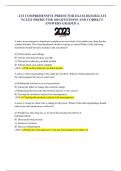
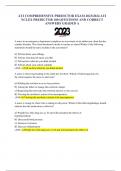
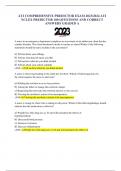
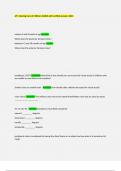
Bates' Guide to Physical Examination and History Taking questions with correct answers 2024 Define empathy: - ANSWERS The capacity of the clinician to identify with the patient and feel the patient's pain as the clinician's own. What does FIFE stand for? - ANSWERS F: Feelings I: Ideas F: Function E: Expectations What are the 7 attributes of a symptom? - ANSWERS 1. Location 2. Quality 3. Quantity 4. Timing 5. Setting 6. Remitting or exacerbating factors 7. Associated manifestations What is motivational interviewing? - ANSWERS It is an advanced skill that uses a set of welldocumented techniques that improves health outcome. When doing motivation interviewing, what are the 3 important factors? - ANSWERS 1. Ask openended questions 2. Listen to understand the patient 3. Inform by providing information Before closing the interview, it is important to... - ANSWERS 1. Review information that was covered 2. Review future evaluation, treatments and follow-up visits. 3. See if patient has any questions What is culture? - ANSWERS The system of shared ideas, rules, and meanings that influences how we view the world, experience it emotionally, and behave in relation to other people. What does culturally competent care consist of? - ANSWERS Understanding of and respect for the cultures, traditions, and practices of a community. Define cultural humility: - ANSWERS A process that requires humility as individuals continually engage in self-reflection and self-critique as lifelong learners and reflective practitioners. True or false: A more challenging task in learning about ourselves is to bring our own values and biases to a conscious level. - ANSWERS TRUE Define tolerance: - ANSWERS A state of adaption in which exposure to a drug induces changes that result in a diminution of one or more of the drug's effects over time. (p.82) Define physical dependence: - ANSWERS A state if adaption that is manifested by a drug classspecific withdrawal syndrome that can be produced by abrupt cessation, rapid dose reduction, decreasing blood level of the drug, and/or administration of an antagonist. (p.82? Define addiction: - ANSWERS A primary, chronic neurobiological disease, with genetic, psychosocial, and environmental factors influencing its developmental and manifestations. It is characterized by behaviours that include one or more of the following: impaired control over drug use, compulsive use, continues use despite harm, and craving. (p.82) Define nonmaleficence or primum non Nocera: - ANSWERS Is commonly stated as, "First do no harm." In the context of an interview, giving information that is incorrect or not really related to the patient's problem can do harm. Avoiding relevant topics or creating barriers to open communication can also do harm. (p.92) Define beneficence: - ANSWERS Is the dictum that the clinician needs to "do good" for the patient. As clinicians, your actions need to be motivated by what is in the patient's best interest. (p.92) Define autonomy: - ANSWERS Reminds us that patients have the right to determine what is in their own best interest. The principle has become increasingly important over time and is consistent with collaborative rather paternalistic clinician-patient relationships. (p.92) Define confidentiality: - ANSWERS Can be one of the most challenging principles. As a clinician, you are obligated not to repeat what you learn from or know about a patient. This privacy is fundamental to our professional relationships with patients. In the daily flurry of activity in a hospital, it is all too easy to let something slip. You must be on your guard. (p.92) What are some clues to physical and sexual abuse? - ANSWERS a) Injuries that are unexplained, seem inconsistent with the patient's story, are concealed by the patient, or cause of embarrassment. b) Delay in getting treatment for trauma. c) History of repeated injuries or "accidents". d) Presence of alcohol or drug abuse in patient or partner. e) Pregnancy at a young age; multiple partners. f) Repeated vaginal infections and STIs. g) Difficulty walking or sitting due to genital/anal pain h) Vaginal lacerations or bruises i) Fear of pelvic examination or physical contact. j) Fear of leaving examination room k) None of the above l) All of the above (p.90) What are the Tavistock Principles of openness and cooperation? - ANSWERS •Rights: people have a right to health and healthcare. •Balance: care of the individual patient is central, but the health of populations is also our concern •Comprehensiveness: in addition to treating illnesses we have an obligation to ease suffering, minimize disability, prevent disease, and promote health. •Improvement: improving health care is a serious and continuing responsibility. •Safety: do no harm •Openness: being open, honest, and trustworthy is vital in health care. (p. 94) What are the three dimensions if cultural humility? - ANSWERS 1) Self-awareness: learn about your own biases; we all have them

Mostrar más Leer menos
Institución
Bates\'
Grado
Bates\'


Ups! No podemos cargar tu documento ahora. Inténtalo de nuevo o contacta con soporte.

Escuela, estudio y materia

Institución
Bates\'
Grado
Bates\'

Información del documento

Subido en
9 de septiembre de 2024
Número de páginas
4
Escrito en
2024/2025
Tipo
Examen
Contiene
Preguntas y respuestas

Temas

Vista previa del contenido

Bates' Guide to Physical Examination
and History Taking questions with
correct answers 2024

Define empathy: - ANSWERS The capacity of the clinician to identify with the patient and feel the
patient's pain as the clinician's own.


What does FIFE stand for? - ANSWERS F: Feelings

I: Ideas

F: Function

E: Expectations


What are the 7 attributes of a symptom? - ANSWERS 1. Location

2. Quality

3. Quantity

4. Timing

5. Setting

6. Remitting or exacerbating factors

7. Associated manifestations


What is motivational interviewing? - ANSWERS It is an advanced skill that uses a set of well-
documented techniques that improves health outcome.


When doing motivation interviewing, what are the 3 important factors? - ANSWERS 1. Ask open-
ended questions

2. Listen to understand the patient

3. Inform by providing information


Before closing the interview, it is important to... - ANSWERS 1. Review information that was covered

2. Review future evaluation, treatments and follow-up visits.
$10.49
Accede al documento completo:

100% de satisfacción garantizada
Inmediatamente disponible después del pago
Tanto en línea como en PDF
No estas atado a nada

Conoce al vendedor
Seller avatar
brendamaina

Conoce al vendedor

Seller avatar
brendamaina Teachme2-tutor
Seguir Necesitas iniciar sesión para seguir a otros usuarios o asignaturas
Vendido
0
Miembro desde
1 año
Número de seguidores
0
Documentos
45
Última venta
-

0.0

0 reseñas

5
0
4
0
3
0
2
0
1
0

Recientemente visto por ti

Por qué los estudiantes eligen Stuvia

Creado por compañeros estudiantes, verificado por reseñas

Calidad en la que puedes confiar: escrito por estudiantes que aprobaron y evaluado por otros que han usado estos resúmenes.

¿No estás satisfecho? Elige otro documento

¡No te preocupes! Puedes elegir directamente otro documento que se ajuste mejor a lo que buscas.

Paga como quieras, empieza a estudiar al instante

Sin suscripción, sin compromisos. Paga como estés acostumbrado con tarjeta de crédito y descarga tu documento PDF inmediatamente.

Student with book image

“Comprado, descargado y aprobado. Así de fácil puede ser.”

Alisha Student

Preguntas frecuentes