

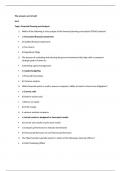
The answers are in bold
Set 1
Topic: Financial Planning and Analysis
1. Which of the following is a key output of the financial planning and analysis (FP&A) function?
a) Forecasted financial statements
b) Audited financial statements
c) Tax returns
d) Regulatory filings
2. The process of evaluating and selecting long-term investments that align with a company's
strategic goals is known as:
a) Working capital management
b) Capital budgeting
c) Financial forecasting
d) Variance analysis
3. Which financial metric is used to assess a company's ability to meet its short-term obligations?
a) Current ratio
b) Debt-to-equity ratio
c) Return on equity
d) Profit margin
4. A variance analysis compares:
a) Actual results to budgeted or forecasted results
b) Current year results to prior year results
c) Company performance to industry benchmarks
d) Financial performance to non-financial performance
5. The FP&A function typically reports to which of the following corporate officers?
a) Chief Marketing Officer
, b) Chief Operating Officer
c) Chief Financial Officer
d) Chief Information Officer
6. Which of the following is NOT a common tool used in financial forecasting?
a) Trend analysis
b) Regression analysis
c) Discounted cash flow analysis
d) Scenario analysis
7. What is the primary purpose of sensitivity analysis in financial modeling?
a) To identify the most likely outcome
b) To assess the impact of changes in key assumptions
c) To determine the optimal course of action
d) To validate the accuracy of the model
8. Which of the following is a potential benefit of using a rolling forecast?
a) Reduced workload for the FP&A team
b) Increased accuracy of long-term forecasts
c) Elimination of the need for budgeting
d) Improved responsiveness to changing business conditions
9. Which of the following is NOT a key component of a company's cost structure?
a) Revenue
b) Fixed costs
c) Variable costs
d) Semi-variable costs
10. What is the formula for calculating the contribution margin?
a) Sales revenue - Variable costs
, b) Gross profit - Fixed costs
c) Net income / Sales revenue
d) Operating income / Total assets
11. Which of the following is a limitation of break-even analysis?
a) It assumes a linear relationship between costs and volume.
b) It does not consider the time value of money.
c) It ignores the impact of fixed costs on profitability
d) All of the above
12. The internal rate of return (IRR) is the discount rate that makes the net present value (NPV) of
an investment equal to:
a) 1
b) -1
c) 0
d) The required rate of return
13. Which capital budgeting technique considers the time value of money?
a) Payback period
b) Accounting rate of return
c) Net present value
d) Profitability index
14. Which of the following is a non-financial factor that should be considered in capital budgeting
decisions?
a) Environmental impact
b) Employee morale
c) Regulatory compliance
d) All of the above
15. What is the purpose of a post-audit in capital budgeting?
Set 1
Topic: Financial Planning and Analysis
1. Which of the following is a key output of the financial planning and analysis (FP&A) function?
a) Forecasted financial statements
b) Audited financial statements
c) Tax returns
d) Regulatory filings
2. The process of evaluating and selecting long-term investments that align with a company's
strategic goals is known as:
a) Working capital management
b) Capital budgeting
c) Financial forecasting
d) Variance analysis
3. Which financial metric is used to assess a company's ability to meet its short-term obligations?
a) Current ratio
b) Debt-to-equity ratio
c) Return on equity
d) Profit margin
4. A variance analysis compares:
a) Actual results to budgeted or forecasted results
b) Current year results to prior year results
c) Company performance to industry benchmarks
d) Financial performance to non-financial performance
5. The FP&A function typically reports to which of the following corporate officers?
a) Chief Marketing Officer
, b) Chief Operating Officer
c) Chief Financial Officer
d) Chief Information Officer
6. Which of the following is NOT a common tool used in financial forecasting?
a) Trend analysis
b) Regression analysis
c) Discounted cash flow analysis
d) Scenario analysis
7. What is the primary purpose of sensitivity analysis in financial modeling?
a) To identify the most likely outcome
b) To assess the impact of changes in key assumptions
c) To determine the optimal course of action
d) To validate the accuracy of the model
8. Which of the following is a potential benefit of using a rolling forecast?
a) Reduced workload for the FP&A team
b) Increased accuracy of long-term forecasts
c) Elimination of the need for budgeting
d) Improved responsiveness to changing business conditions
9. Which of the following is NOT a key component of a company's cost structure?
a) Revenue
b) Fixed costs
c) Variable costs
d) Semi-variable costs
10. What is the formula for calculating the contribution margin?
a) Sales revenue - Variable costs
, b) Gross profit - Fixed costs
c) Net income / Sales revenue
d) Operating income / Total assets
11. Which of the following is a limitation of break-even analysis?
a) It assumes a linear relationship between costs and volume.
b) It does not consider the time value of money.
c) It ignores the impact of fixed costs on profitability
d) All of the above
12. The internal rate of return (IRR) is the discount rate that makes the net present value (NPV) of
an investment equal to:
a) 1
b) -1
c) 0
d) The required rate of return
13. Which capital budgeting technique considers the time value of money?
a) Payback period
b) Accounting rate of return
c) Net present value
d) Profitability index
14. Which of the following is a non-financial factor that should be considered in capital budgeting
decisions?
a) Environmental impact
b) Employee morale
c) Regulatory compliance
d) All of the above
15. What is the purpose of a post-audit in capital budgeting?

