BIOL 254 Anatomy and Physiology
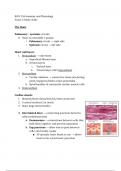
Exam 2 Study Guide
The Heart
Pulmonary + systemic circuits
● Heart is essentially 2 pumps
○ Pulmonary circuit → right side
○ Systemic circuit → left side
Heart wall layers
1. Pericardium → outermost
a. Superficial fibrous layer
b. Serious layers
i. Parietal layer
ii. Visceral layer (AKA Epicardium)
2. Myocardium
a. Cardiac skeleton → connective tissue (anchoring
point/supports/limits action potentials)
b. Spiral bundles of contractile cardiac muscle cells
3. Endocardium
Cardiac muscle
1. Striated/short/branched/fat/interconnected
2. 1 central nucleus (2 at most)
3. Many large mitochondria
4. Intercalated discs → connecting junctions between
cells (cardiomyocytes)
a. Desmosomes → connections between cells that
hold them together and prevent separation
b. Gap junctions → allow ions to pass between
cells; electrically couple
■ AP spreads, heart beats as one → allows
heart to be a functional syncytium
, Physiology of skeletal muscle vs. cardiac muscle
Similarities
● Muscle contraction preceded by depolarizing AP
● AP travels down T-tubules and causes SR to release Ca++
● Excitation-contraction coupling → Ca++ binds troponin and causes
actin/myosin filaments to slide
Differences
● Contractile cells → contraction
● Pacemaker cells → non-contractile cells that spontaneously depolarize
○ Initiate depolarization of entire heart
● All cardiomyocytes contract as a unit → functional syncytium
● Influx of Ca++ from extracellular fluid triggers release of Ca++ from SR
● Absolute refractory period longer in cardiac muscle cells
Syncytium of the heart and APs
● Atrial syncytium
● Ventricular syncytium
○ Separated by fibrous tissue
Exam 2 Study Guide
The Heart
Pulmonary + systemic circuits
● Heart is essentially 2 pumps
○ Pulmonary circuit → right side
○ Systemic circuit → left side
Heart wall layers
1. Pericardium → outermost
a. Superficial fibrous layer
b. Serious layers
i. Parietal layer
ii. Visceral layer (AKA Epicardium)
2. Myocardium
a. Cardiac skeleton → connective tissue (anchoring
point/supports/limits action potentials)
b. Spiral bundles of contractile cardiac muscle cells
3. Endocardium
Cardiac muscle
1. Striated/short/branched/fat/interconnected
2. 1 central nucleus (2 at most)
3. Many large mitochondria
4. Intercalated discs → connecting junctions between
cells (cardiomyocytes)
a. Desmosomes → connections between cells that
hold them together and prevent separation
b. Gap junctions → allow ions to pass between
cells; electrically couple
■ AP spreads, heart beats as one → allows
heart to be a functional syncytium
, Physiology of skeletal muscle vs. cardiac muscle
Similarities
● Muscle contraction preceded by depolarizing AP
● AP travels down T-tubules and causes SR to release Ca++
● Excitation-contraction coupling → Ca++ binds troponin and causes
actin/myosin filaments to slide
Differences
● Contractile cells → contraction
● Pacemaker cells → non-contractile cells that spontaneously depolarize
○ Initiate depolarization of entire heart
● All cardiomyocytes contract as a unit → functional syncytium
● Influx of Ca++ from extracellular fluid triggers release of Ca++ from SR
● Absolute refractory period longer in cardiac muscle cells
Syncytium of the heart and APs
● Atrial syncytium
● Ventricular syncytium
○ Separated by fibrous tissue