Creativity in business
Chapter 3: The creative process
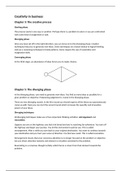
Starting phase
The process starts in one way or another. Perhaps there is a problem to solve or you are confronted
with some kind of assignment or task.
Diverging phase
Once you have set off in the right direction, you can move on to the diverging phase. Creative
techniques help you to generate new ideas. Some techniques are closely related to logical thinking
and use a reasoning technique to break patterns. Some require the use of associative and
imaginative skills.
Converging phase
In the third stage, an abundance of ideas forces you to make choices.
Chapter 5: The diverging phase
In the diverging phase, you need to generate new ideas. You find as many ideas as possible for a
gives problem or objective. Postponing judgement is crucial in the diverging phase.
There are two diverging rounds. In the first round you should express all the ideas you spontaneously
come up with. Next you can start the second round which increases the quantity and innovative
power of your ideas.
Diverging techniques
All diverging techniques make use of two important thinking activities: estrangement and
resociation.
Suppose you are on the highway; you feel a bit bored and you’re searching for adventure. You turn off
the highway and begin your journey. You let the environment surprise you. This is called
estrangement. After a while you turn back to your original destination. You want to continue towards
your destination and you trust your sense of direction. You find new roads. This is called resociation.
Estrangement means that your conscious attention is no longer focused on the problem or objective,
but you direct attention towards and element or situation unrelated to the problem.
Resociating is a conscious thought activity which forces a return from that element towards the
problem.
, Presuppositions
Presuppositions are thought patterns that arise automatically when a person reflects on a specific
issue. Presuppositions may be consciously or unconsciously present.
The technique consists of giving time in the diverging phase to the detection of presuppositions in
order to eliminate them temporarily afterw3wards, while remembering to postpone judgement.
There are two basic methods with which to identify presuppositions.
First method
A. You consider a few crucial terms in the starting formulation.
For example: crucial terms in the question ‘How can we reduce the queues at the checkout in
the supermarket?’ are queue, cash desk, reduce.
B. Then you trace the presuppositions that are connected with these words or their context.
C. After that, you take each presupposition and ask the question: what if this presupposition
didn’t apply here, or what if we inverted the presupposition? What kind of new ideas would
arise?
Second method
A. You start with the ideas from the first round.
B. You look at the solutions, detect common characteristics in these ideas and write them
down. These common features are the presuppositions.
C. Then you do exactly as described above, in C.
Direct analogy
Two elements seem analogous if they have similar characteristics. A mug and a glass are analogous
because they have a large analogy base, but there are differences too.
When using direct analogy, you look for inspiration in a theme that is not at all related to the
problem.
A. You choose an analogon that will serve as source of
inspiration.
The analogon should meet the following conditions:
Be a concrete term
Be far removed from the subject
Be inspiring
B. You write down features and associations of this
analogon.
We try to find at least five particular characteristics for this analogon.
C. Resociation: use the characteristics to come up with new ideas.
Superhero
A. Think of a hero or a heroine whom you are in awe of, in a positive or negative way.
B. Bring the hero or heroine to life in your thoughts.
Ask yourself how the hero would react when confronted with the similar problem. How
would they tackle this problem?
C. Transform every solution you find into concrete suggestions for solving the problem.
Chapter 3: The creative process
Starting phase
The process starts in one way or another. Perhaps there is a problem to solve or you are confronted
with some kind of assignment or task.
Diverging phase
Once you have set off in the right direction, you can move on to the diverging phase. Creative
techniques help you to generate new ideas. Some techniques are closely related to logical thinking
and use a reasoning technique to break patterns. Some require the use of associative and
imaginative skills.
Converging phase
In the third stage, an abundance of ideas forces you to make choices.
Chapter 5: The diverging phase
In the diverging phase, you need to generate new ideas. You find as many ideas as possible for a
gives problem or objective. Postponing judgement is crucial in the diverging phase.
There are two diverging rounds. In the first round you should express all the ideas you spontaneously
come up with. Next you can start the second round which increases the quantity and innovative
power of your ideas.
Diverging techniques
All diverging techniques make use of two important thinking activities: estrangement and
resociation.
Suppose you are on the highway; you feel a bit bored and you’re searching for adventure. You turn off
the highway and begin your journey. You let the environment surprise you. This is called
estrangement. After a while you turn back to your original destination. You want to continue towards
your destination and you trust your sense of direction. You find new roads. This is called resociation.
Estrangement means that your conscious attention is no longer focused on the problem or objective,
but you direct attention towards and element or situation unrelated to the problem.
Resociating is a conscious thought activity which forces a return from that element towards the
problem.
, Presuppositions
Presuppositions are thought patterns that arise automatically when a person reflects on a specific
issue. Presuppositions may be consciously or unconsciously present.
The technique consists of giving time in the diverging phase to the detection of presuppositions in
order to eliminate them temporarily afterw3wards, while remembering to postpone judgement.
There are two basic methods with which to identify presuppositions.
First method
A. You consider a few crucial terms in the starting formulation.
For example: crucial terms in the question ‘How can we reduce the queues at the checkout in
the supermarket?’ are queue, cash desk, reduce.
B. Then you trace the presuppositions that are connected with these words or their context.
C. After that, you take each presupposition and ask the question: what if this presupposition
didn’t apply here, or what if we inverted the presupposition? What kind of new ideas would
arise?
Second method
A. You start with the ideas from the first round.
B. You look at the solutions, detect common characteristics in these ideas and write them
down. These common features are the presuppositions.
C. Then you do exactly as described above, in C.
Direct analogy
Two elements seem analogous if they have similar characteristics. A mug and a glass are analogous
because they have a large analogy base, but there are differences too.
When using direct analogy, you look for inspiration in a theme that is not at all related to the
problem.
A. You choose an analogon that will serve as source of
inspiration.
The analogon should meet the following conditions:
Be a concrete term
Be far removed from the subject
Be inspiring
B. You write down features and associations of this
analogon.
We try to find at least five particular characteristics for this analogon.
C. Resociation: use the characteristics to come up with new ideas.
Superhero
A. Think of a hero or a heroine whom you are in awe of, in a positive or negative way.
B. Bring the hero or heroine to life in your thoughts.
Ask yourself how the hero would react when confronted with the similar problem. How
would they tackle this problem?
C. Transform every solution you find into concrete suggestions for solving the problem.