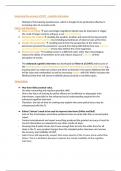
Improving the accuracy of EWT – cognitive interviews
- Method of interviewing eyewitnesses, which is thought to be particularly effective in
increasing rates of accurate recall.
Fisher and Gieselman
1. Report everything even seemingly insignificant details may be important or trigger
the recall of larger event by acting as a cue (retrieval failure)
2. Reinstate the context recalling the weather, location and mood of the day prevents
context dependent forgetting by reminding eyewitnesses of external cues at the time.
3. Change the perspective recalling events from the perspective of the victim or
persecutor prevents the eyewitness’ account from being affected by their own schemas
or preconceived perceptions of how they believe the crime happened.
4. Reverse the order recalling events in a different order, other than chronological,
reduces the ability of eyewitness to lie and reduces impact of schemas of their
perception of events.
- The enhanced cognitive interview was developed by Fisher et al (1987) and focuses on
the social dynamics of the interactions between the eyewitness and the interviewer e.g.,
knowing when to make eye contact and when to diminish it (increases likelihood the EW
will be calm and comfortable) as well as increasing rapport with EW. Which increases the
likelihood that they will answer truthfully about personal or sensitive topics.
EVALUATION
May have little practical value.
- Too time consuming and requires specialist skills.
- Only a few hours of training for police officers are insufficient to adequately train
interviewers, especially for the enhanced social understanding required for the
enhanced cognitive interview.
- Therefore, the lack of time for training may explain why some police forces may be
unimpressed with the CI.
Entire CI doesn’t need to be used to improve interviews.(Milne and Bull)
- each of the 4 techniques used alone produced more accurate data than a normal police
report.
- Context reinstatement and report everything produced the greatest accuracy of recall or
correct information as compared to any other combo of steps.
- Meaning that if police forces don’t have enough time to train the entire force for all
steps in the CI, even gradual changes from the standard police interview can increase
the accuracy and reliability of EWT.
- police forces did apparently suspect that some aspects of the CI were more useful than
others. This is a limitation because it reduces the overall credibility of the cognitive
interview.
- Method of interviewing eyewitnesses, which is thought to be particularly effective in
increasing rates of accurate recall.
Fisher and Gieselman
1. Report everything even seemingly insignificant details may be important or trigger
the recall of larger event by acting as a cue (retrieval failure)
2. Reinstate the context recalling the weather, location and mood of the day prevents
context dependent forgetting by reminding eyewitnesses of external cues at the time.
3. Change the perspective recalling events from the perspective of the victim or
persecutor prevents the eyewitness’ account from being affected by their own schemas
or preconceived perceptions of how they believe the crime happened.
4. Reverse the order recalling events in a different order, other than chronological,
reduces the ability of eyewitness to lie and reduces impact of schemas of their
perception of events.
- The enhanced cognitive interview was developed by Fisher et al (1987) and focuses on
the social dynamics of the interactions between the eyewitness and the interviewer e.g.,
knowing when to make eye contact and when to diminish it (increases likelihood the EW
will be calm and comfortable) as well as increasing rapport with EW. Which increases the
likelihood that they will answer truthfully about personal or sensitive topics.
EVALUATION
May have little practical value.
- Too time consuming and requires specialist skills.
- Only a few hours of training for police officers are insufficient to adequately train
interviewers, especially for the enhanced social understanding required for the
enhanced cognitive interview.
- Therefore, the lack of time for training may explain why some police forces may be
unimpressed with the CI.
Entire CI doesn’t need to be used to improve interviews.(Milne and Bull)
- each of the 4 techniques used alone produced more accurate data than a normal police
report.
- Context reinstatement and report everything produced the greatest accuracy of recall or
correct information as compared to any other combo of steps.
- Meaning that if police forces don’t have enough time to train the entire force for all
steps in the CI, even gradual changes from the standard police interview can increase
the accuracy and reliability of EWT.
- police forces did apparently suspect that some aspects of the CI were more useful than
others. This is a limitation because it reduces the overall credibility of the cognitive
interview.