Reflectors
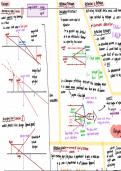
Telescopes Telescopes
flecting ractors
v .
magnification image
F
verging (conver lense & object
CASSEGRAIN REFLECTING T
-
Reflecting telescopes can be much wider than
o
·
makes ayrallel rays converge ↳ concave mirror used as
light collected
by telescope I area
to a focus
objective # chromatic abberation
focal point
Draw
I
↳ where lines meet =
conver lense nified ↳ so
telescopes
&
mag parallel rays directed racting
object
M inverted at it are reflected & focused
use lenses
DIAGRAM
real ·
focal length to a
point by the Mirror
no secondary mirror or
supp
--
& ·
O
parallel concave
rays
S & &
L Mirror framen - would block lig
L f
wider field of view th
C &
image
L ·
-
· f =
Focal length reflector > angular
M
principal M -
-
accis ↑
isLess
-
& & & &
magnified ↳ astronomical
image" convec sense
virtual
f =
Principal foent a easier to loca
object upright
In a
Cassegrain reflecting telescope the
is a convex mirror
positioned near
secondary
focal point of
mirror
mirror ? concave
· focus
RAGRAM purpose light Mirror
-
=
be es
:
must
S
PARABOLIC focal of objec
·
length
·
N &
>
-
I
Langua
inerging lens (concave
J) viewer sees Virtual
at
infinity
makes parallel lines diverge (spread apart)
image
tiny hole where
Astrophy
Marlene
concave
focal length is twice
Mirror light travels through
Diminished as it's reflecting
object
Virtual
Upright
collecting power-amout of light a telescope
sunwa
due to
O
collects splitting colour
image : light entering Pupil/objective proportional to rea in each cate
is of white reduc
M
& area
3
is
proportional to
=
diameter Squared
2
J
na refracting
, &
-
ar Resolution
-
Star Magnitudes parent Magnitude (m) My -
Mc = 2 5
.
log
Diffraction 9 5 x 10's m
I
light year measure of star
brightnes
ent
absolve glog
=
.
You can't tell two star apart it objective is
Sun to Earth 500,
↳ depends on
intensity of
light
Light from
=
received
too narrow
objective lens is a perture which collects
a
star at a
greater distance from earth
·
Parallax -
apparent displacement of 2 star than 10
has
parsec a SMALLER
diffracts light absolute
1AU = 1 496x10 "m magnitude -
appears brighter
↳ causes to SPREAD OUT than
slightly
.
10
image ↳ partec
Earth to Sun
· narrower objective
= more diffraction /
of angle O
allas angle subtended to the star
-
↳
greater spread image by
& measured in the line between S & E
two star
Resolving ARC SECONDS
tano-e5 astronomical unit
es
J
3
(seen separately so d
↑ distance from
If CENTRAL DIFFRACTION SPOTS of two ↳ distance to astar Sun to
( I
star
minimum
angular
overlap
significantly they
star do not
can be resolved
resolution aka
which subtends angle
smaller
paralle further away
Resolving Power
ofI second from centre
ange star is
Criterion
by eigh
arc
↳ can be shown
- of Earth to centre of Sun
↳ Minimum
angle
The resolution of
images of two point
the
to tell them
apart = X Wavelength light Dare-AR(Seconds s
pares =
objects is NOT possible if J
Gminimum
B - Diameter of circular J
any part of the central
of either lies
angle apeture
Spot image -
>
angular of
inside the first dark
the other
image
ring of
separation
of -
angle of diffraction
first dam ring
Astrophysics emitted
. two star not
Infrared Telescopes
Radio Telescopes
Telescopes &
Technology
&
reflector focuses I
efficient than have
large Concave
· >
-
- more
eye dish radio telescopes
single consist of detector at focal point o
·
Onto infrared
CCD ->
Charge-coupled device -> or
photographic film Satellite
LARGE PARABOLIC DISH With aerial at LOCATION Major ADV det
: :
3
light-sensitive
↓
of sees that em
array focal point of did X
range
: 0 .
01mm-Imm
DISA Mir
location
:
Resolution Major
ground
:
become when exposed to light
:
Telescopes Telescopes
flecting ractors
v .
magnification image
F
verging (conver lense & object
CASSEGRAIN REFLECTING T
-
Reflecting telescopes can be much wider than
o
·
makes ayrallel rays converge ↳ concave mirror used as
light collected
by telescope I area
to a focus
objective # chromatic abberation
focal point
Draw
I
↳ where lines meet =
conver lense nified ↳ so
telescopes
&
mag parallel rays directed racting
object
M inverted at it are reflected & focused
use lenses
DIAGRAM
real ·
focal length to a
point by the Mirror
no secondary mirror or
supp
--
& ·
O
parallel concave
rays
S & &
L Mirror framen - would block lig
L f
wider field of view th
C &
image
L ·
-
· f =
Focal length reflector > angular
M
principal M -
-
accis ↑
isLess
-
& & & &
magnified ↳ astronomical
image" convec sense
virtual
f =
Principal foent a easier to loca
object upright
In a
Cassegrain reflecting telescope the
is a convex mirror
positioned near
secondary
focal point of
mirror
mirror ? concave
· focus
RAGRAM purpose light Mirror
-
=
be es
:
must
S
PARABOLIC focal of objec
·
length
·
N &
>
-
I
Langua
inerging lens (concave
J) viewer sees Virtual
at
infinity
makes parallel lines diverge (spread apart)
image
tiny hole where
Astrophy
Marlene
concave
focal length is twice
Mirror light travels through
Diminished as it's reflecting
object
Virtual
Upright
collecting power-amout of light a telescope
sunwa
due to
O
collects splitting colour
image : light entering Pupil/objective proportional to rea in each cate
is of white reduc
M
& area
3
is
proportional to
=
diameter Squared
2
J
na refracting
, &
-
ar Resolution
-
Star Magnitudes parent Magnitude (m) My -
Mc = 2 5
.
log
Diffraction 9 5 x 10's m
I
light year measure of star
brightnes
ent
absolve glog
=
.
You can't tell two star apart it objective is
Sun to Earth 500,
↳ depends on
intensity of
light
Light from
=
received
too narrow
objective lens is a perture which collects
a
star at a
greater distance from earth
·
Parallax -
apparent displacement of 2 star than 10
has
parsec a SMALLER
diffracts light absolute
1AU = 1 496x10 "m magnitude -
appears brighter
↳ causes to SPREAD OUT than
slightly
.
10
image ↳ partec
Earth to Sun
· narrower objective
= more diffraction /
of angle O
allas angle subtended to the star
-
↳
greater spread image by
& measured in the line between S & E
two star
Resolving ARC SECONDS
tano-e5 astronomical unit
es
J
3
(seen separately so d
↑ distance from
If CENTRAL DIFFRACTION SPOTS of two ↳ distance to astar Sun to
( I
star
minimum
angular
overlap
significantly they
star do not
can be resolved
resolution aka
which subtends angle
smaller
paralle further away
Resolving Power
ofI second from centre
ange star is
Criterion
by eigh
arc
↳ can be shown
- of Earth to centre of Sun
↳ Minimum
angle
The resolution of
images of two point
the
to tell them
apart = X Wavelength light Dare-AR(Seconds s
pares =
objects is NOT possible if J
Gminimum
B - Diameter of circular J
any part of the central
of either lies
angle apeture
Spot image -
>
angular of
inside the first dark
the other
image
ring of
separation
of -
angle of diffraction
first dam ring
Astrophysics emitted
. two star not
Infrared Telescopes
Radio Telescopes
Telescopes &
Technology
&
reflector focuses I
efficient than have
large Concave
· >
-
- more
eye dish radio telescopes
single consist of detector at focal point o
·
Onto infrared
CCD ->
Charge-coupled device -> or
photographic film Satellite
LARGE PARABOLIC DISH With aerial at LOCATION Major ADV det
: :
3
light-sensitive
↓
of sees that em
array focal point of did X
range
: 0 .
01mm-Imm
DISA Mir
location
:
Resolution Major
ground
:
become when exposed to light
: