Matric Geography
Climatology
Revision
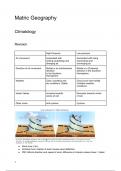
High Pressure Low pressure
Air movement Associated with Associated with rising
sinking (subsiding) and (ascending) and
diverging air. converging air.
Direction of air movement Rotate in an anticlockwise Rotate in a Clockwise
direction direction in the Southern
in the Southern Hemisphere
Hemisphere
Weather Clear, cloudless and Cloud cover and rainfall.
dry conditions. Stable. Unstable weather
conditions.
Isobar Values Increase towards Decrease towards centre
centre of cell of cell.
Other name Anti-cyclone Cyclone
● Wind from H to L
● Coriolios from rotation of each causes wind deflection
● PGF affects direction and speed of wind, difference in Isobars values closer = faster
1
, ● Weather front transition zone
between two different air masses
Mid-latitude Cyclones
● Aka Frontal depressions, low-pressure systems with meeting of warm and cold air
masses
● 2 air masses meet form frontal conditions warm followed by cold air
● Diameter 1000 - 4000km
● All year round but SA in winter months
● Family of fronts is a linked series of depressions.
Formation and movement
● Between 30 - 60 N n S
● Move West to east due to Westerlies.
● 40 - 90 km/h speeds
Needs to form
● Convergence of two large air massdes at the polar front
● Warm moist subtropical air masses from Westerlies and dry cold air from
Polar winds
● Creates unstable weather conditions that result in a low pressure cyclone that
the two air masses rotate around.
2
,Stages of Development
1. Initial stage
● Warm, moist subtropical air meets cold, drier air along the polar front
● Air masses don't mix move parallel in opposite directions on both sides of the front
● Retain their own density and characteristics ie cold, dry
2. Development
● Disturbance on polar front
● Decrease in pressure
● Tongue of war less dense air is uplifted by cold dense air and low pressure forms
● The polar front has wave-like appearance
● Air circulation converges in a clockwise direction
3. Mature
● Definate warm secto depression devlops
● Front devlop, 2 distinct air masses with diff air temps
● Warm preceds cold
● Rain along cold front where strong uplift of warm moist air due to to steep slope of
cold front.
4. Occluded stage
● Warm sector narrows
● Cold front moves faster than warm and catches up with it.
● Cold front overtake warm front 1st in low pressure centre and then progressively
outwards
● Cold air wedges under warm air lifts it up and isolates warm air from earth’s surface
called occlusion
Weather associated with Mid-Lat Cyclones
Winds veer or back as the system passes because air it is rotating clockwise therefore
Westerly wind now moves North Westerly wind and if a northern wind back it becomes a
North Westerly wind.
3
, Weather Behind C. front C.front Warm Sector Warm Front Cyclone
passing approach
Air pressure Slow rate of Sudden Lowest Decrease in Steady
increase increase pressure press decrease
Direction S W-> SW W NW -> W NW
Speed Gusty Very strong Decreases Strong Increases
gale slowly
Temp cold 5 Sudden Warm - mild Sudden rise Cool 8
decrease 12
Cloud Cov Decreasing Thick towing Low stratus Low thick Cirrus n
cumulonimbus to Cumulonimbu clear nimbostratus Cirrostratuss
cumulus s patches
Precipitation Heavy showers Short heavy Drizzle Continuous none
rain / hail rainfall
B happens first weather progresses from right to left
Front occlusions
Cold
cold air mass is colder than the
air mass in front of it, the front
air mass is lifted and a narrow
zone of precipitation is
experienced.
4
Climatology
Revision
High Pressure Low pressure
Air movement Associated with Associated with rising
sinking (subsiding) and (ascending) and
diverging air. converging air.
Direction of air movement Rotate in an anticlockwise Rotate in a Clockwise
direction direction in the Southern
in the Southern Hemisphere
Hemisphere
Weather Clear, cloudless and Cloud cover and rainfall.
dry conditions. Stable. Unstable weather
conditions.
Isobar Values Increase towards Decrease towards centre
centre of cell of cell.
Other name Anti-cyclone Cyclone
● Wind from H to L
● Coriolios from rotation of each causes wind deflection
● PGF affects direction and speed of wind, difference in Isobars values closer = faster
1
, ● Weather front transition zone
between two different air masses
Mid-latitude Cyclones
● Aka Frontal depressions, low-pressure systems with meeting of warm and cold air
masses
● 2 air masses meet form frontal conditions warm followed by cold air
● Diameter 1000 - 4000km
● All year round but SA in winter months
● Family of fronts is a linked series of depressions.
Formation and movement
● Between 30 - 60 N n S
● Move West to east due to Westerlies.
● 40 - 90 km/h speeds
Needs to form
● Convergence of two large air massdes at the polar front
● Warm moist subtropical air masses from Westerlies and dry cold air from
Polar winds
● Creates unstable weather conditions that result in a low pressure cyclone that
the two air masses rotate around.
2
,Stages of Development
1. Initial stage
● Warm, moist subtropical air meets cold, drier air along the polar front
● Air masses don't mix move parallel in opposite directions on both sides of the front
● Retain their own density and characteristics ie cold, dry
2. Development
● Disturbance on polar front
● Decrease in pressure
● Tongue of war less dense air is uplifted by cold dense air and low pressure forms
● The polar front has wave-like appearance
● Air circulation converges in a clockwise direction
3. Mature
● Definate warm secto depression devlops
● Front devlop, 2 distinct air masses with diff air temps
● Warm preceds cold
● Rain along cold front where strong uplift of warm moist air due to to steep slope of
cold front.
4. Occluded stage
● Warm sector narrows
● Cold front moves faster than warm and catches up with it.
● Cold front overtake warm front 1st in low pressure centre and then progressively
outwards
● Cold air wedges under warm air lifts it up and isolates warm air from earth’s surface
called occlusion
Weather associated with Mid-Lat Cyclones
Winds veer or back as the system passes because air it is rotating clockwise therefore
Westerly wind now moves North Westerly wind and if a northern wind back it becomes a
North Westerly wind.
3
, Weather Behind C. front C.front Warm Sector Warm Front Cyclone
passing approach
Air pressure Slow rate of Sudden Lowest Decrease in Steady
increase increase pressure press decrease
Direction S W-> SW W NW -> W NW
Speed Gusty Very strong Decreases Strong Increases
gale slowly
Temp cold 5 Sudden Warm - mild Sudden rise Cool 8
decrease 12
Cloud Cov Decreasing Thick towing Low stratus Low thick Cirrus n
cumulonimbus to Cumulonimbu clear nimbostratus Cirrostratuss
cumulus s patches
Precipitation Heavy showers Short heavy Drizzle Continuous none
rain / hail rainfall
B happens first weather progresses from right to left
Front occlusions
Cold
cold air mass is colder than the
air mass in front of it, the front
air mass is lifted and a narrow
zone of precipitation is
experienced.
4