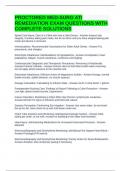
PROCTORED MED-SURG ATI
REMEDIATION EXAM QUESTIONS WITH
COMPLETE SOLUTIONS
Spinal Cord Injury: Care of a Client who has a Halo Device - Answer-Inspect skin
integrity. Continue taking pain meds, but do not drive until you have stopped taking pain
meds and device is removed.
Immunizations: Recommended Vaccinations for Older Adult Clients - Answer-Flu,
pneumonia, and shingles.
Electrolyte Imbalances: Manifestations of Hypokalemia - Answer-Constipation, heart
palpitations, fatigue, muscle weakness, numbness and tingling.
Cardiovascular Diagnostic and Therapeutic Procedures: Removing a Peripherally
Inserted Central Catheter - Answer-Instruct client to hold their breath when removing.
Do not apply direct pressure to the insertion site.
Electrolyte Imbalances: Effective Action of Magnesium Sulfate - Answer-Energy, normal
breath sounds, stable behavior, no muscle spasms.
Dosage Calculation: Calculating IV Infusion Rate - Answer-mL/hr X drop factor = gtt/min
Postoperative Nursing Care: Findings to Report Following a Colon Resection - Answer-
Low hgb, absent bowel sounds, hypotension.
Cancer Disorders: Monitoring a Client Who Has Chronic Lymphocytic Leukemia -
Answer-Monitor for signs of infection and blood lab values.
Sensory Perception: Performing Ear Irrigation - Answer-Use warm water, do not insert
the tip too far, have client sit up and hold basin under ear.
Chest Tube Insertion and Monitoring: Maintaining Drainage System - Answer-Strip
tubing per order, to not milk, monitor for bubbling in the water seal chamber.
Head Injury: Administering Medications for Increased Intracranial Pressure - Answer-
Mannitol
Electrocardiography and Dysrhythmia Monitoring: Identifying First-Degree Heart Block -
Answer-Prolonged PR interval
Electrocardiography and Dysrhythmia Monitoring: Priority Action for Sinus Bradycardia -
Answer-Atropine, then temporary pacing if necessary
REMEDIATION EXAM QUESTIONS WITH
COMPLETE SOLUTIONS
Spinal Cord Injury: Care of a Client who has a Halo Device - Answer-Inspect skin
integrity. Continue taking pain meds, but do not drive until you have stopped taking pain
meds and device is removed.
Immunizations: Recommended Vaccinations for Older Adult Clients - Answer-Flu,
pneumonia, and shingles.
Electrolyte Imbalances: Manifestations of Hypokalemia - Answer-Constipation, heart
palpitations, fatigue, muscle weakness, numbness and tingling.
Cardiovascular Diagnostic and Therapeutic Procedures: Removing a Peripherally
Inserted Central Catheter - Answer-Instruct client to hold their breath when removing.
Do not apply direct pressure to the insertion site.
Electrolyte Imbalances: Effective Action of Magnesium Sulfate - Answer-Energy, normal
breath sounds, stable behavior, no muscle spasms.
Dosage Calculation: Calculating IV Infusion Rate - Answer-mL/hr X drop factor = gtt/min
Postoperative Nursing Care: Findings to Report Following a Colon Resection - Answer-
Low hgb, absent bowel sounds, hypotension.
Cancer Disorders: Monitoring a Client Who Has Chronic Lymphocytic Leukemia -
Answer-Monitor for signs of infection and blood lab values.
Sensory Perception: Performing Ear Irrigation - Answer-Use warm water, do not insert
the tip too far, have client sit up and hold basin under ear.
Chest Tube Insertion and Monitoring: Maintaining Drainage System - Answer-Strip
tubing per order, to not milk, monitor for bubbling in the water seal chamber.
Head Injury: Administering Medications for Increased Intracranial Pressure - Answer-
Mannitol
Electrocardiography and Dysrhythmia Monitoring: Identifying First-Degree Heart Block -
Answer-Prolonged PR interval
Electrocardiography and Dysrhythmia Monitoring: Priority Action for Sinus Bradycardia -
Answer-Atropine, then temporary pacing if necessary