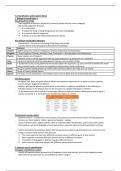
4.3 Classification and Evolution Notes
1. Biological classification 2
Classifying living things
- Each organism is studied in detail to be correctly placed into the correct category
- We classify organisms because:
1. It is convenient
2. It makes the study of living things easier and more manageable
3. It is easier to identify organisms
4. It allows us to see the relationships between species
The modern classification hierarchy
- Classification = the process of placing living things into groups
- Current system of classification has 8 taxonomic levels/taxa:
Taxa Features
Domain Highest taxonomic rank of 3 categories: Archaea, Eubacteria and Eukaryotae
Kingdom 5 main kingdoms: Plantae, Animalia, Fungi, Protoctista -> all eukaryotes, and Prokaryotae
Phylum Major subdivision of kingdom
A phylum contains all the organisms with the same body plan e.g. possession of a backbone
Class A group of organisms with the same general traits e.g. same number of legs
Order A subdivision of class using additional information about the organisms e.g. class mammal is divided into meat-
eating animals (order Carnivora) and vegetation-eating animals (order Herbivora)
Family Group of closely related genera e.g. within order Carnivora there is the ‘dog’ and ‘cat’ family
Genus Group of closely related species
Species The basic unit of classification, all members show some variation but are all essentially the same
Classifying species
- At higher taxa, there are great physical differences between organisms so it is easier to place a species
into its domain, kingdom and phylum
- Within a phylum the species are placed into a class which is slightly more difficult as the differences
between classes in one phylum may not be very great so a longer description is needed
- As we descend into lower taxa it is increasingly difficult to separate closely related species and to place a
species accurately so a more and more detailed description is needed
The binomial naming system
- Binomial system = a system that uses the genus and species to avoid confusion when naming organisms
- Humans are homo sapiens: Homo = genus and sapiens = species
- Genus is written with a capital and the name is underlined when handwritten, put in italics when typed
- Latin used as a universal language so each species has a universal name and avoids potential confusion
- System devised by Carl Linnaeus, before this the species were given long descriptions or a common name
- Using a common name doesn’t work because:
1. The same organism may have different common names in different parts of one country
2. Same organism may have different common names in different countries
3. Translation of languages or dialects may give different names
4. Same common name may be used for different species across the world
2. Features used in classification
5 kingdom classification system
- Initially all organisms were grouped into 2 kingdoms: plants and animals, but as more organisms were
discovered it was clear that not all could fit into either category
, - Initially the animal kingdom included single-celled organisms with animal-like features, and same for
plants; until electron microscopes revealed further details that some have both animal and plant features
- This resulted in the new 5-kingdom system based on microscopic level observable features of anatomy
Prokaryota Protoctista Fungi Plantae Animalia
Type of body Mostly Unicellular and Mycelium composed Multicellular: not Multicellular,
unicellular, use multicellular on hyphae and yeast compact branching most have
binary fission are unicellular body compact body
Nuclear No Yes Yes Yes Yes
envelope
Cell walls Yes – Present in some species Yes – chitin Yes – cellulose No
peptidoglycan – cellulose, chloroplasts
Cell vacuoles Present in a few Large permanent Large permanent Small
species vacuoles vacuoles temporary
vacuoles e.g.
lysosomes
Organelles and No Yes Yes Yes Yes
fibres
Type of nutrition Autotrophic and Autotrophic and Heterotrophic Autotrophic Heterotrophic
heterotrophic heterotrophic
Mobility Some bacteria Some have flagella or No Gametes of some Muscular tissue
have flagella cilia plants have flagella
Nervous co- No No No No Yes
ordination
Examples Bacteria and Amoeba, algae, silme Mould fungi, yeast Flowering plants, Jellyfish, coral,
blue-green moulds mosses, ferns, worms, insects,
bacteria conifers vertebrates
- Autotrophic = can synthesise their organic compounds and molecules for energy use and building biomass
from inorganic compounds
- Heterotrophic = feed by decomposing living or dead organic material
3. Evidence used in classification
Using biological molecules in classification
- Convergent evolution: 2 unrelated species evolve to look similar by adapting to a common environment
- They may be classified in the same taxonomic group according to their observable features, but evidence
from biological molecules can help determine how closely related one species is to another
- Certain large biological molecules involved in the most fundamental characteristics of life (e.g. respiration
and photosynthesis)
- We can assume that if the earliest living organisms had identical versions of these molecules, the
differences seen today are a result of evolution
- 2 organisms with similar molecules = not evolved apart for very long = closely related
- 2 organisms with very different molecules = evolved separately for longer = less closely related
- Can be used to clarify evolutionary relationships that we are unsure about
Cytochrome c
- Protein used in respiration, present in all organisms that respire but not identical in all
- Amino acids in cytochrome c can be identified and the sequences compared with other organisms
1. If the sequences are the same, the two species must be closely related
2. If the sequences are different, the two species are not so closely related
3. More differences found between the sequences = less closely related
DNA
- DNA is genetic code, a particular sequence codes for the same sequence of amino acids for all organisms
- Changes to DNA sequence = mutations, randomly occurring
- Comparing DNA sequences allows us to classify species, more similar = more closely related
1. Biological classification 2
Classifying living things
- Each organism is studied in detail to be correctly placed into the correct category
- We classify organisms because:
1. It is convenient
2. It makes the study of living things easier and more manageable
3. It is easier to identify organisms
4. It allows us to see the relationships between species
The modern classification hierarchy
- Classification = the process of placing living things into groups
- Current system of classification has 8 taxonomic levels/taxa:
Taxa Features
Domain Highest taxonomic rank of 3 categories: Archaea, Eubacteria and Eukaryotae
Kingdom 5 main kingdoms: Plantae, Animalia, Fungi, Protoctista -> all eukaryotes, and Prokaryotae
Phylum Major subdivision of kingdom
A phylum contains all the organisms with the same body plan e.g. possession of a backbone
Class A group of organisms with the same general traits e.g. same number of legs
Order A subdivision of class using additional information about the organisms e.g. class mammal is divided into meat-
eating animals (order Carnivora) and vegetation-eating animals (order Herbivora)
Family Group of closely related genera e.g. within order Carnivora there is the ‘dog’ and ‘cat’ family
Genus Group of closely related species
Species The basic unit of classification, all members show some variation but are all essentially the same
Classifying species
- At higher taxa, there are great physical differences between organisms so it is easier to place a species
into its domain, kingdom and phylum
- Within a phylum the species are placed into a class which is slightly more difficult as the differences
between classes in one phylum may not be very great so a longer description is needed
- As we descend into lower taxa it is increasingly difficult to separate closely related species and to place a
species accurately so a more and more detailed description is needed
The binomial naming system
- Binomial system = a system that uses the genus and species to avoid confusion when naming organisms
- Humans are homo sapiens: Homo = genus and sapiens = species
- Genus is written with a capital and the name is underlined when handwritten, put in italics when typed
- Latin used as a universal language so each species has a universal name and avoids potential confusion
- System devised by Carl Linnaeus, before this the species were given long descriptions or a common name
- Using a common name doesn’t work because:
1. The same organism may have different common names in different parts of one country
2. Same organism may have different common names in different countries
3. Translation of languages or dialects may give different names
4. Same common name may be used for different species across the world
2. Features used in classification
5 kingdom classification system
- Initially all organisms were grouped into 2 kingdoms: plants and animals, but as more organisms were
discovered it was clear that not all could fit into either category
, - Initially the animal kingdom included single-celled organisms with animal-like features, and same for
plants; until electron microscopes revealed further details that some have both animal and plant features
- This resulted in the new 5-kingdom system based on microscopic level observable features of anatomy
Prokaryota Protoctista Fungi Plantae Animalia
Type of body Mostly Unicellular and Mycelium composed Multicellular: not Multicellular,
unicellular, use multicellular on hyphae and yeast compact branching most have
binary fission are unicellular body compact body
Nuclear No Yes Yes Yes Yes
envelope
Cell walls Yes – Present in some species Yes – chitin Yes – cellulose No
peptidoglycan – cellulose, chloroplasts
Cell vacuoles Present in a few Large permanent Large permanent Small
species vacuoles vacuoles temporary
vacuoles e.g.
lysosomes
Organelles and No Yes Yes Yes Yes
fibres
Type of nutrition Autotrophic and Autotrophic and Heterotrophic Autotrophic Heterotrophic
heterotrophic heterotrophic
Mobility Some bacteria Some have flagella or No Gametes of some Muscular tissue
have flagella cilia plants have flagella
Nervous co- No No No No Yes
ordination
Examples Bacteria and Amoeba, algae, silme Mould fungi, yeast Flowering plants, Jellyfish, coral,
blue-green moulds mosses, ferns, worms, insects,
bacteria conifers vertebrates
- Autotrophic = can synthesise their organic compounds and molecules for energy use and building biomass
from inorganic compounds
- Heterotrophic = feed by decomposing living or dead organic material
3. Evidence used in classification
Using biological molecules in classification
- Convergent evolution: 2 unrelated species evolve to look similar by adapting to a common environment
- They may be classified in the same taxonomic group according to their observable features, but evidence
from biological molecules can help determine how closely related one species is to another
- Certain large biological molecules involved in the most fundamental characteristics of life (e.g. respiration
and photosynthesis)
- We can assume that if the earliest living organisms had identical versions of these molecules, the
differences seen today are a result of evolution
- 2 organisms with similar molecules = not evolved apart for very long = closely related
- 2 organisms with very different molecules = evolved separately for longer = less closely related
- Can be used to clarify evolutionary relationships that we are unsure about
Cytochrome c
- Protein used in respiration, present in all organisms that respire but not identical in all
- Amino acids in cytochrome c can be identified and the sequences compared with other organisms
1. If the sequences are the same, the two species must be closely related
2. If the sequences are different, the two species are not so closely related
3. More differences found between the sequences = less closely related
DNA
- DNA is genetic code, a particular sequence codes for the same sequence of amino acids for all organisms
- Changes to DNA sequence = mutations, randomly occurring
- Comparing DNA sequences allows us to classify species, more similar = more closely related