5.3 Neuronal Control
5.3.1 Neurones
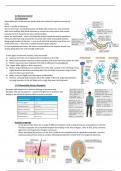
- Specialised cells of the nervous system that carry electrical impulses around the
body
- Nerve = bundle of neurones
- All neurones have a long fibre (axon), cell body with nucleus etc, axon terminal
with nerve endings that allow neurones to connect to many others and receive
impulses to form networks for easy communica8on
- Some are myelinated – axon is insulated by myelin sheath (formed by specialised
Schwann cells that wrap around the neurone) with small uninsulated sec8ons
along length (nodes of Ranvier) -> as a result electrical impulses jump from one
node to the next -> less 8me is wasted transferring the impulse
- In non-myelinated neurones, the axon is uninsulated so the impulse travels more
slowly, going down the en8re length of the axon
- 3 main types of neurone: sensory, relay and motor
a) Sensory neurones carry impulses from receptors to the CNS
b) Relay (intermediate) neurones connect sensory and motor neurones within the CNS
c) Motors neurones carry impulses from CNS to effectors (muscles/gland)
- The 3 types differ slightly in their structures
a) Motor: large cell body at one end that lies in the CNS, nucleus in the cell body, many
highly-branches dendrites extending from the cell body to provide a large surface
area for other axon terminals
b) Relay: short but highly branches axons and dendrites
c) Sensory: cell body that branches off in the middle of the cell, single long dendron
carrying impulses to the cell body and a single long axon carrying away
5.3.2 Mammalian Sensory Receptors
- Receptor cells respond to a s8mulus (change in environment)
- Receptor cells are transducers – convert energy from in one form into
energy in an electrical impulse within a sensory neurone
Pacinian corpuscles
- In any area of skin there are a range of different receptors with varying structures and posi8ons in the skin
- Pacinian corpuscles are a mechanoreceptor found deep in the skin in fingers, soles of feet, joints, tendons,
ligaments, and respond to changes in pressure
- When s8mulated by pressure on the skin it leads to the establishment of a generator poten8al = nervous
impulse produced by a sensory receptor following transduc8on of one form of energy into electrical
, - Pacinian corpuscles are found at the end of sensory
neurone axons, made of many layers of membrane
around the end of the neurone separated by a gel
containing Na+ ions
- The sec8on of axon surrounded by layers of membrane
contains stretch-mediated sodium ion channels which
open when sufficient pressure is applied
- This allows Na+ to flow into the neurone so that an
electrical poten8al difference across the axon
membrane is established – this is the generator
poten8al
5.3.3 Res;ng Poten;als
- Neurones transmit electrical impulses -> travel rapidly along neurone cell surface membrane from one end
to the other
- In a res8ng axon (not currently transmiQng impulses), the inside of the axon always has a nega8ve
electrical poten8al compared to the outside of the axon -> called the res8ng poten8al
- This poten8al difference (when there are no impulses) is about -70mV (70mV lower than the outside)
- 2 factors contribute to establishing and maintaining res8ng poten8al:
a) Ac8ve transport of sodium ions and potassium ions
b) Differen8al membrane permeability
Ac;ve transport of sodium ions and potassium ions
1. Carrier proteins (sodium-potassium pumps) are present in the neurone membranes
2. They use ATP to ac8vely transport 3 sodium ions out of the axon for every 2 potassium ions they ac8vely
transport in
3. Therefore there is a higher conc of posi8ve ions outside the axon than inside
4. The movement of ions via the sodium-potassium pumps establishes an electrochemical gradient
Differen;al membrane permeability
- Cell-surface membrane of neurones has selec8ve protein channels that allow sodium and potassium ions
to move across the membrane by facilitated diffusion
- The protein channels are less permeable to sodium ions than potassium ions
- Hence potassium ions can diffuse back down their concentra8on gradient, out of the axon, at a faster rate
than sodium ions
5.3.4 Ac;on Poten;als
- Not a flow of electrons, instead occurs via a brief change in the distribu8on of electric charge across the
cell surface membrane
- Caused by the rapid movement of sodium ions and potassium ions across the membrane of the axon
- Voltage-gated channel proteins open and close depending on the electrical poten8al across the axon
membrane to allow ions through
- They are closed when the axon membrane is at its res8ng poten8al
Stage 1: S;mulus
- A s8mulus triggers sodium ion channels in the membrane to open allowing sodium ions to diffuse into the
neurone down an electrochemical gradient
5.3.1 Neurones
- Specialised cells of the nervous system that carry electrical impulses around the
body
- Nerve = bundle of neurones
- All neurones have a long fibre (axon), cell body with nucleus etc, axon terminal
with nerve endings that allow neurones to connect to many others and receive
impulses to form networks for easy communica8on
- Some are myelinated – axon is insulated by myelin sheath (formed by specialised
Schwann cells that wrap around the neurone) with small uninsulated sec8ons
along length (nodes of Ranvier) -> as a result electrical impulses jump from one
node to the next -> less 8me is wasted transferring the impulse
- In non-myelinated neurones, the axon is uninsulated so the impulse travels more
slowly, going down the en8re length of the axon
- 3 main types of neurone: sensory, relay and motor
a) Sensory neurones carry impulses from receptors to the CNS
b) Relay (intermediate) neurones connect sensory and motor neurones within the CNS
c) Motors neurones carry impulses from CNS to effectors (muscles/gland)
- The 3 types differ slightly in their structures
a) Motor: large cell body at one end that lies in the CNS, nucleus in the cell body, many
highly-branches dendrites extending from the cell body to provide a large surface
area for other axon terminals
b) Relay: short but highly branches axons and dendrites
c) Sensory: cell body that branches off in the middle of the cell, single long dendron
carrying impulses to the cell body and a single long axon carrying away
5.3.2 Mammalian Sensory Receptors
- Receptor cells respond to a s8mulus (change in environment)
- Receptor cells are transducers – convert energy from in one form into
energy in an electrical impulse within a sensory neurone
Pacinian corpuscles
- In any area of skin there are a range of different receptors with varying structures and posi8ons in the skin
- Pacinian corpuscles are a mechanoreceptor found deep in the skin in fingers, soles of feet, joints, tendons,
ligaments, and respond to changes in pressure
- When s8mulated by pressure on the skin it leads to the establishment of a generator poten8al = nervous
impulse produced by a sensory receptor following transduc8on of one form of energy into electrical
, - Pacinian corpuscles are found at the end of sensory
neurone axons, made of many layers of membrane
around the end of the neurone separated by a gel
containing Na+ ions
- The sec8on of axon surrounded by layers of membrane
contains stretch-mediated sodium ion channels which
open when sufficient pressure is applied
- This allows Na+ to flow into the neurone so that an
electrical poten8al difference across the axon
membrane is established – this is the generator
poten8al
5.3.3 Res;ng Poten;als
- Neurones transmit electrical impulses -> travel rapidly along neurone cell surface membrane from one end
to the other
- In a res8ng axon (not currently transmiQng impulses), the inside of the axon always has a nega8ve
electrical poten8al compared to the outside of the axon -> called the res8ng poten8al
- This poten8al difference (when there are no impulses) is about -70mV (70mV lower than the outside)
- 2 factors contribute to establishing and maintaining res8ng poten8al:
a) Ac8ve transport of sodium ions and potassium ions
b) Differen8al membrane permeability
Ac;ve transport of sodium ions and potassium ions
1. Carrier proteins (sodium-potassium pumps) are present in the neurone membranes
2. They use ATP to ac8vely transport 3 sodium ions out of the axon for every 2 potassium ions they ac8vely
transport in
3. Therefore there is a higher conc of posi8ve ions outside the axon than inside
4. The movement of ions via the sodium-potassium pumps establishes an electrochemical gradient
Differen;al membrane permeability
- Cell-surface membrane of neurones has selec8ve protein channels that allow sodium and potassium ions
to move across the membrane by facilitated diffusion
- The protein channels are less permeable to sodium ions than potassium ions
- Hence potassium ions can diffuse back down their concentra8on gradient, out of the axon, at a faster rate
than sodium ions
5.3.4 Ac;on Poten;als
- Not a flow of electrons, instead occurs via a brief change in the distribu8on of electric charge across the
cell surface membrane
- Caused by the rapid movement of sodium ions and potassium ions across the membrane of the axon
- Voltage-gated channel proteins open and close depending on the electrical poten8al across the axon
membrane to allow ions through
- They are closed when the axon membrane is at its res8ng poten8al
Stage 1: S;mulus
- A s8mulus triggers sodium ion channels in the membrane to open allowing sodium ions to diffuse into the
neurone down an electrochemical gradient