5.7 Respira,on
5.7.1 Need for Cellular Respira,on
- Living organisms composed of cells -> processes
occur to maintain life -> requires energy
- Respira9on in all living cells releases energy from the
breakdown of organic molecules, involving transfer
of chemical poten9al energy from nutrient molecules
into useable energy forms
- Glucose + oxygen -> carbon dioxide + water + energy
- C6H12O6 + 6O2 -> 6CO2 + 6H2O + 2870kJ
- Autotrophs can synthesise their own useable carbon
compounds through photosynthesis
- Heterotrophs have to eat food to get a supply of pre-
made useable carbon compounds
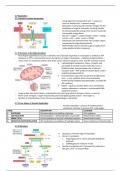
5.7.2 Structure of the Mitochondrion
- Rod-shaped organelles (0.5-1µm) in diameter, site of aerobic respira9on in eukaryotes to synthesise ATP
- Synthesis of ATP in mitochondria occurs during the last stage of respira9on – oxida9ve phosphoryla9on –
which relies on membrane proteins that make up the ‘electron transport chain’ and ATP synthase enzyme
• 2 phospholipid membranes: Outer is smooth and
permeable to several smooth molecules, Inner is
folded (cristae), less permeable, site of electron
transport chain + ATP synthase enzymes (both used in
oxida9ve phosphoryla9on)
• Intermembrane space has low pH due to high proton
conc. -> conc. gradient across inner membrane
formed during oxida9ve phosphoryla9on, essen9al for
ATP synthesis
• Matrix = aqueous solu9on within inner membranes,
contains ribosomes + enzymes + mitochondrial DNA
needed to func9on
- Large surface area from cristae = mitochondria can hold many electron transport chains + enzymes
- More ac9ve cell types = larger mitochondria and more 9ghtly packed cristae = even larger sa
- Number of mitochondria in each cell can vary depending on cell ac9vity
5.7.3 Four Stages of Aerobic Respira,on
-Aerobic respira9on = process of breaking down a
respiratory substrate to produce ATP using oxygen
STAGE DESCRIPTION LOCATION
1. GLYCOLYSIS Phosphoryla9on and spli^ng of glucose Cell cytoplasm
2. LINK REACTION Decarboxyla9on + dehydrogena9on of pyruvate Mitochondria matrix
3. KREBS CYCLE Cyclical pathway w/ enzyme-controlled reac9ons Mitochondria matrix
4. OXIDATIVE PHOSPHORYLATION ATP produc9on via oxida9on of hydrogen atoms Inner membrane of mitochondria
5.7.4 Glycolysis
• Glycolysis is the first stage of respira9on
• Occurs in cytoplasm:
1. Trapping glucose in cell by phosphoryla9ng the
molecule
2. Spli^ng glucose molecule in two
• Results in produc9on of 2 Pyruvate (3C) molecules +
Net gain 2 ATP + 2 reduced NAD
, Steps of glycolysis
1. Phosphoryla9on: Glucose (6C) is phosphorylated by 2 ATP ->
Fructose bisphosphate (6C)
1. Glucose + 2ATP -> Fructose bisphosphate 2. Lysis: Fructose bisphosphate (6C) -> splits to 2 molecules of
2. Fructose bisphosphate -> 2 Triose phosphate triose phosphate (3C)
3. 4H + 2NAD -> 2NADH + 2H+ 3. Oxida9on: Hydrogen removed from each of the 2 molecules ->
4. 4Pi + 4ADP -> 4ATP transferred to coenzyme NAD -> NADH
5. 2 triose phosphate -> 2 Pyruvate 4. Dephosphoryla9on: phosphates transferred from
intermediate substrate molecules to form 4 ATP
5. Pyruvate produced: end product, used in next stage
5.7.5 The Link Reac,on
- End product of glycolysis is pyruvate: has lots of
chemical energy that can be used in respira9on to
produce more ATP
- Pyruvate enters mitochondrial matrix vias ac9ve
transport (using a transport protein and ATP) when
oxygen is available -> aerobic respira9on con9nues
- Called ‘link’ reac9on as it links glycolysis to the Krebs
cycle
1. Pyruvate oxidised by enzymes -> acetate (CH3CO(O)-)
and CO2 (requires reduc9on of NAD to NADH)
2. Acetate + coenzyme A -> acetyl coenzyme A (acetyl
CoA)
Products are Acetyl CoA, CO2, NADH
- Coenzyme = molecule that helps an enzyme carry out its func9on, not used in respira9on itself
- CoA consists of a nucleoside (ribose and adenine) and a vitamin
- Link reac9on: CoA binds to remainder of pyruvate molecule (acetyl group 2C) -> forms acetyl CoA ->
supplies acetyl group to the Krebs cycle -> used to con9nue aerobic respira9on
- Links ini9al stage in cytoplasm to the later stages in mitochondria
5.7.6 The Krebs Cycle
- Series of enzyme-controlled reac9ons occurring in the matrix of mitochondria
- Starts with 2C Acetyl CoA entering circular pathway from the link reac9on
- Acetyl CoA is also formed from fafy acids (from lipid breakdown) and amino acids -> these enter directly
into the Krebs cycle from other metabolic pathways
1. 4C oxaloacetate accepts the 2C acetyl fragment
from acetyl CoA -> forms 6C citrate, CoA is released
2. Becomes intermediate 5C compound
3. Series of redox reac9ons occur to convert citrate
back to oxaloacetate
Regenera,on of Oxaloacetate
• Series of redox reac9ons occur
1. Decarboxyla9on of citrate -> releases 2CO2 as
waste gas
2. Oxida9on/dehydrogena9on of citrate -> releases
H atoms -> reduce coenzymes NAD and FAD
8H + 3NAD + FAD -> 3NADH + 3H+ + FADH2
3. Substrate-level phosphoryla9on: phosphate
transferred from one of the intermediates to
ADP -> ATP
5.7.1 Need for Cellular Respira,on
- Living organisms composed of cells -> processes
occur to maintain life -> requires energy
- Respira9on in all living cells releases energy from the
breakdown of organic molecules, involving transfer
of chemical poten9al energy from nutrient molecules
into useable energy forms
- Glucose + oxygen -> carbon dioxide + water + energy
- C6H12O6 + 6O2 -> 6CO2 + 6H2O + 2870kJ
- Autotrophs can synthesise their own useable carbon
compounds through photosynthesis
- Heterotrophs have to eat food to get a supply of pre-
made useable carbon compounds
5.7.2 Structure of the Mitochondrion
- Rod-shaped organelles (0.5-1µm) in diameter, site of aerobic respira9on in eukaryotes to synthesise ATP
- Synthesis of ATP in mitochondria occurs during the last stage of respira9on – oxida9ve phosphoryla9on –
which relies on membrane proteins that make up the ‘electron transport chain’ and ATP synthase enzyme
• 2 phospholipid membranes: Outer is smooth and
permeable to several smooth molecules, Inner is
folded (cristae), less permeable, site of electron
transport chain + ATP synthase enzymes (both used in
oxida9ve phosphoryla9on)
• Intermembrane space has low pH due to high proton
conc. -> conc. gradient across inner membrane
formed during oxida9ve phosphoryla9on, essen9al for
ATP synthesis
• Matrix = aqueous solu9on within inner membranes,
contains ribosomes + enzymes + mitochondrial DNA
needed to func9on
- Large surface area from cristae = mitochondria can hold many electron transport chains + enzymes
- More ac9ve cell types = larger mitochondria and more 9ghtly packed cristae = even larger sa
- Number of mitochondria in each cell can vary depending on cell ac9vity
5.7.3 Four Stages of Aerobic Respira,on
-Aerobic respira9on = process of breaking down a
respiratory substrate to produce ATP using oxygen
STAGE DESCRIPTION LOCATION
1. GLYCOLYSIS Phosphoryla9on and spli^ng of glucose Cell cytoplasm
2. LINK REACTION Decarboxyla9on + dehydrogena9on of pyruvate Mitochondria matrix
3. KREBS CYCLE Cyclical pathway w/ enzyme-controlled reac9ons Mitochondria matrix
4. OXIDATIVE PHOSPHORYLATION ATP produc9on via oxida9on of hydrogen atoms Inner membrane of mitochondria
5.7.4 Glycolysis
• Glycolysis is the first stage of respira9on
• Occurs in cytoplasm:
1. Trapping glucose in cell by phosphoryla9ng the
molecule
2. Spli^ng glucose molecule in two
• Results in produc9on of 2 Pyruvate (3C) molecules +
Net gain 2 ATP + 2 reduced NAD
, Steps of glycolysis
1. Phosphoryla9on: Glucose (6C) is phosphorylated by 2 ATP ->
Fructose bisphosphate (6C)
1. Glucose + 2ATP -> Fructose bisphosphate 2. Lysis: Fructose bisphosphate (6C) -> splits to 2 molecules of
2. Fructose bisphosphate -> 2 Triose phosphate triose phosphate (3C)
3. 4H + 2NAD -> 2NADH + 2H+ 3. Oxida9on: Hydrogen removed from each of the 2 molecules ->
4. 4Pi + 4ADP -> 4ATP transferred to coenzyme NAD -> NADH
5. 2 triose phosphate -> 2 Pyruvate 4. Dephosphoryla9on: phosphates transferred from
intermediate substrate molecules to form 4 ATP
5. Pyruvate produced: end product, used in next stage
5.7.5 The Link Reac,on
- End product of glycolysis is pyruvate: has lots of
chemical energy that can be used in respira9on to
produce more ATP
- Pyruvate enters mitochondrial matrix vias ac9ve
transport (using a transport protein and ATP) when
oxygen is available -> aerobic respira9on con9nues
- Called ‘link’ reac9on as it links glycolysis to the Krebs
cycle
1. Pyruvate oxidised by enzymes -> acetate (CH3CO(O)-)
and CO2 (requires reduc9on of NAD to NADH)
2. Acetate + coenzyme A -> acetyl coenzyme A (acetyl
CoA)
Products are Acetyl CoA, CO2, NADH
- Coenzyme = molecule that helps an enzyme carry out its func9on, not used in respira9on itself
- CoA consists of a nucleoside (ribose and adenine) and a vitamin
- Link reac9on: CoA binds to remainder of pyruvate molecule (acetyl group 2C) -> forms acetyl CoA ->
supplies acetyl group to the Krebs cycle -> used to con9nue aerobic respira9on
- Links ini9al stage in cytoplasm to the later stages in mitochondria
5.7.6 The Krebs Cycle
- Series of enzyme-controlled reac9ons occurring in the matrix of mitochondria
- Starts with 2C Acetyl CoA entering circular pathway from the link reac9on
- Acetyl CoA is also formed from fafy acids (from lipid breakdown) and amino acids -> these enter directly
into the Krebs cycle from other metabolic pathways
1. 4C oxaloacetate accepts the 2C acetyl fragment
from acetyl CoA -> forms 6C citrate, CoA is released
2. Becomes intermediate 5C compound
3. Series of redox reac9ons occur to convert citrate
back to oxaloacetate
Regenera,on of Oxaloacetate
• Series of redox reac9ons occur
1. Decarboxyla9on of citrate -> releases 2CO2 as
waste gas
2. Oxida9on/dehydrogena9on of citrate -> releases
H atoms -> reduce coenzymes NAD and FAD
8H + 3NAD + FAD -> 3NADH + 3H+ + FADH2
3. Substrate-level phosphoryla9on: phosphate
transferred from one of the intermediates to
ADP -> ATP