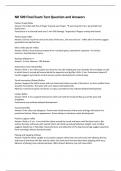
NR 509 Final Exam Test Question and Answers
Palmer Grasp Reflex
Answer: the infant will flex all finger to grasp your finger. *If seen beyond 4 mo= pyramidal tract
dysfunction.
Persistance of a clinched hand over 2 mo=CNS damage *especially if fingers overlap the thumb.
Plantar grasp reflex
Answer: 6-8 mo Touch the sole at the base of the toes , the toes will curl. -reflex after 8 months suggest
pyramidal tract dysfunction.
Moro reflex (startle reflex)
Answer: Birth to 4 persistence beyond 4 mo =cerebral palsy, asymmetric response = fx clavicle,
humerus, brachial plexus injury.
Rooting reflexterm-4
Answer: 3-4 mo. absence- CNS disease
Asymmetric Tonic Neck Reflex
Answer: Birth- 2 mo infant supine turn head to one side holding jaw over shoulder the arms/legs on side
to which head is turned will extend while the opposite arm/leg flex. Birth -2 mo. Persistence beyond 2
months suggest asymmetric central nervous system development/ cerebral palsy
Trunk incurvation (Galant) Reflex
Answer: Support the infant prone with one hand and stroke one side of the back 1 cm from midline from
shoulder to buttocks. The spine will curve toward stimulated side.
Absence: transverse spinal cord lesion or injury, persistence may indicate delayed development.
Landau Reflex
Answer: Birth- 6 mo suspend infant prone with one hand the head will flip up and the spine will
straighten.
Persistence may indicate delayed development
Parachute Reflex
Answer: 8 mo. does not disappear. Prone lower head toward surface arms and legs will extend in a
protective fashion. Delay in appearance- future delays in voluntary motor development.
Positive support reflex
Answer: Birth or 2 mo - 6 mo Hold the infant around the trunk and lower until the feet touch a flat
surface the hips and knees with extend infant will stand up and partially bear weight. Lack of reflex
suggests hypotonia or flaccidity, fixed extension and adduction of the legs (scissoring) suggest spasticity
from neurologic disease (cerebral palsy)
Placing and stepping reflexes
Answer: Hold the infant upright as in positive support reflex have one sole touch the tabletop the hip
and knee of that foot with flex and the other foot with stem forward alternative stepping with occur.
Absence of placing may indicate paralysis, NB by breech delivery may not have reflex.
Palmer Grasp Reflex
Answer: the infant will flex all finger to grasp your finger. *If seen beyond 4 mo= pyramidal tract
dysfunction.
Persistance of a clinched hand over 2 mo=CNS damage *especially if fingers overlap the thumb.
Plantar grasp reflex
Answer: 6-8 mo Touch the sole at the base of the toes , the toes will curl. -reflex after 8 months suggest
pyramidal tract dysfunction.
Moro reflex (startle reflex)
Answer: Birth to 4 persistence beyond 4 mo =cerebral palsy, asymmetric response = fx clavicle,
humerus, brachial plexus injury.
Rooting reflexterm-4
Answer: 3-4 mo. absence- CNS disease
Asymmetric Tonic Neck Reflex
Answer: Birth- 2 mo infant supine turn head to one side holding jaw over shoulder the arms/legs on side
to which head is turned will extend while the opposite arm/leg flex. Birth -2 mo. Persistence beyond 2
months suggest asymmetric central nervous system development/ cerebral palsy
Trunk incurvation (Galant) Reflex
Answer: Support the infant prone with one hand and stroke one side of the back 1 cm from midline from
shoulder to buttocks. The spine will curve toward stimulated side.
Absence: transverse spinal cord lesion or injury, persistence may indicate delayed development.
Landau Reflex
Answer: Birth- 6 mo suspend infant prone with one hand the head will flip up and the spine will
straighten.
Persistence may indicate delayed development
Parachute Reflex
Answer: 8 mo. does not disappear. Prone lower head toward surface arms and legs will extend in a
protective fashion. Delay in appearance- future delays in voluntary motor development.
Positive support reflex
Answer: Birth or 2 mo - 6 mo Hold the infant around the trunk and lower until the feet touch a flat
surface the hips and knees with extend infant will stand up and partially bear weight. Lack of reflex
suggests hypotonia or flaccidity, fixed extension and adduction of the legs (scissoring) suggest spasticity
from neurologic disease (cerebral palsy)
Placing and stepping reflexes
Answer: Hold the infant upright as in positive support reflex have one sole touch the tabletop the hip
and knee of that foot with flex and the other foot with stem forward alternative stepping with occur.
Absence of placing may indicate paralysis, NB by breech delivery may not have reflex.