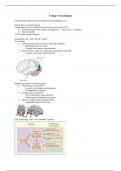
College 5 Neurobiologie
We kunnen gevoelens niet zien maar gezichtsuitdrukkingen wel
Neural basis: visual processing
Visual stimuli are first analyzed in the primary visual cortex (V1)
Retina (rods and cones; staafjes en kegeltjes) --> optic nerve --> thalamus
Basic properties
V2-V5: more complex aspects
Neural basis: the “what” and the “where”
Two streams
Ventral stream: what you see (occipital temporal)
- Identifying: chair is a chair
- Couples with memory representation
Dorsal stream: where is it in the space (occipital parietal)
- Location in the space and movement
Regions specialized in face processing
Occipitial face area (OFA)
- Located in the inferior occipital gyrus
- Configuration of the face
Fusiform face area (FFA)
- Part of the fusiform gyrus (boven)
- Identity (gezicht koppelen aan mens)
Superior temporal sulcus (onder) (STS)
- Changeable aspects of the face
Face processing: “core” and “extended” systems
,Occipital Face Area vs Fusiform Face Area
Zelfde stimulus herhalen --> het signaal en dus respons wordt minder --> adaptation, als er iets veranderd in het
gezicht dan wordt er weer hetzelfde op gereageerd, maar als hetzelfde gezicht zonder aanpassing komt dan wordt
er gesproken van adaptatie; van een verschillende hoek/verschillend lichtval dan kan het nog steeds gezien
worden als hetzelfde gezicht
Morphing of faces from Marilyn Monroe to Margaret Thatcher
OFA related to degree of physical difference between images (structureel)
FFA related to who the participant perceives it to be (identity)
Rival claim for fusiform face area
Expert in visual discrimination for within category, not for faces per se
- Prolonged experience with face exemplars
- Training on other objects can lead to FFA activation
- Can distinguish males/females
- Learn to categorize
BUT: the impairment of a prosopagnosia (niet meer mogelijk om gezichten te herkennen) patient was
specific to faces
Role in non-face perception is debated
Face recognition unit: entiteit van gezichtsverwerkingsmodellen die gezichten herkent
Person identity node: entiteit van gezichtsverwerkingsmodellen die semantische (feitenkennis) en perceptuele
informatie over een bepaald individu aan elkaar koppelt
Superior Temporal Sulcus (STS)
- Responds to changeable (fleeting) aspects of face (gaze, poses; they come and go)
- Responds to bodies as well as faces (biological motion)
- Receives multi-sensory inputs (e.g. sights and sound of speech)
- Links ventral to dorsal system allowing mirroring other’s action in one’s own motor system
- Role in emotional expression recognition is less clear
Eye gaze perception
- Eye-contact (communication, dominance)
Smaller dark region surrounded by white sclera
- Intention knowing without asking
Direction of gaze provides clues to mental states such as intention
- Involved in joint attention (social development, cooperation) Waar kijkt mama naar, dat is dus
interessant; aandacht is gericht op een object door de reactie van iemand anders op dat object
Judging gaze direction activates STS not FFA, but judging face identity activates FFA not STS
Gaze cueing task (je ziet een gezicht of een dubbele pijn, eerst recht gezicht, daarna kijken de ogen een
andere kant op)
- STS responds more to eye cues than arrow cues
, - Effect greater when cued to empty space rather than object; als er iets onverwachts gebeurt dan
wordt er langer naar gekeken
- Autism: problem with joint attention and lack of eye contact
No modulation effect of empty space & social significance of gaze rather than gaze perception pers
In monkeys, STS cells are sensitive to gaze direction
STS takes head position information too
- For example, this neuron could be said to code the locus o attention (down, in this case) rather than
eye gaze per se.
Gaze = Staren
POINTING
Proto-imperative “give me that”
- Reward based learning
- Kijken of mama naar je vinger kijkt
Proto declaritive “look at that”
- Join attention related, involves understanding what the other sees
- Lack of proto-declarative pointing can be a marker for autism
- In infancy there are two types of pointing; 1 is ze willen iets krijgen. 2 is ze willen dat er naar iets
gekeken wordt
Moving the eye where the other is pointing/looking activates STS in fMRI studies
Pointing is not readily used/understood by other animals (dogs being notable exception)
In monkeys, cells in STS already respond
to both looking and reaching direction and more when they correspond
- Basis for coding intentional vs. accidental actions
PERCEIVING BODIES
EBA (extra-striate body area)
- Abstract description of body plan
- Graded response
- Responds more to body parts and bodies than other objects and faces
FBA (fusiform body area)
- More to whole bodies instead of body parts
STS (superior temporal sulcus)
- Dynamic bodies
Perceiving bodies: STS and Biological Motion
- Led lights on joints (record in dark)
- Verschil detecteren tussen de aanwezigheid van een mens vs. beweging cues op zichzelf
- STS: processing van lichaamsbeweging; detecteren van biologische beweging
- V5/MT: detecteren van visuele beweging
Integrates different sensory inputs and STS
- Single-cell recordings in monkeys
- Activation in STS increased when the same vocalization is both seen and heard
- Speech recognition
Recognizing Expressions
Using dynamic information, STS
- BUT, impairments in recognizing facial expressions not linked to the STS but found following
lesions to ‘extend system’
Mapping faces onto regions specialized for emotional stimuli
- Separate pathways for different emotions
- Selective lesions to amygdala (fear) and insula (disgust)
Simulating the expression motorically
- Lesions to sensorimotor areas
Simulation
Seeing an expression activates sensory-motor mechanisms that produce expressions
Watching expressions produces tiny changes in facial muscles (electromyographic)
Bite task selectively disrupts the recognition of happy expression
We kunnen gevoelens niet zien maar gezichtsuitdrukkingen wel
Neural basis: visual processing
Visual stimuli are first analyzed in the primary visual cortex (V1)
Retina (rods and cones; staafjes en kegeltjes) --> optic nerve --> thalamus
Basic properties
V2-V5: more complex aspects
Neural basis: the “what” and the “where”
Two streams
Ventral stream: what you see (occipital temporal)
- Identifying: chair is a chair
- Couples with memory representation
Dorsal stream: where is it in the space (occipital parietal)
- Location in the space and movement
Regions specialized in face processing
Occipitial face area (OFA)
- Located in the inferior occipital gyrus
- Configuration of the face
Fusiform face area (FFA)
- Part of the fusiform gyrus (boven)
- Identity (gezicht koppelen aan mens)
Superior temporal sulcus (onder) (STS)
- Changeable aspects of the face
Face processing: “core” and “extended” systems
,Occipital Face Area vs Fusiform Face Area
Zelfde stimulus herhalen --> het signaal en dus respons wordt minder --> adaptation, als er iets veranderd in het
gezicht dan wordt er weer hetzelfde op gereageerd, maar als hetzelfde gezicht zonder aanpassing komt dan wordt
er gesproken van adaptatie; van een verschillende hoek/verschillend lichtval dan kan het nog steeds gezien
worden als hetzelfde gezicht
Morphing of faces from Marilyn Monroe to Margaret Thatcher
OFA related to degree of physical difference between images (structureel)
FFA related to who the participant perceives it to be (identity)
Rival claim for fusiform face area
Expert in visual discrimination for within category, not for faces per se
- Prolonged experience with face exemplars
- Training on other objects can lead to FFA activation
- Can distinguish males/females
- Learn to categorize
BUT: the impairment of a prosopagnosia (niet meer mogelijk om gezichten te herkennen) patient was
specific to faces
Role in non-face perception is debated
Face recognition unit: entiteit van gezichtsverwerkingsmodellen die gezichten herkent
Person identity node: entiteit van gezichtsverwerkingsmodellen die semantische (feitenkennis) en perceptuele
informatie over een bepaald individu aan elkaar koppelt
Superior Temporal Sulcus (STS)
- Responds to changeable (fleeting) aspects of face (gaze, poses; they come and go)
- Responds to bodies as well as faces (biological motion)
- Receives multi-sensory inputs (e.g. sights and sound of speech)
- Links ventral to dorsal system allowing mirroring other’s action in one’s own motor system
- Role in emotional expression recognition is less clear
Eye gaze perception
- Eye-contact (communication, dominance)
Smaller dark region surrounded by white sclera
- Intention knowing without asking
Direction of gaze provides clues to mental states such as intention
- Involved in joint attention (social development, cooperation) Waar kijkt mama naar, dat is dus
interessant; aandacht is gericht op een object door de reactie van iemand anders op dat object
Judging gaze direction activates STS not FFA, but judging face identity activates FFA not STS
Gaze cueing task (je ziet een gezicht of een dubbele pijn, eerst recht gezicht, daarna kijken de ogen een
andere kant op)
- STS responds more to eye cues than arrow cues
, - Effect greater when cued to empty space rather than object; als er iets onverwachts gebeurt dan
wordt er langer naar gekeken
- Autism: problem with joint attention and lack of eye contact
No modulation effect of empty space & social significance of gaze rather than gaze perception pers
In monkeys, STS cells are sensitive to gaze direction
STS takes head position information too
- For example, this neuron could be said to code the locus o attention (down, in this case) rather than
eye gaze per se.
Gaze = Staren
POINTING
Proto-imperative “give me that”
- Reward based learning
- Kijken of mama naar je vinger kijkt
Proto declaritive “look at that”
- Join attention related, involves understanding what the other sees
- Lack of proto-declarative pointing can be a marker for autism
- In infancy there are two types of pointing; 1 is ze willen iets krijgen. 2 is ze willen dat er naar iets
gekeken wordt
Moving the eye where the other is pointing/looking activates STS in fMRI studies
Pointing is not readily used/understood by other animals (dogs being notable exception)
In monkeys, cells in STS already respond
to both looking and reaching direction and more when they correspond
- Basis for coding intentional vs. accidental actions
PERCEIVING BODIES
EBA (extra-striate body area)
- Abstract description of body plan
- Graded response
- Responds more to body parts and bodies than other objects and faces
FBA (fusiform body area)
- More to whole bodies instead of body parts
STS (superior temporal sulcus)
- Dynamic bodies
Perceiving bodies: STS and Biological Motion
- Led lights on joints (record in dark)
- Verschil detecteren tussen de aanwezigheid van een mens vs. beweging cues op zichzelf
- STS: processing van lichaamsbeweging; detecteren van biologische beweging
- V5/MT: detecteren van visuele beweging
Integrates different sensory inputs and STS
- Single-cell recordings in monkeys
- Activation in STS increased when the same vocalization is both seen and heard
- Speech recognition
Recognizing Expressions
Using dynamic information, STS
- BUT, impairments in recognizing facial expressions not linked to the STS but found following
lesions to ‘extend system’
Mapping faces onto regions specialized for emotional stimuli
- Separate pathways for different emotions
- Selective lesions to amygdala (fear) and insula (disgust)
Simulating the expression motorically
- Lesions to sensorimotor areas
Simulation
Seeing an expression activates sensory-motor mechanisms that produce expressions
Watching expressions produces tiny changes in facial muscles (electromyographic)
Bite task selectively disrupts the recognition of happy expression