8/22/24, 1:25 AM
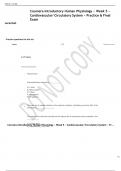
Coursera Introductory Human Physiology ~ Week 5 ~
Cardiovascular/ Circulatory System ~ Practice & Final
Exam
Jeremiah
Practice questions for this set
Learn 1 /7 Study with Learn
A ) P wave
Choose matching term
1 Practice Exam
Atrial depolarization occurs during ____________
A ) P wave
2 B ) QRS complex
C ) T Wave
D ) PR segment
E ) ST segment
The main site of variable resistance in the systemic circulation, contributing more than 60% of the
3
total resistance are _________________________
The region of the heart that normally has the highest rate of spontaneous action potentials is the
___________________
4 A ) Purkinje fibers
Coursera Introductory Human Physiology ~ Week 5 ~ Cardiovascular/ Circulatory System ~ Pr...
B ) Atrioventricular ( AV ) node
1/5
, 8/22/24, 1:25 AM
C ) Bundle of HIS
D ) Sinoatrial ( SA ) node
Don't know?
Terms in this set (32)
Practice Exam == 20 questions ==
Valves are found _________________________ in the heart and in the veins
The driving force of blood flow is a(n) pressure
__________ gradient
Vascular resistance is related to the E ) A, B, C, & D
_________________________
A ) length of the blood vessel
B ) diameter of a blood vessel
C ) nature of the blood vessel ( turbulent &
lamellar )
D ) viscosity of the blood
E ) A, B, C, & D
Each of the following changes will result in C ) decreased vessel diameter
increased blood flow to a tissue EXCEPT
__________________________
A ) increased blood pressure
B ) increased blood volume
C ) decreased vessel diameter
D ) decreased peripheral resistance
As blood vessel length increases D) resistance increases and flow decreases
__________________
A ) resistance increases
B ) flow decreases
C ) friction decreases
D ) A and B
E ) A, B and C
The steep repolarization of phase 3 of the K+
cardiac contractile cell's action potential is
due to which ion(s)?
Phase 2 (plateau) of the cardiac contractile Ca++ influx and K+ efflux
cell action potential is due to a combination
of____________________
The volume of blood ejected from each stroke volume
ventricle during a contraction is called the
____________________
Coursera Introductory Human Physiology ~ Week 5 ~ Cardiovascular/ Circulatory System ~ Pr...
2/5
Coursera Introductory Human Physiology ~ Week 5 ~
Cardiovascular/ Circulatory System ~ Practice & Final
Exam
Jeremiah
Practice questions for this set
Learn 1 /7 Study with Learn
A ) P wave
Choose matching term
1 Practice Exam
Atrial depolarization occurs during ____________
A ) P wave
2 B ) QRS complex
C ) T Wave
D ) PR segment
E ) ST segment
The main site of variable resistance in the systemic circulation, contributing more than 60% of the
3
total resistance are _________________________
The region of the heart that normally has the highest rate of spontaneous action potentials is the
___________________
4 A ) Purkinje fibers
Coursera Introductory Human Physiology ~ Week 5 ~ Cardiovascular/ Circulatory System ~ Pr...
B ) Atrioventricular ( AV ) node
1/5
, 8/22/24, 1:25 AM
C ) Bundle of HIS
D ) Sinoatrial ( SA ) node
Don't know?
Terms in this set (32)
Practice Exam == 20 questions ==
Valves are found _________________________ in the heart and in the veins
The driving force of blood flow is a(n) pressure
__________ gradient
Vascular resistance is related to the E ) A, B, C, & D
_________________________
A ) length of the blood vessel
B ) diameter of a blood vessel
C ) nature of the blood vessel ( turbulent &
lamellar )
D ) viscosity of the blood
E ) A, B, C, & D
Each of the following changes will result in C ) decreased vessel diameter
increased blood flow to a tissue EXCEPT
__________________________
A ) increased blood pressure
B ) increased blood volume
C ) decreased vessel diameter
D ) decreased peripheral resistance
As blood vessel length increases D) resistance increases and flow decreases
__________________
A ) resistance increases
B ) flow decreases
C ) friction decreases
D ) A and B
E ) A, B and C
The steep repolarization of phase 3 of the K+
cardiac contractile cell's action potential is
due to which ion(s)?
Phase 2 (plateau) of the cardiac contractile Ca++ influx and K+ efflux
cell action potential is due to a combination
of____________________
The volume of blood ejected from each stroke volume
ventricle during a contraction is called the
____________________
Coursera Introductory Human Physiology ~ Week 5 ~ Cardiovascular/ Circulatory System ~ Pr...
2/5