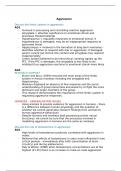
Aggression
Discuss the limbic system in aggression
AO1
- Involved in processing and controlling reactive aggression
- Amygdala = attaches significance to emotional stimuli and
processes threat/challenge
- Hypothalamus = regulates responses to emotional stimuli. If
hypothalamus is damaged, may be an inappropriate response to
perceived threat
- Hippocampus = involved in the formation of long-term memories –
identifies whether to respond with fear or aggression. If damaged,
person cannot put stimuli into context and amygdala may respond
inappropriately
- Limbic system believed to be hierarchical, sending signals up the
PFC. If the PFC is damaged, the amygdala is less likely to be
inhibited thus aggressive reactions to emotional stimuli more likely
AO3
RESEARCH SUPPORT
- Kluver and Bucy (1939) removed the main areas of the limbic
system in rhesus monkeys including the amygdala and
hippocampus.
- Monkeys displayed an absence of fear response and the social
understanding of group hierarchies and would try to fight the more
dominant and larger members of the group.
- This research demonstrates the importance of the limbic system in
regulating aggressive responses.
HOWEVER – GENERALISATION ISSUES
- Using animals to provide evidence for aggression in humans – there
is a difference between human physiology and the question of
whether we cannot generalise research findings from animals to
human aggressive behaviours
- Despite humans and monkeys both possessing similar neural
structures, we cannot be sure that the processes involved in
mediating aggression in humans are the same as monkeys
Discuss the role of testosterone in aggression
AO1
- High levels of testosterone positively correlated with aggression in
males.
- Believed that effects of testosterone in utero most influential in two
critical periods – immediately after birth (sensitisation of brain
circuitry) and during adolescence.
- Daly & Wilson (1998) when testosterone concentrations are at the
highest (21-35) there is an increase on male-on-male aggression.
, AO3
RESEARCH SUPPORT
- Wagner et al (1979) found experimental evidence that when male
mice were castrated, aggression levels dropped yet when they
subsequently received testosterone injections, aggression levels
rose again.
- Positive correlation between testosterone levels and aggression
supports role of testosterone
HOWEVER
- Later research has found that the timing of castration can have a
profound effect
- If they are castrated at birth, before testosterone has a chance to
change neural circuitry, being given testosterone injections later in
life will not result in increased aggression
- Therefore the sensation of neural circuitry early in life allows for the
effect of testosterone to manifest in adulthood
Discuss the role of serotonin in aggression
AO1
- High levels of serotonin = reduced aggression
- Serotonin is thought to inhibit aggressive responses to emotional
stimuli by reducing firing in orbital frontal cortex
- Damage to this mechanism will reduce the inhibitory effects of
serotonin resulting in increased impulsive behaviour and aggression
- Is an inhibitory neurotransmitter which has a calming effect and
reduces the amygdala
AO3
RESEARCH SUPPORT
- Raleigh et al (1991) - vervet monkeys fed experimental diets high in
tryptophan (increases serotonin) exhibited decreased aggression.
Those fed diet low in tryptophan displayed increased aggression.
- Tryptophan has also been used successfully in the past to treat
juvenile delinquents and unpredictable mental patients to reduce
their aggressive tendencies
HOWEVER
- Animal studies useful as shows cause and effect – helpful in
identifying contributing factors
- BUT extrapolation issues – humans much more complex brains,
social systems, social consequences to violence
Discuss the role of genes in aggression
AO1
- Brunner first identified MAOA as a candidate gene for aggression
after studying a Dutch family where all 29 males exhibited extreme
aggressive behaviour. Located it on the X chromosome.
- Clinical imaging work has demonstrated that people with the low-
activity form of the MAOA gene (L-MAOA) display greater reactivity
in the amygdala and lower activity in the regulatory prefrontal areas
Discuss the limbic system in aggression
AO1
- Involved in processing and controlling reactive aggression
- Amygdala = attaches significance to emotional stimuli and
processes threat/challenge
- Hypothalamus = regulates responses to emotional stimuli. If
hypothalamus is damaged, may be an inappropriate response to
perceived threat
- Hippocampus = involved in the formation of long-term memories –
identifies whether to respond with fear or aggression. If damaged,
person cannot put stimuli into context and amygdala may respond
inappropriately
- Limbic system believed to be hierarchical, sending signals up the
PFC. If the PFC is damaged, the amygdala is less likely to be
inhibited thus aggressive reactions to emotional stimuli more likely
AO3
RESEARCH SUPPORT
- Kluver and Bucy (1939) removed the main areas of the limbic
system in rhesus monkeys including the amygdala and
hippocampus.
- Monkeys displayed an absence of fear response and the social
understanding of group hierarchies and would try to fight the more
dominant and larger members of the group.
- This research demonstrates the importance of the limbic system in
regulating aggressive responses.
HOWEVER – GENERALISATION ISSUES
- Using animals to provide evidence for aggression in humans – there
is a difference between human physiology and the question of
whether we cannot generalise research findings from animals to
human aggressive behaviours
- Despite humans and monkeys both possessing similar neural
structures, we cannot be sure that the processes involved in
mediating aggression in humans are the same as monkeys
Discuss the role of testosterone in aggression
AO1
- High levels of testosterone positively correlated with aggression in
males.
- Believed that effects of testosterone in utero most influential in two
critical periods – immediately after birth (sensitisation of brain
circuitry) and during adolescence.
- Daly & Wilson (1998) when testosterone concentrations are at the
highest (21-35) there is an increase on male-on-male aggression.
, AO3
RESEARCH SUPPORT
- Wagner et al (1979) found experimental evidence that when male
mice were castrated, aggression levels dropped yet when they
subsequently received testosterone injections, aggression levels
rose again.
- Positive correlation between testosterone levels and aggression
supports role of testosterone
HOWEVER
- Later research has found that the timing of castration can have a
profound effect
- If they are castrated at birth, before testosterone has a chance to
change neural circuitry, being given testosterone injections later in
life will not result in increased aggression
- Therefore the sensation of neural circuitry early in life allows for the
effect of testosterone to manifest in adulthood
Discuss the role of serotonin in aggression
AO1
- High levels of serotonin = reduced aggression
- Serotonin is thought to inhibit aggressive responses to emotional
stimuli by reducing firing in orbital frontal cortex
- Damage to this mechanism will reduce the inhibitory effects of
serotonin resulting in increased impulsive behaviour and aggression
- Is an inhibitory neurotransmitter which has a calming effect and
reduces the amygdala
AO3
RESEARCH SUPPORT
- Raleigh et al (1991) - vervet monkeys fed experimental diets high in
tryptophan (increases serotonin) exhibited decreased aggression.
Those fed diet low in tryptophan displayed increased aggression.
- Tryptophan has also been used successfully in the past to treat
juvenile delinquents and unpredictable mental patients to reduce
their aggressive tendencies
HOWEVER
- Animal studies useful as shows cause and effect – helpful in
identifying contributing factors
- BUT extrapolation issues – humans much more complex brains,
social systems, social consequences to violence
Discuss the role of genes in aggression
AO1
- Brunner first identified MAOA as a candidate gene for aggression
after studying a Dutch family where all 29 males exhibited extreme
aggressive behaviour. Located it on the X chromosome.
- Clinical imaging work has demonstrated that people with the low-
activity form of the MAOA gene (L-MAOA) display greater reactivity
in the amygdala and lower activity in the regulatory prefrontal areas