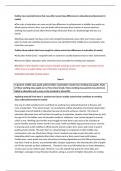
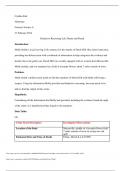
Outline two material factors that may affect social class differences in educational achievement (4
marks)
•The costs of education can cause social class differences in achievement as middle class pupils can
afford private school, tutors, exercise books which increase their chances of success whereas
working class pupils cannot afford these things which puts them at a disadvantage and acts as a
barrier.
•Working class pupils may have more overcrowded housing that means they won’t have a quiet
place to study and complete homework and so may fall behind their middle class counterparts who
have their own space.
Outline three policies that have sought to reduce social class differences in education (6 marks)
• Education Action Zones - targeted funds on schools in socially deprived areas to raise achievement.
•Grants for higher education make university more accessible for working class students.
•Abolition of the tripartite system meant all pupils would go to the same type of secondary school
rather than m/c pupils taking most of the place in grammar schools.
BURSARIES AND FREE SCHOOL MEALS
Item A
In general, middle class pupils achieve better examination results than working class pupils. Many
of those working class pupils are on free school meals. Many working class parents may also have
failed in education and so may not be involved in school life.
Applying material from Item A, analyse two factors outside schools that contribute to working
class underachievement (10 marks)
One way in which outside factors contribute to working class underachievement is finances and
costs of education. “Free school meals” are an indicator (within education) of economic deprivation,
these pupils may fall behind in education because of poverty acting as a barrier. The costs of
education determine how well and how far pupils go in education, despite school being free up until
the age of 18, the hidden costs of education (uniform, stationary, trips, books) equates to around
£1614 a year. Working class families may struggle to meet these costs and can be a burden on
poorer families as Emily Tanner found in her study. Smith and Noble argue poverty acts as a barrier
to learning such as the inability to afford private schools, tuition fees, tutors and resort to poorer
quality private schools. This puts them at a disadvantage in comparison to their middle class
counterparts, who can afford these things. Poorer students may take on part time jobs such as
babysitting which can negatively affect their school work as they cannot cope with balance.
Furthermore, many pupils may miss school due to feeling stigmatised and not fitting in because they
may have ‘hand me downs’ and unfashionable, cheaper equipment. Also showing why 20% of pupils
on FSM do not take up their entitlement. Therefore, they may fall behind due to lower attendance
on days such as non uniform days. However, it can be argued that grants for universities and
Oxbridge’s campaign to stop financial situations acting as a barrier to higher education are making
, education more inclusive and accessible for the working classes to increase their chances of
educational opportunities and success.
Another factor is “many working class parents may have also failed and are not involved in school
life”. Attitudes and values of students' parents in education are seen to play a huge role in how well
the child does. Douglas found that working class parents do not place a high value on education
compared to middle class parents. For example, they are less ambitious for their child’s career, show
less encouragement for educational achievement and take less of an interest in their child’s
education. They paid schools and teachers less visits than middle class parents. This links to Dunne
and Gazeley idea that what teachers believe about the role of students' home life leads them to
label pupils differently meaning working class pupils are entered for easier exams and middle class
pupils are given extension work as teachers believe they have parents support. Furthermore, cultural
theorists such as Sugarman believe that lack of parental interest is part of a working class subculture
of disregard for education which can explain working class underachievement as he says they are
fatalistic, believe in group loyalty, believe in immediate gratification and present time orientation.
Sugarman argues working class subcultures are fatalistic and believe there is nothing we can do to
change the course of life, which gives thor children the impression that educational achievement
cannot be achieved through hard work. They also believe in immediate gratification where they seek
pleasure now rather than making sacrifices for future gains, therefore they are more inclined to go
straight into a low wage for example, rather than going to university on no wage and a higher wage
later on. The idea is that working class children take on these ideas and consequently have lower
levels of educational achievement than their middle class counterparts who have delayed
gratification and do not let group loyalty hold them back. One criticism comes from Keddie who
argues cultural theorists victim blame the working classes. She says a child cannot be culturally
deprived of their own culture, and working class failure is because of a middle class dominated
unfair education system. 8⁸
Item B
There are clear social class differences in educational achievement. Some sociologists argue that
these are the result of factors outside schools. Some claim that working class parents place less
value on education and so their children see it as less important than do middle class pupils.
Differences in speech codes and in the level of the family’s material resources may also have an
important impact.
However, others suggest that what happens in school has a greater effect on social class
differences in achievement.
Applying material from Item B and your knowledge, evaluate the view that middle class pupils’
higher level of achievement are the product of factors outside schools (30 marks)
It is clear that there are class differences in education achievement. By the age of 3 children from
disadvantaged backgrounds are up to one year behind those from more privileged homes. 90% of
failing schools are in deprived areas and only 1 in 5 working class pupils go to university. Sociologists
argue whether it is external or internal to school factors that cause middle class students high levels
of educational achievement.
marks)
•The costs of education can cause social class differences in achievement as middle class pupils can
afford private school, tutors, exercise books which increase their chances of success whereas
working class pupils cannot afford these things which puts them at a disadvantage and acts as a
barrier.
•Working class pupils may have more overcrowded housing that means they won’t have a quiet
place to study and complete homework and so may fall behind their middle class counterparts who
have their own space.
Outline three policies that have sought to reduce social class differences in education (6 marks)
• Education Action Zones - targeted funds on schools in socially deprived areas to raise achievement.
•Grants for higher education make university more accessible for working class students.
•Abolition of the tripartite system meant all pupils would go to the same type of secondary school
rather than m/c pupils taking most of the place in grammar schools.
BURSARIES AND FREE SCHOOL MEALS
Item A
In general, middle class pupils achieve better examination results than working class pupils. Many
of those working class pupils are on free school meals. Many working class parents may also have
failed in education and so may not be involved in school life.
Applying material from Item A, analyse two factors outside schools that contribute to working
class underachievement (10 marks)
One way in which outside factors contribute to working class underachievement is finances and
costs of education. “Free school meals” are an indicator (within education) of economic deprivation,
these pupils may fall behind in education because of poverty acting as a barrier. The costs of
education determine how well and how far pupils go in education, despite school being free up until
the age of 18, the hidden costs of education (uniform, stationary, trips, books) equates to around
£1614 a year. Working class families may struggle to meet these costs and can be a burden on
poorer families as Emily Tanner found in her study. Smith and Noble argue poverty acts as a barrier
to learning such as the inability to afford private schools, tuition fees, tutors and resort to poorer
quality private schools. This puts them at a disadvantage in comparison to their middle class
counterparts, who can afford these things. Poorer students may take on part time jobs such as
babysitting which can negatively affect their school work as they cannot cope with balance.
Furthermore, many pupils may miss school due to feeling stigmatised and not fitting in because they
may have ‘hand me downs’ and unfashionable, cheaper equipment. Also showing why 20% of pupils
on FSM do not take up their entitlement. Therefore, they may fall behind due to lower attendance
on days such as non uniform days. However, it can be argued that grants for universities and
Oxbridge’s campaign to stop financial situations acting as a barrier to higher education are making
, education more inclusive and accessible for the working classes to increase their chances of
educational opportunities and success.
Another factor is “many working class parents may have also failed and are not involved in school
life”. Attitudes and values of students' parents in education are seen to play a huge role in how well
the child does. Douglas found that working class parents do not place a high value on education
compared to middle class parents. For example, they are less ambitious for their child’s career, show
less encouragement for educational achievement and take less of an interest in their child’s
education. They paid schools and teachers less visits than middle class parents. This links to Dunne
and Gazeley idea that what teachers believe about the role of students' home life leads them to
label pupils differently meaning working class pupils are entered for easier exams and middle class
pupils are given extension work as teachers believe they have parents support. Furthermore, cultural
theorists such as Sugarman believe that lack of parental interest is part of a working class subculture
of disregard for education which can explain working class underachievement as he says they are
fatalistic, believe in group loyalty, believe in immediate gratification and present time orientation.
Sugarman argues working class subcultures are fatalistic and believe there is nothing we can do to
change the course of life, which gives thor children the impression that educational achievement
cannot be achieved through hard work. They also believe in immediate gratification where they seek
pleasure now rather than making sacrifices for future gains, therefore they are more inclined to go
straight into a low wage for example, rather than going to university on no wage and a higher wage
later on. The idea is that working class children take on these ideas and consequently have lower
levels of educational achievement than their middle class counterparts who have delayed
gratification and do not let group loyalty hold them back. One criticism comes from Keddie who
argues cultural theorists victim blame the working classes. She says a child cannot be culturally
deprived of their own culture, and working class failure is because of a middle class dominated
unfair education system. 8⁸
Item B
There are clear social class differences in educational achievement. Some sociologists argue that
these are the result of factors outside schools. Some claim that working class parents place less
value on education and so their children see it as less important than do middle class pupils.
Differences in speech codes and in the level of the family’s material resources may also have an
important impact.
However, others suggest that what happens in school has a greater effect on social class
differences in achievement.
Applying material from Item B and your knowledge, evaluate the view that middle class pupils’
higher level of achievement are the product of factors outside schools (30 marks)
It is clear that there are class differences in education achievement. By the age of 3 children from
disadvantaged backgrounds are up to one year behind those from more privileged homes. 90% of
failing schools are in deprived areas and only 1 in 5 working class pupils go to university. Sociologists
argue whether it is external or internal to school factors that cause middle class students high levels
of educational achievement.