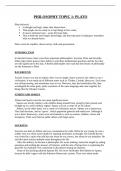
PHILOSOPHY TOPIC 1: PLATO
Plato believed…
in thought and logic rather than observation.
That people are too ready to accept things at face value.
In man’s immortal soul – wrote the book fado.
That at birth the soul forgets knowledge, and that education is helping to remember
what we already know.
Plato wrote the republic, about society, truth and government.
INTRODUCTION
In Ancient Greece, there were three important philosophers: Socrates, Plato and Aristotle.
What makes them great is their ability to articulate fundamental questions and the fact they
are still significant to this day. A British philosopher once said that the history of philosophy
are the footnotes to Plato.
BACKROUND
Ancient Greece was not an empire, there was no single centre of power, but rather it was a
civilisation. It was made up of different states such as: Thebes, Corinth, Ithaca etc. Each state
was self-governing, and sometimes were at war. However, they had similarities like, they
worshipped the same gods, spoke variations of the same language and came together for
things like the Olympic Games.
ATHENS AND SPARTA
Athens and Sparta were the two most significant states.
Sparta was strictly military with children being trained from young by their parents and
brought up in a strict military regime. Sparta was not a centre of art of culture.
Athens, on the other hand, was a centre of civilisation and art. Athens was a democracy.
They had elections, and an ‘agora’, which appointed generals and made laws. Although it
was a direct democracy, some were not listened to, such as women, children, slaves and
foreigners. Trials were held as public affairs with large juries.
SOCRATES
Socrates was born in Athens and was a stonemason by trade. When he was young, he was a
soldier who was often struck dumb for standing motionless in thought. He claimed that he
was visited by a spirit who told him not when he was correct, but when he was mistaken. He
said this spirit returns multiple times throughout his life.
After the military, he became a philosopher. He wrote nothing, instead he taught by asking
questions and probing the answers of listeners, with the aim of being clear in explaining the
good life for mankind. This could lead to discomfort among his listeners.
Some of his teaching admired Spartan life. His lover Alcibiades fled Athens for Sparta,
because he didn’t agree with the Athenian Democratic system. They were taken under
, because of their seeming provocation of law and order. Socrates was accused and put on trial
for ‘mocking the Gods and corrupting the morals oof young men. The accused was expected
to defend themselves by consulting a sophist or an orator. Socrates didn’t. His defence
seemed provocative in tone, and it was thought he sought his own death. He was convicted
and sentenced the death by dinking hemlock. He refused any schemes to preserve his life.
After his death, his followers honoured him by writing down his teachings, one of those
followers being Plato.
PLATO
Plato was a philosophical a literacy genius. He continues Socrates legacy in two ways:
1. Founding The Academy (385BC) – modern day university, this is where philosophical
teaching would continue.
2. Wrote a series of dialogues, capturing and expanding on the thought of Socrates. The
dialogues dramatized the ideas, thought they were used for teaching. In most
dialogues, Socrates was the main speaker. The Republic, Plato’s most famous of the
dialogues, Socrates was the narrator. It is important to remember that the Socrates of
the dialogues is not the same as the Socrates from history, Plato just used Socrates as
a mouthpiece for his ideas.
PYTHAGORUS
Pythagorus influenced Plato. Pythagoreans were fascinated by maths and had a kind of notion
of atomic theory like elements being numbers. They thought objects were made up of twos,
threes, etc. Together, they were fascinated by ratios and how one thing was in proportion to
another. Pythagoreans had a sharp distinction between the material of the body and the
spiritual soul. All these points emerge in Plato’s theory of the form. Aristotle’s Metaphysics
talks about the close affinity between Plato and the Pythagoreans.
HERACLITUS
Plato was very aware of the thought of Heraclitus. Heraclitus was fascinated by the endless
change we find in things. He said, “No man can step in the same river twice” (this is not
found directly in the surviving works). Plato explained this by saying that “Everything
changes, and nothing stays still”. Plato didn’t agree with Heraclitus as he believed that some
things had to be certain to have certain knowledge. Plato seeks to relate everything to the
nature of good life, the soul, nature of purpose and reality. Plato seeks a certain basis for all
our knowledge of reality. He believes that because we live in a world of change and
uncertainty, there must be an alternative unchanging spiritual world where certainty can be
found.
Plato believed…
in thought and logic rather than observation.
That people are too ready to accept things at face value.
In man’s immortal soul – wrote the book fado.
That at birth the soul forgets knowledge, and that education is helping to remember
what we already know.
Plato wrote the republic, about society, truth and government.
INTRODUCTION
In Ancient Greece, there were three important philosophers: Socrates, Plato and Aristotle.
What makes them great is their ability to articulate fundamental questions and the fact they
are still significant to this day. A British philosopher once said that the history of philosophy
are the footnotes to Plato.
BACKROUND
Ancient Greece was not an empire, there was no single centre of power, but rather it was a
civilisation. It was made up of different states such as: Thebes, Corinth, Ithaca etc. Each state
was self-governing, and sometimes were at war. However, they had similarities like, they
worshipped the same gods, spoke variations of the same language and came together for
things like the Olympic Games.
ATHENS AND SPARTA
Athens and Sparta were the two most significant states.
Sparta was strictly military with children being trained from young by their parents and
brought up in a strict military regime. Sparta was not a centre of art of culture.
Athens, on the other hand, was a centre of civilisation and art. Athens was a democracy.
They had elections, and an ‘agora’, which appointed generals and made laws. Although it
was a direct democracy, some were not listened to, such as women, children, slaves and
foreigners. Trials were held as public affairs with large juries.
SOCRATES
Socrates was born in Athens and was a stonemason by trade. When he was young, he was a
soldier who was often struck dumb for standing motionless in thought. He claimed that he
was visited by a spirit who told him not when he was correct, but when he was mistaken. He
said this spirit returns multiple times throughout his life.
After the military, he became a philosopher. He wrote nothing, instead he taught by asking
questions and probing the answers of listeners, with the aim of being clear in explaining the
good life for mankind. This could lead to discomfort among his listeners.
Some of his teaching admired Spartan life. His lover Alcibiades fled Athens for Sparta,
because he didn’t agree with the Athenian Democratic system. They were taken under
, because of their seeming provocation of law and order. Socrates was accused and put on trial
for ‘mocking the Gods and corrupting the morals oof young men. The accused was expected
to defend themselves by consulting a sophist or an orator. Socrates didn’t. His defence
seemed provocative in tone, and it was thought he sought his own death. He was convicted
and sentenced the death by dinking hemlock. He refused any schemes to preserve his life.
After his death, his followers honoured him by writing down his teachings, one of those
followers being Plato.
PLATO
Plato was a philosophical a literacy genius. He continues Socrates legacy in two ways:
1. Founding The Academy (385BC) – modern day university, this is where philosophical
teaching would continue.
2. Wrote a series of dialogues, capturing and expanding on the thought of Socrates. The
dialogues dramatized the ideas, thought they were used for teaching. In most
dialogues, Socrates was the main speaker. The Republic, Plato’s most famous of the
dialogues, Socrates was the narrator. It is important to remember that the Socrates of
the dialogues is not the same as the Socrates from history, Plato just used Socrates as
a mouthpiece for his ideas.
PYTHAGORUS
Pythagorus influenced Plato. Pythagoreans were fascinated by maths and had a kind of notion
of atomic theory like elements being numbers. They thought objects were made up of twos,
threes, etc. Together, they were fascinated by ratios and how one thing was in proportion to
another. Pythagoreans had a sharp distinction between the material of the body and the
spiritual soul. All these points emerge in Plato’s theory of the form. Aristotle’s Metaphysics
talks about the close affinity between Plato and the Pythagoreans.
HERACLITUS
Plato was very aware of the thought of Heraclitus. Heraclitus was fascinated by the endless
change we find in things. He said, “No man can step in the same river twice” (this is not
found directly in the surviving works). Plato explained this by saying that “Everything
changes, and nothing stays still”. Plato didn’t agree with Heraclitus as he believed that some
things had to be certain to have certain knowledge. Plato seeks to relate everything to the
nature of good life, the soul, nature of purpose and reality. Plato seeks a certain basis for all
our knowledge of reality. He believes that because we live in a world of change and
uncertainty, there must be an alternative unchanging spiritual world where certainty can be
found.