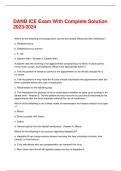
CEN Practice Revision Guide with Complete
Rationale
Emergency Medical Service has brought a 24-year-
old man to the ED with gunshot wounds to his
abdomen and left groin area. His blood pressure is
84/52 and heart rate is 120 per minute. His skin is
diaphoretic, cool, and pale. The treatment the nurse
should prepare for is:
a. Chest compressions
b. Endotracheal intubation
c. Administration of verapamil
d. Rapid administration of a crystalloid solution
✔️✔️d. Rapid administration of a crystalloid
solution
The gunshot wounds and symptoms would indicate
that the young man has lost a significant amount of
blood that has resulted in hypovolemia. The
,treatment of hypovolemia is a rapid infusion of a
crystalloid intravenous solution.
You are on the ED team caring for a 10-year-old
child with a normal systolic blood pressure,
increased heart rate, slightly delayed capillary refill
and cool, pale skin. What severity of shock is the
child likely in?
a. Decompensated shock
b. Hypotensive shock
c. Compensated shock
d. None of the above ✔️✔️c. Compensated shock
Severity of shock is often characterized by its effect
on the systolic blood pressure. When the
compensatory mechanisms work and maintain the
systolic blood pressure, the shock is defined as
"compensated". When the mechanisms can no
longer support the blood pressure, shock is
,classified as "hypotensive" (formally called
"decompensated").
You are caring for a patient in cardiogenic shock.
You know that a probable cause of this condition is:
a. Dehydration
b. Spinal cord injury
c. Congestive heart failure
d. Infection ✔️✔️c. Congestive heart failure
Congestive heart failure is a common cause of
cardiogenic shock. Acute myocardial infarction and
other heart conditions can also cause cardiogenic
shock. Dehydration can be a cause of hypovolemic
shock. Spinal cord injury can cause neurogenic
shock. Infection can cause septic shock.
You are caring for a 10-year-old child with normal
blood pressure, increased heart rate, and cool pale
, skin. The child is reported to have had vomitting
and diarrhea the past two days. As you perform
your primary assessment, you note that respirations
are clear and not labored. What is the probable first
intervention for this child?
a. Give 20 ml/kg bolus of saline or lactated Ringer's
b. Start an Epinephrine infusion at 0.1mg/kg
c. Give Epinephrine bolus of 0.01 mg/kg
d. Give Amiodarone 5 mg/kg IV over 60 minutes
✔️✔️a. Give 20 ml/kg bolus of saline or lactated
Ringer's
By all indications, the child is in hypovolemic shock
and the first interventions should be a fluid bolus at
20 ml/kg of saline or lactated Ringer's solution.
You assume care for the patient in the ED. During
the time she has been in the ED, she has
consistently complained of photophobia, a stiff
neck, increasing confusion, and nausea. Her history
Rationale
Emergency Medical Service has brought a 24-year-
old man to the ED with gunshot wounds to his
abdomen and left groin area. His blood pressure is
84/52 and heart rate is 120 per minute. His skin is
diaphoretic, cool, and pale. The treatment the nurse
should prepare for is:
a. Chest compressions
b. Endotracheal intubation
c. Administration of verapamil
d. Rapid administration of a crystalloid solution
✔️✔️d. Rapid administration of a crystalloid
solution
The gunshot wounds and symptoms would indicate
that the young man has lost a significant amount of
blood that has resulted in hypovolemia. The
,treatment of hypovolemia is a rapid infusion of a
crystalloid intravenous solution.
You are on the ED team caring for a 10-year-old
child with a normal systolic blood pressure,
increased heart rate, slightly delayed capillary refill
and cool, pale skin. What severity of shock is the
child likely in?
a. Decompensated shock
b. Hypotensive shock
c. Compensated shock
d. None of the above ✔️✔️c. Compensated shock
Severity of shock is often characterized by its effect
on the systolic blood pressure. When the
compensatory mechanisms work and maintain the
systolic blood pressure, the shock is defined as
"compensated". When the mechanisms can no
longer support the blood pressure, shock is
,classified as "hypotensive" (formally called
"decompensated").
You are caring for a patient in cardiogenic shock.
You know that a probable cause of this condition is:
a. Dehydration
b. Spinal cord injury
c. Congestive heart failure
d. Infection ✔️✔️c. Congestive heart failure
Congestive heart failure is a common cause of
cardiogenic shock. Acute myocardial infarction and
other heart conditions can also cause cardiogenic
shock. Dehydration can be a cause of hypovolemic
shock. Spinal cord injury can cause neurogenic
shock. Infection can cause septic shock.
You are caring for a 10-year-old child with normal
blood pressure, increased heart rate, and cool pale
, skin. The child is reported to have had vomitting
and diarrhea the past two days. As you perform
your primary assessment, you note that respirations
are clear and not labored. What is the probable first
intervention for this child?
a. Give 20 ml/kg bolus of saline or lactated Ringer's
b. Start an Epinephrine infusion at 0.1mg/kg
c. Give Epinephrine bolus of 0.01 mg/kg
d. Give Amiodarone 5 mg/kg IV over 60 minutes
✔️✔️a. Give 20 ml/kg bolus of saline or lactated
Ringer's
By all indications, the child is in hypovolemic shock
and the first interventions should be a fluid bolus at
20 ml/kg of saline or lactated Ringer's solution.
You assume care for the patient in the ED. During
the time she has been in the ED, she has
consistently complained of photophobia, a stiff
neck, increasing confusion, and nausea. Her history