Wk6: Diffraction Abbreviations:
Saturday, November 7, 2020 1:35 PM b/w = between
w/ = with
INC = increase
• The wave nature of light (diffraction) poses a limit to the resolution that can be DEC = decrease
achieved.
○ Features of an object that are significantly smaller than the wavelength of light Central maxima; labeled n=0.
n=-1
n=-2
cannot be resolved.
○ Electron microscopes circumvent this limit. 100eV= 1.6*10^-17J
• Diffraction: bending of waves around sharp edges.
Dark spots are wavelengths that cancel each other out.
○ Occurs when waves strike objects w/ dimensions comparable to their wavelength.
○ Superposition (sum): sum of all parts of the waves that pass thru the opening.
○ Diffraction pattern: distribution of constructive waves and destructive waves;
depends on the wavelength of the waves and size/shape of the obstacle.
• Diffraction grating: consists of a single slit or many adjacent slits; laser strikes and
allows light waves to come through. Glass w/ holes in line pattern.
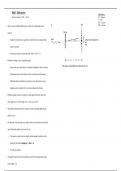
• The diffraction pattern produced by a grating is a series of alternating light and dark
spots (Fig. 6.1a).
• On either side of the central spot, at an angle θ1 from the incident direction, are the first
spots, followed by another pair of spots at θ2, etc.
○ The angles are related to the wavelength λ and the spacing between lines in the
grating d by the relation dsin𝜃𝑛=𝑛𝜆. -> dtheta = nλ
○ d: width of a single slit.
• The angle θ between the center of the bright spot and the first minimum (dark spot) is
given by sin𝜃 = 𝜆/𝑑.
Saturday, November 7, 2020 1:35 PM b/w = between
w/ = with
INC = increase
• The wave nature of light (diffraction) poses a limit to the resolution that can be DEC = decrease
achieved.
○ Features of an object that are significantly smaller than the wavelength of light Central maxima; labeled n=0.
n=-1
n=-2
cannot be resolved.
○ Electron microscopes circumvent this limit. 100eV= 1.6*10^-17J
• Diffraction: bending of waves around sharp edges.
Dark spots are wavelengths that cancel each other out.
○ Occurs when waves strike objects w/ dimensions comparable to their wavelength.
○ Superposition (sum): sum of all parts of the waves that pass thru the opening.
○ Diffraction pattern: distribution of constructive waves and destructive waves;
depends on the wavelength of the waves and size/shape of the obstacle.
• Diffraction grating: consists of a single slit or many adjacent slits; laser strikes and
allows light waves to come through. Glass w/ holes in line pattern.
• The diffraction pattern produced by a grating is a series of alternating light and dark
spots (Fig. 6.1a).
• On either side of the central spot, at an angle θ1 from the incident direction, are the first
spots, followed by another pair of spots at θ2, etc.
○ The angles are related to the wavelength λ and the spacing between lines in the
grating d by the relation dsin𝜃𝑛=𝑛𝜆. -> dtheta = nλ
○ d: width of a single slit.
• The angle θ between the center of the bright spot and the first minimum (dark spot) is
given by sin𝜃 = 𝜆/𝑑.