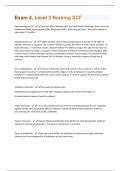
Exam 3 Level 3 Nursing SCF
Autism Spectrum Disorder (ASD) Definition - Complex neurodevelopmental disorder affecting the
ability to communicate A broad disorder can have mild to severe, characterized by w withdrawal into self
and their own world, accompanied by intellectual & social defects. Occurs more often in boys than girls.
Onset occurs in early childhood. Often runs into a chronic course. Predisposing Factors communication
trouble with not picking up on non-verbal ques, crossing arms, frown, not understanding. Can't point at
an object they want, can't talk to people, repeat echolalia-parrot words, scripted speeches use dialogue
from movies, tactile sensory system misfiring, Hypo or hyper sensitive. Regress in skills that they learned:
verbal to non-verbal.
How a chest drainage system works - -Inserted in between the visceral & parietal pleura "pleural
space" or Mediastinal space, Restores negative pressure so the lung can expand properly
-Expiratory positive pressure from the patient helps push air and fluid out of the chest (cough, Valsalva)
-Gravity helps fluid drainage as long as the chest drainage system is below the level of the chest
-Suction can improve the speed at which air and fluid are pulled from the chest
Pneumothorax (PTX) - excess air in the chest cavity, it takes up space so the lungs cannot expand
Hemothorax - blood in the chest cavity (which takes up space so lung cannot expand causing a
collapsed lung
Empyema - pus in a body cavity, especially the pleural cavity
Collection Chamber - Closed Chest Drainage: Fluid drains into the chest tube thru a connecting
tube & then into a collection chamber
Water-Seal Chamber - Closed drainage: Acts as a one way valve so air can drain from the chest
activity but can't return to the patient; suction.
,Tidaling - Normal Finding: Fluctuations in the water seal chamber fluid level that correspond
w/respirations, only with tall water column, adjusts w/Patient's respirations, Stops if lung is fully re-
expanded or system obstructed. Note: w/chest tube, water should rise with inspiration & fall with
expiration but visa versa if on a ventilator
Bubbling In Water Seal Chamber - In the bottom of the water seal chamber indicates an air leak
(caused most often by poor tubing connections, Air leaks: could be patient chest tube insertion site,
loose connection, Check if patient is in distress
Control Regulator - water filled or dry suction removes chest drainage & maintains flow
Pleural Space - Normally has about 20 mL of fluid for lubrication, & -20 cm of negative pressure
Traditional Water Seal a/k/a Wet Suction - It has 3 chambers; a collection chamber, water seal
chamber, & a wet suction control chamber, requires sterile fluid instilled into water seal & suction
chambers. It has positive & negative pressure release valves, you will have intermittent bubbling this
indicates proper functioning. Additional suctioning can be added by connecting to a suction source
Dry Suction Water Seal - Common in hospitals, 3 chambers, a collection chamber, water seal
chamber (middle chamber) & suction regulator dial. Requires sterile fluid instilled in water seal chamber
at 2-cm level, no fluid filled suction chamber. Suction pressure is set w/an orange regulator dial. Has
Positive & Negative pressure release valves, Has an indicator to signify that the suction pressure is
adequate, Quieter than traditional water seal systems
Dry Suction Also referred to as a one-way valve system - Has a one way mechanical valve that
allows air to leave the chest & prevents air from moving back into the chest wall. No need to fill suction
chamber w/fluid, thus can be set up quickly in an emergency, draining air from thoracic cavity. Not good
for fluid drainage (hemothorax). Works even if knocked over, making it ideal for ambulatory pt's.
Negative Pressure - In the water seal column indicates negative pressure in the pleural space, the
goal of chest tube therapy. The whole reason a pt has a chest cavity is to Restore negative pressure, so pt
can breathe
Chest Tube Assessment - Vital Signs, Pulse Ox, Lung sounds for good expansion, assess for air leak,
assess tubing & connections, assess for tidaling, chest tube insertion site & you want to know what # is
,on the tube at the insertion site, dressing, fluid levels in water seal chamber, Atrium Box below level of
chest, Monitor output, color, amt of drainage, mark box w/amount of drainage, assess for pain, check for
subcutaneous emphysema-feels like Rice Krispies air under the skin, Adults drainage s/b about 70 mL/hr.
if more than 100 mL/hr. Children: >5mL/1 hr. or >3 mL/3 hrs. If order states drain w/gravity no suction
will be applied. Unclamp port on the top of the device. Encourage pt to cough, deep breathe, this aides
in lung expansion & facilitates drainage
The mnemonic DOPE is used for - The water seal chamber on the chest tube system has a
constant bubbling not associated with respirations this could be a sign of a pneumothorax or other
problems: Dislodgement, Obstruction, Pneumothorax, & Equipment Failure. A normal air leak will
coincide with the patient's exhale or w/a good cough
Chest Tube Emergency Supplies to have in room w/Pt at all times - 2 clamps w/out teeth for each
chest tube placed, Vaseline gauze or 4x4's & tape per facility, Sterile water, suture removal kit.
Continuous Bubbling on Chest Tube - Cross Clamp to locate source of air leak, start at insertion
site clam right next to patient, if bubbling then the leak is at insertion site. If not continue until the
bubbling stops. Do not leave clamped can cause tension Pneumothorax less than one minute max. Do
not strip or milk tubing, can increase negative pressure & damage lungs, if drainage unit cracked replace
unit
Chest Tube Emergencies - Chest tube & drainage system disconnected. This means the water seal
is broken & atmospheric air is rushing into chest causing the lung to collapse. Have Sterile water handy
put open end of chest tube into the bottle of sterile water ASAP to resume water seal. If chest tube
comes dislodged from the patient apply sterile dressing 4x4 or Vaseline gauze and tape on 3 sides.
Elevate HOB apply O2. Call rapid response. Chest x-ray, prepare to have another chest tube installed. Pre-
medicate for pain
Steps to screen for Critical Congenital Heart Defects CCHD - Should begin after 24 h. of age this
will decrease false positives. The screening should occur in R. Hand and either foot. If using only one
pulse oximeter, test one right after the other. The infant passes if saturation is 95% or greater in R hand
or foot & the difference is 3% or less between the R. hand & foot. Automatic fail if O2 sats. is less 90% in
the R. Hand and Foot. If greater than 90% but less than 95% in R. Hand & foot or there is more than 3%
diff. between R hand & foot then repeat screen in 1 h. After 3rd exam 90% to less than 95% in either R.
Hand & foot or more than 3% diff. will be considered to have failed.
Pass="negative"
Failed="Positive"
, Tests that will be done following a "Positive"=Failed Critical Congenital Heart Defects CCHD Test -
Cardiology, Echo, Chest Xray and EKG done
Right Hand is - Pre-ductal
Foot are - Post-ductal
Possible Physical Symptoms of Critical Congenital Heart Defects CCHD - Problems breathing,
pounding heart, weak pulse, very pale or blue skin color, poor feeding, very sleepy, Murmur, Thrill,
Edema, Exertional dyspnea, cough, Tachycardia, Tachypnea, Weight loss, Diaphoretic, cyanosis-central or
circumoral-acrocyanosis does not count, abnormal O2 sat. Diminished pulses, squatting, pallor, BP
7 Defects Pulse Oximetry Screening is most likely to detect in the Critical Congenital Heart Defects CCHD
Test - hypoplastic left heart syndrome, pulmonary atresia, tetralogy of Fallot, Total Anomalous
Pulmonary Venous Return, Transposition of the Great Arteries, Tricuspid Atresia, & Truncus Arteriosus.
When does the heart form in vitro - 8 weeks heart is already complete. 6 wks. all 4 chambers.
Meds, illness, heredity all affect heart development often before Mom knows she is pregnant
Foramen Ovale - Hole between left & right atrium, should close at birth
Ductus Arteriosus - this bypasses lungs & goes directly into the aorta (60% of blood takes this
route)
Fluid Dynamic Issues - remember blood will want to follow path of least resistance, (high to low
pressure)
Grading of Heart Murmurs - The scale is between Grade 1 & Grade 6, with 6 being the worst,
Grade 5 & 6 you can hear & feel turbulence.
Autism Spectrum Disorder (ASD) Definition - Complex neurodevelopmental disorder affecting the
ability to communicate A broad disorder can have mild to severe, characterized by w withdrawal into self
and their own world, accompanied by intellectual & social defects. Occurs more often in boys than girls.
Onset occurs in early childhood. Often runs into a chronic course. Predisposing Factors communication
trouble with not picking up on non-verbal ques, crossing arms, frown, not understanding. Can't point at
an object they want, can't talk to people, repeat echolalia-parrot words, scripted speeches use dialogue
from movies, tactile sensory system misfiring, Hypo or hyper sensitive. Regress in skills that they learned:
verbal to non-verbal.
How a chest drainage system works - -Inserted in between the visceral & parietal pleura "pleural
space" or Mediastinal space, Restores negative pressure so the lung can expand properly
-Expiratory positive pressure from the patient helps push air and fluid out of the chest (cough, Valsalva)
-Gravity helps fluid drainage as long as the chest drainage system is below the level of the chest
-Suction can improve the speed at which air and fluid are pulled from the chest
Pneumothorax (PTX) - excess air in the chest cavity, it takes up space so the lungs cannot expand
Hemothorax - blood in the chest cavity (which takes up space so lung cannot expand causing a
collapsed lung
Empyema - pus in a body cavity, especially the pleural cavity
Collection Chamber - Closed Chest Drainage: Fluid drains into the chest tube thru a connecting
tube & then into a collection chamber
Water-Seal Chamber - Closed drainage: Acts as a one way valve so air can drain from the chest
activity but can't return to the patient; suction.
,Tidaling - Normal Finding: Fluctuations in the water seal chamber fluid level that correspond
w/respirations, only with tall water column, adjusts w/Patient's respirations, Stops if lung is fully re-
expanded or system obstructed. Note: w/chest tube, water should rise with inspiration & fall with
expiration but visa versa if on a ventilator
Bubbling In Water Seal Chamber - In the bottom of the water seal chamber indicates an air leak
(caused most often by poor tubing connections, Air leaks: could be patient chest tube insertion site,
loose connection, Check if patient is in distress
Control Regulator - water filled or dry suction removes chest drainage & maintains flow
Pleural Space - Normally has about 20 mL of fluid for lubrication, & -20 cm of negative pressure
Traditional Water Seal a/k/a Wet Suction - It has 3 chambers; a collection chamber, water seal
chamber, & a wet suction control chamber, requires sterile fluid instilled into water seal & suction
chambers. It has positive & negative pressure release valves, you will have intermittent bubbling this
indicates proper functioning. Additional suctioning can be added by connecting to a suction source
Dry Suction Water Seal - Common in hospitals, 3 chambers, a collection chamber, water seal
chamber (middle chamber) & suction regulator dial. Requires sterile fluid instilled in water seal chamber
at 2-cm level, no fluid filled suction chamber. Suction pressure is set w/an orange regulator dial. Has
Positive & Negative pressure release valves, Has an indicator to signify that the suction pressure is
adequate, Quieter than traditional water seal systems
Dry Suction Also referred to as a one-way valve system - Has a one way mechanical valve that
allows air to leave the chest & prevents air from moving back into the chest wall. No need to fill suction
chamber w/fluid, thus can be set up quickly in an emergency, draining air from thoracic cavity. Not good
for fluid drainage (hemothorax). Works even if knocked over, making it ideal for ambulatory pt's.
Negative Pressure - In the water seal column indicates negative pressure in the pleural space, the
goal of chest tube therapy. The whole reason a pt has a chest cavity is to Restore negative pressure, so pt
can breathe
Chest Tube Assessment - Vital Signs, Pulse Ox, Lung sounds for good expansion, assess for air leak,
assess tubing & connections, assess for tidaling, chest tube insertion site & you want to know what # is
,on the tube at the insertion site, dressing, fluid levels in water seal chamber, Atrium Box below level of
chest, Monitor output, color, amt of drainage, mark box w/amount of drainage, assess for pain, check for
subcutaneous emphysema-feels like Rice Krispies air under the skin, Adults drainage s/b about 70 mL/hr.
if more than 100 mL/hr. Children: >5mL/1 hr. or >3 mL/3 hrs. If order states drain w/gravity no suction
will be applied. Unclamp port on the top of the device. Encourage pt to cough, deep breathe, this aides
in lung expansion & facilitates drainage
The mnemonic DOPE is used for - The water seal chamber on the chest tube system has a
constant bubbling not associated with respirations this could be a sign of a pneumothorax or other
problems: Dislodgement, Obstruction, Pneumothorax, & Equipment Failure. A normal air leak will
coincide with the patient's exhale or w/a good cough
Chest Tube Emergency Supplies to have in room w/Pt at all times - 2 clamps w/out teeth for each
chest tube placed, Vaseline gauze or 4x4's & tape per facility, Sterile water, suture removal kit.
Continuous Bubbling on Chest Tube - Cross Clamp to locate source of air leak, start at insertion
site clam right next to patient, if bubbling then the leak is at insertion site. If not continue until the
bubbling stops. Do not leave clamped can cause tension Pneumothorax less than one minute max. Do
not strip or milk tubing, can increase negative pressure & damage lungs, if drainage unit cracked replace
unit
Chest Tube Emergencies - Chest tube & drainage system disconnected. This means the water seal
is broken & atmospheric air is rushing into chest causing the lung to collapse. Have Sterile water handy
put open end of chest tube into the bottle of sterile water ASAP to resume water seal. If chest tube
comes dislodged from the patient apply sterile dressing 4x4 or Vaseline gauze and tape on 3 sides.
Elevate HOB apply O2. Call rapid response. Chest x-ray, prepare to have another chest tube installed. Pre-
medicate for pain
Steps to screen for Critical Congenital Heart Defects CCHD - Should begin after 24 h. of age this
will decrease false positives. The screening should occur in R. Hand and either foot. If using only one
pulse oximeter, test one right after the other. The infant passes if saturation is 95% or greater in R hand
or foot & the difference is 3% or less between the R. hand & foot. Automatic fail if O2 sats. is less 90% in
the R. Hand and Foot. If greater than 90% but less than 95% in R. Hand & foot or there is more than 3%
diff. between R hand & foot then repeat screen in 1 h. After 3rd exam 90% to less than 95% in either R.
Hand & foot or more than 3% diff. will be considered to have failed.
Pass="negative"
Failed="Positive"
, Tests that will be done following a "Positive"=Failed Critical Congenital Heart Defects CCHD Test -
Cardiology, Echo, Chest Xray and EKG done
Right Hand is - Pre-ductal
Foot are - Post-ductal
Possible Physical Symptoms of Critical Congenital Heart Defects CCHD - Problems breathing,
pounding heart, weak pulse, very pale or blue skin color, poor feeding, very sleepy, Murmur, Thrill,
Edema, Exertional dyspnea, cough, Tachycardia, Tachypnea, Weight loss, Diaphoretic, cyanosis-central or
circumoral-acrocyanosis does not count, abnormal O2 sat. Diminished pulses, squatting, pallor, BP
7 Defects Pulse Oximetry Screening is most likely to detect in the Critical Congenital Heart Defects CCHD
Test - hypoplastic left heart syndrome, pulmonary atresia, tetralogy of Fallot, Total Anomalous
Pulmonary Venous Return, Transposition of the Great Arteries, Tricuspid Atresia, & Truncus Arteriosus.
When does the heart form in vitro - 8 weeks heart is already complete. 6 wks. all 4 chambers.
Meds, illness, heredity all affect heart development often before Mom knows she is pregnant
Foramen Ovale - Hole between left & right atrium, should close at birth
Ductus Arteriosus - this bypasses lungs & goes directly into the aorta (60% of blood takes this
route)
Fluid Dynamic Issues - remember blood will want to follow path of least resistance, (high to low
pressure)
Grading of Heart Murmurs - The scale is between Grade 1 & Grade 6, with 6 being the worst,
Grade 5 & 6 you can hear & feel turbulence.