HRM2602
HUMAN RESOURCE MAINTENANCE & RETENTION
MAY/JUN 2017
Section A
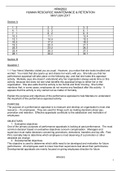
1. 2 2. 2 3. 2
4. 1 5. 3 6. 1
7. 1 8. 2 9. 3
10. 3 11. 1 12. 4
13. 1 14. 4 15. 3
16. 2 17. 2 18. 2
19. 2 20. 4 21. 3
22. 3 23. 2 24. 2
25. 4 26. 3 27. 3
28. 1 29. 2 30. 1
Section B
Question 1
1.1 Your friend, Manteku visited you as usual. However, you notice that she looks troubled and
worried. You insist that she opens up and shares her worry with you. She tells you that her
performance appraisal will take place on the following day, and that she hates this appraisal
activity. Manteku says she doesn’t understand why her organisation always waste time on this
activity, because she does not see what benefits this appraisal brings to either her or the
organisation. She also adds that this activity is too formal and finds it boring. She further
mentions that, in some cases, employees do not receive any feedback after this activity. It
appears that this activity is only carried out as matter of formality.
Explain the purpose and objectives of the performance appraisal to help Manteku to understand
the important of the performance appraisal activity.
PURPOSE
The purpose of a performance appraisal is to measure and develop an organisation’s most vital
resource – it’s employees. They are used for things such as making decisions about pay,
promotion and retention. Effective appraisals contribute to the satisfaction and motivation of
employees.
OBJECTIVES
1. Evaluative objectives
One of the primary purposes of performance appraisals is looking at past performance. The most
common decision based on evaluative objectives concern compensation. Managers and
supervisor must make decisions concerning promotions, demotions, transfers and lay-offs. Past
PA’s normally help to determine which employee is most deserving of a promotion or other
desirable job change
2. Developmental objectives
This objective is used to determine which skills need to be developed and motivation for future
performance. All employees want to know how their supervisors feel about their performance.
Developmental appraisals are mainly focused on giving employees direction for future
HRM2602
1
HUMAN RESOURCE MAINTENANCE & RETENTION
MAY/JUN 2017
Section A
1. 2 2. 2 3. 2
4. 1 5. 3 6. 1
7. 1 8. 2 9. 3
10. 3 11. 1 12. 4
13. 1 14. 4 15. 3
16. 2 17. 2 18. 2
19. 2 20. 4 21. 3
22. 3 23. 2 24. 2
25. 4 26. 3 27. 3
28. 1 29. 2 30. 1
Section B
Question 1
1.1 Your friend, Manteku visited you as usual. However, you notice that she looks troubled and
worried. You insist that she opens up and shares her worry with you. She tells you that her
performance appraisal will take place on the following day, and that she hates this appraisal
activity. Manteku says she doesn’t understand why her organisation always waste time on this
activity, because she does not see what benefits this appraisal brings to either her or the
organisation. She also adds that this activity is too formal and finds it boring. She further
mentions that, in some cases, employees do not receive any feedback after this activity. It
appears that this activity is only carried out as matter of formality.
Explain the purpose and objectives of the performance appraisal to help Manteku to understand
the important of the performance appraisal activity.
PURPOSE
The purpose of a performance appraisal is to measure and develop an organisation’s most vital
resource – it’s employees. They are used for things such as making decisions about pay,
promotion and retention. Effective appraisals contribute to the satisfaction and motivation of
employees.
OBJECTIVES
1. Evaluative objectives
One of the primary purposes of performance appraisals is looking at past performance. The most
common decision based on evaluative objectives concern compensation. Managers and
supervisor must make decisions concerning promotions, demotions, transfers and lay-offs. Past
PA’s normally help to determine which employee is most deserving of a promotion or other
desirable job change
2. Developmental objectives
This objective is used to determine which skills need to be developed and motivation for future
performance. All employees want to know how their supervisors feel about their performance.
Developmental appraisals are mainly focused on giving employees direction for future
HRM2602
1