Plan: “Evaluate the extent to which checks and balances ensure effective government.”
Introduction
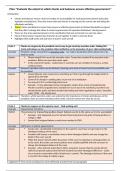
Checks and balances ensure a level of scrutiny an accountability for each government branch (executive,
legislative and judiciary). They also ensure that each branch is carrying out the correct role and doing this
effectively and fairly.
Thesis: checks and balances cannot truly ensure an effective government as Richard Neustadt has argued
that they didn't manage this rather it created a government of separated institutions 'sharing powers'
There are few truly separated powers in the constitution that just one branch can exercise alone.
Many of their powers required two branches to act together in order to exercise them.
Highlight which C&B works well and were it doesn’t work as well.
Point 1 Checks on congress by the president can be easy to get round by executive order. Making this
check and balance on the president often ineffective on the procedure of govt. C&B working badly
Example President can get around this by executive order - can make a declaration which allows him to do
what he wants
Explain Obama singed Paris accord by executive order, Trump then revoked it by executive order -
weakness. Biden uses executive order again
In the context of treaties - undermines it, countries are not confident in America, as they
could just leave.
Example However, executive orders can be declined, ensuring some level of control and accountability over
the president
Explain Cannot allocate more resources to something as it has to go through the budget which is
signed off by the HOR
Cannot if its already in existing policy or job role of an institution
Can only do it if it is redirecting policy focus.
Example - Trump attempted to ban immigration visitors from a host of predominantly
Muslim countries (arguably had a mandate for it as it was in his manifesto), but there was
already border police and they already had funding and rules/regulations in place. Executive
order 13769 - 'the Muslim ban'
Judgement Therefore, whilst executive orders can undermine the importance of checks and balances on the
president, there are some restrictions that create a level of control over what he can do.
Point 2 Checks by congress on the supreme court – C&B working well
Example Impeachment of justices
Explain The process for impeaching justices (lower federal courts) is the same as it is for a president
Example - only happened once for Samuel Chase being found not guilty of being partisan in
rulings in 1805
Samuel Kent resigned before a verdict was reached in 2009
Example Ratification of judicial appointments
Explain Senate only - presidential nominations to the supreme court have a huge impact on the
ideological makeup of the court.
President will choose a nomination close to their ideological beliefs and may change the
belief of the court overall.
While this doesn't directly affect the power of the court, by allowing or refusing justices on
to the court, the senate can ensure justices ware suitably qualified and look to ensure or
change the ideological balance of the court.
Example - when Antonin Scalia died in 2016, among the reasons that the senate did not
ratify his proposed replacement (Merrick Garland) was their ideological difference - Scalia
was a staunch conservative while Garland was a centrist. The ideological balance of the court
is crucial to the rulings it is likely to give.
Judgement Here checks and balances work sufficiently (contrast from last paragraph)
Introduction
Checks and balances ensure a level of scrutiny an accountability for each government branch (executive,
legislative and judiciary). They also ensure that each branch is carrying out the correct role and doing this
effectively and fairly.
Thesis: checks and balances cannot truly ensure an effective government as Richard Neustadt has argued
that they didn't manage this rather it created a government of separated institutions 'sharing powers'
There are few truly separated powers in the constitution that just one branch can exercise alone.
Many of their powers required two branches to act together in order to exercise them.
Highlight which C&B works well and were it doesn’t work as well.
Point 1 Checks on congress by the president can be easy to get round by executive order. Making this
check and balance on the president often ineffective on the procedure of govt. C&B working badly
Example President can get around this by executive order - can make a declaration which allows him to do
what he wants
Explain Obama singed Paris accord by executive order, Trump then revoked it by executive order -
weakness. Biden uses executive order again
In the context of treaties - undermines it, countries are not confident in America, as they
could just leave.
Example However, executive orders can be declined, ensuring some level of control and accountability over
the president
Explain Cannot allocate more resources to something as it has to go through the budget which is
signed off by the HOR
Cannot if its already in existing policy or job role of an institution
Can only do it if it is redirecting policy focus.
Example - Trump attempted to ban immigration visitors from a host of predominantly
Muslim countries (arguably had a mandate for it as it was in his manifesto), but there was
already border police and they already had funding and rules/regulations in place. Executive
order 13769 - 'the Muslim ban'
Judgement Therefore, whilst executive orders can undermine the importance of checks and balances on the
president, there are some restrictions that create a level of control over what he can do.
Point 2 Checks by congress on the supreme court – C&B working well
Example Impeachment of justices
Explain The process for impeaching justices (lower federal courts) is the same as it is for a president
Example - only happened once for Samuel Chase being found not guilty of being partisan in
rulings in 1805
Samuel Kent resigned before a verdict was reached in 2009
Example Ratification of judicial appointments
Explain Senate only - presidential nominations to the supreme court have a huge impact on the
ideological makeup of the court.
President will choose a nomination close to their ideological beliefs and may change the
belief of the court overall.
While this doesn't directly affect the power of the court, by allowing or refusing justices on
to the court, the senate can ensure justices ware suitably qualified and look to ensure or
change the ideological balance of the court.
Example - when Antonin Scalia died in 2016, among the reasons that the senate did not
ratify his proposed replacement (Merrick Garland) was their ideological difference - Scalia
was a staunch conservative while Garland was a centrist. The ideological balance of the court
is crucial to the rulings it is likely to give.
Judgement Here checks and balances work sufficiently (contrast from last paragraph)