1. Analgesic drugs
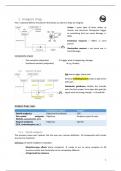
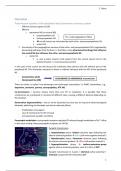
Pain = physical defense mechanism that keeps us aware to keep an integrity.
Cortex = outer layer of brain makes us
human and conscious. Recognizes trigger
as something that can cause damage =>
PAIN.
Emotional response = differs in each
person.
Nociceptive neurons = can sense nox =>
harm/damage.
Components of pain
- Pain sensation (objective) trigger what is happening, damage.
- Emotional reaction (subjective) e.g. Anxiety.
1.2. Control of pain
Not every trigger cause pain.
All these inhibiting factors make us able to live
with pain.
Substantia gelatinosa inhibits the transfer
over this first synaps. So to open this gate the
signal must be strong enough. => threshold!
Analgesic drugs: types
Component of pain? Target?
Opioid analgesics Objective & emotional CNS
Non-opioid analgesics Objective Periphery (spot of pain)
(NSAIDs, paracetamol, etc.)
Atypical analgesics Objective Specific
(TCA, carbamazepine, etc.)
1.2.1. Opioid analgesics
The previous name was ‘opiates’ but this was very narrow definition. ‘all compounds with similar
structure to morphine’.
Definition of opioid analgesics nowadays:
- Morphine-type effects (same receptors). needs to act on same receptors so 3D
structure similar but chemically can be completely different.
- Antagonized by naloxone.
1
,Opium
‘Klaproos’, poppy is also part of the same family. Zone around earth where
these plants grow -> Afghanistan, Laos, etc.
Harvested: make cuts to get latex like stuff come out:
Let the juice oxidize and turn brown,
then scrape this off.
In Opium we find a lot of substances,
alkaloids => active substances.
Morphine, codeine, thebaine,
noscapine, papaverine, ethropine, etc.
o Ethropine when it is purified, not to be used in humans to kill. Way
too potent. It is normally used to anesthesize large animals like elephants.
Tried to recreate opium in the lab but it is very difficult to reproduce. Hence
till this day most morphine and codeine are still produced naturally.
Morphine as prototype:
- Add calcium Ca-morphinate will remain in solution whereas
most other compounds, that we also find in opium, will
precipitate.
- Add a base morphine precipitates.
- Dissolved with HCl put in mold (brick).
- Do a couple of times to let H2O evaporate.
- Every plant has 3-5 seedpods which need to be cut 3 times. You need 1ha for the ‘small’
brick.
Important structure of Morphine.
Asymmetric C.
2
,(-)-Morphine (Left isomer) ↔ receptor
+charged in physiological pH will pass by anionic site.
+right isomer won’t fit.
Pharmacokinetics: Morphine
extensive first-pass metabolism thereby limiting oral bioavailability. Moreover, the bioavailability may
vary greatly between and within individuals, a major reason why opioids always must be titrated
carefully and individually and should not be dosed according to body weight. The terminal plasma life
of most morphine analogues is quite short. (3-6h).
- Exceptions: Methadone, Buprenorphine.
Biotransformation is the major route of elimination, often through conjugation forming an inactive
glucuronic acid derivative that is renally cleared. Given renal clearance the dose should be reduced in
case of renal insufficiency.
Glucuronides which are excreted biliary, may be reabsorbed after gastrointestinal hydrolysis, thus
constituting an entero-hepatic circulation. The limited conjugation capacity of neonates results in
much longer duration of action and risk of respiratory depression.
Morphine is slowly and variably absorbed from the gastrointestinal tract and is therefore usually
administered parenterally (s.c., i.v. or i.m.) for the treatment of acute pain. In chronic pain, morphine
is often taken orally (p.o.), potentially as a sustained (delayed) release preparation. Potent opioids are
administered intrathecally or through a pain pump. Diamorphine (i.e. di-acetylmorphine or heroin)
and codeine are to various extents hydrolyzed to morphine; hence, they can be considered as
prodrugs.
Morphine analogues:
All things about morphine are also true
for other opioids, if not prof will say so.
Acylgroups, more hydrophilic so will
enter more quickly in brain (past BBB).
Naloxone binds receptor without
activating it => antagonizing.
3
, Analgesic effect:
- Objective component: attenuation pain threshold↗
- Subjective component: attenuation
o Relief/liberation, anxiolytic effect.
o Sometimes (!) euphoria not always some people feel bad.
o Sedation (hypnotic effect).
o High dose: clouding to loss of consciousness (coma). ‘narcotic’ negative
connotation.
If you use opioids at right place & time no such coma only pain killing.
Gate even more difficult to open,
threshold for pain ↗↗.
Effects on autonomic NS: downsides:
- Respiratory depression:
o Sensitivity of respiratory center for CO2
already happens at low dose.
o Life threatening!!
patient will forget to breathe as it’s not triggered to do so, more blood
into brain due to vasodilation, cerebral pressure ↗ and bleeding => death!
- Miosis pupil will be very small.
- Constipation
o tonus↗; peristalsis↘ smooth muscles of intestines, feces remain at
same place, more water reabsorption constipation.
partially enteric (parasympathetic). through cholinergic
neurotransmission.
Partially central. If you inject morphine into the brain, you see
immediate effects in intestines.
- Delay emptying stomach.
o ↗tonus of the sphincter; ↘motility.
o has effects on other oral drugs!
- Cough reflex↘
o can be used in cough syrups and then positive effect.
o Inhibition of cough center.
- Emesis – sometimes vomiting and nausea.
4
Pain = physical defense mechanism that keeps us aware to keep an integrity.
Cortex = outer layer of brain makes us
human and conscious. Recognizes trigger
as something that can cause damage =>
PAIN.
Emotional response = differs in each
person.
Nociceptive neurons = can sense nox =>
harm/damage.
Components of pain
- Pain sensation (objective) trigger what is happening, damage.
- Emotional reaction (subjective) e.g. Anxiety.
1.2. Control of pain
Not every trigger cause pain.
All these inhibiting factors make us able to live
with pain.
Substantia gelatinosa inhibits the transfer
over this first synaps. So to open this gate the
signal must be strong enough. => threshold!
Analgesic drugs: types
Component of pain? Target?
Opioid analgesics Objective & emotional CNS
Non-opioid analgesics Objective Periphery (spot of pain)
(NSAIDs, paracetamol, etc.)
Atypical analgesics Objective Specific
(TCA, carbamazepine, etc.)
1.2.1. Opioid analgesics
The previous name was ‘opiates’ but this was very narrow definition. ‘all compounds with similar
structure to morphine’.
Definition of opioid analgesics nowadays:
- Morphine-type effects (same receptors). needs to act on same receptors so 3D
structure similar but chemically can be completely different.
- Antagonized by naloxone.
1
,Opium
‘Klaproos’, poppy is also part of the same family. Zone around earth where
these plants grow -> Afghanistan, Laos, etc.
Harvested: make cuts to get latex like stuff come out:
Let the juice oxidize and turn brown,
then scrape this off.
In Opium we find a lot of substances,
alkaloids => active substances.
Morphine, codeine, thebaine,
noscapine, papaverine, ethropine, etc.
o Ethropine when it is purified, not to be used in humans to kill. Way
too potent. It is normally used to anesthesize large animals like elephants.
Tried to recreate opium in the lab but it is very difficult to reproduce. Hence
till this day most morphine and codeine are still produced naturally.
Morphine as prototype:
- Add calcium Ca-morphinate will remain in solution whereas
most other compounds, that we also find in opium, will
precipitate.
- Add a base morphine precipitates.
- Dissolved with HCl put in mold (brick).
- Do a couple of times to let H2O evaporate.
- Every plant has 3-5 seedpods which need to be cut 3 times. You need 1ha for the ‘small’
brick.
Important structure of Morphine.
Asymmetric C.
2
,(-)-Morphine (Left isomer) ↔ receptor
+charged in physiological pH will pass by anionic site.
+right isomer won’t fit.
Pharmacokinetics: Morphine
extensive first-pass metabolism thereby limiting oral bioavailability. Moreover, the bioavailability may
vary greatly between and within individuals, a major reason why opioids always must be titrated
carefully and individually and should not be dosed according to body weight. The terminal plasma life
of most morphine analogues is quite short. (3-6h).
- Exceptions: Methadone, Buprenorphine.
Biotransformation is the major route of elimination, often through conjugation forming an inactive
glucuronic acid derivative that is renally cleared. Given renal clearance the dose should be reduced in
case of renal insufficiency.
Glucuronides which are excreted biliary, may be reabsorbed after gastrointestinal hydrolysis, thus
constituting an entero-hepatic circulation. The limited conjugation capacity of neonates results in
much longer duration of action and risk of respiratory depression.
Morphine is slowly and variably absorbed from the gastrointestinal tract and is therefore usually
administered parenterally (s.c., i.v. or i.m.) for the treatment of acute pain. In chronic pain, morphine
is often taken orally (p.o.), potentially as a sustained (delayed) release preparation. Potent opioids are
administered intrathecally or through a pain pump. Diamorphine (i.e. di-acetylmorphine or heroin)
and codeine are to various extents hydrolyzed to morphine; hence, they can be considered as
prodrugs.
Morphine analogues:
All things about morphine are also true
for other opioids, if not prof will say so.
Acylgroups, more hydrophilic so will
enter more quickly in brain (past BBB).
Naloxone binds receptor without
activating it => antagonizing.
3
, Analgesic effect:
- Objective component: attenuation pain threshold↗
- Subjective component: attenuation
o Relief/liberation, anxiolytic effect.
o Sometimes (!) euphoria not always some people feel bad.
o Sedation (hypnotic effect).
o High dose: clouding to loss of consciousness (coma). ‘narcotic’ negative
connotation.
If you use opioids at right place & time no such coma only pain killing.
Gate even more difficult to open,
threshold for pain ↗↗.
Effects on autonomic NS: downsides:
- Respiratory depression:
o Sensitivity of respiratory center for CO2
already happens at low dose.
o Life threatening!!
patient will forget to breathe as it’s not triggered to do so, more blood
into brain due to vasodilation, cerebral pressure ↗ and bleeding => death!
- Miosis pupil will be very small.
- Constipation
o tonus↗; peristalsis↘ smooth muscles of intestines, feces remain at
same place, more water reabsorption constipation.
partially enteric (parasympathetic). through cholinergic
neurotransmission.
Partially central. If you inject morphine into the brain, you see
immediate effects in intestines.
- Delay emptying stomach.
o ↗tonus of the sphincter; ↘motility.
o has effects on other oral drugs!
- Cough reflex↘
o can be used in cough syrups and then positive effect.
o Inhibition of cough center.
- Emesis – sometimes vomiting and nausea.
4