

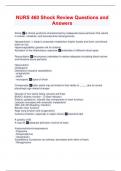
NURS 460 Shock Review Questions and Answers Shock ✅A clinical syndrome characterized by inadequate tissue perfusion that results in cellular, metabolic, and hemodynamic derangements. Hypoperfusion -> leads to anaerobic metabolism (higher lactate acid level, send blood down on ice) Hypercoagulability (greater risk for clotting) Activation of the inflammatory response ✅similarities of different shock types Resuscitation ✅the process undertaken to restore adequate circulating blood volume and therefore tissue perfusion Hypovolemic Cardiogenic Distributive (massive vasodilation): - anaphylactic - septic - neurogenic ✅types of shock Compensate ✅older adults may be limited in their ability to _____ due to normal physiologic age related changes Glucose (if liver starts failing, glucose will drop) BUN/Cr (kidney function - Cr best indicator) Sodium , potassium, chloride (key components in heart function) Lactacte (increases with anaerobic metabolism) CBC with diff (bleeding, infection) Bilirubin (liver function) Abgs (lung function and oxygenation) Cultures (infection, especially in septic shock) ✅important labs A systolic of 90 A map 65 ✅adequate perfusion must be at least... Vasoconstrictors/vasopressors - Dopamine - Norepinephrine - Vasopressin Vasodilators (if pressure can tolerate, decreases work effort of heart) - Nitroglycerine - ACE Inhibitors Inotropic Agents (cardiogenic) - Dobutamine Antibiotics (septic) ✅medications for shock Hypovolemic shock ✅the circulating volume (blood or fluid) is inadequate for the body's needs = the tank is not full External fluid loss (burn, severe dehydration, trauma) Internal fluid loss (GI bleed, fluid shift) ✅causes of hypovolemic shock Increased: HR, RR, hematocrit (if loss of fluid) Decreased: BP, U/O; cool, pale skin; mentation; flat neck veins, CO, CVP, hematocrit (if loss of blood) ✅clinical presentation of hypovolemic shock If you can feel radial pulse = at least 80 If you can feel femoral pulse = at least 70 If you can feel carotid pulse = at least 60 ✅estimating systolic blood pressure by pulse palpation Eliminate the cause Replace what is lost (need a good working IV) ✅resuscitation of hypovolemic shock Crystalloid ✅hypertonic, hypotonic, isotonic; saline or lactated ringers; add more fluid to the intravascular system; able to diffuse through capillary wall; 3:1 rule (3 ml for every 1ml of blood loss) Colloid ✅blood (gives patient hemoglobin), albumin, volume expanders; can't diffuse through capillary wall and stay in intravascular space Gravity (only basic fluids with no additive): just hang wide open, possibly with pressure bag Pump: highest you can set is 999 ✅How to give fluid bolus Get consent Start within 30 minutes of arrival and must be completed within 4 hours Monitor for reaction (most likely to occur in the first 15 minutes): back pain, fever, tachycardia, etc; stop transfusion if suspected; send back to blood bank 2 nurses check off Can run with NORMAL SALINE ✅How to give blood Cardiogenic shock ✅results when an inefficient heart cannot sustain adequate circulation
Vista previa 2 fuera de 5 páginas
Examen
NURS 460 Shock Review Questions and Answers
Vista previa 2 fuera de 5 páginas
Shock A clinical syndrome characterized by inadequate tissue perfusion that results in cellular, metabolic, and hemodynamic derangements. Hypoperfusion - leads to anaerobic metabolism (higher lactate acid level, send blood down on ice) Hypercoagulability (greater risk for clotting) Activation of the inflammatory response similarities of different shock types Resuscitation the process undertaken to restore adequate circulating blood volume and therefore tissue perfusion Hypovolemic Cardiogenic Distributive (massive vasodilation): - anaphylactic - septic - neurogenic types of shock Compensate older adults may be limited in their ability to _____ due to normal physiologic age related changes Glucose (if liver starts failing, glucose will drop) BUN/Cr (kidney function - Cr best indicator) Sodium, potassium, chloride (key components in heart function) Lactacte (increases with anaerobic metabolism) CBC with diff (bleeding, infection) Bilirubin (liver function) Abgs (lung function and oxygenation) Cultures (infection, especially in septic shock) important labs A systolic of 90 A map 65 adequate perfusion must be at least... Vasoconstrictors/vasopressors - Dopamine - Norepinephrine - Vasopressin Vasodilators (if pressure can tolerate, decreases work effort of heart) - Nitroglycerine
Vista previa del contenido
Información del documento
- Subido en
- 2 de agosto de 2024
- Número de páginas
- 5
- Escrito en
- 2024/2025
- Tipo
- Examen
- Contiene
- Preguntas y respuestas
$9.49
¿Documento equivocado? Cámbialo gratis
Dentro de los 14 días posteriores a la compra y antes de descargarlo, puedes elegir otro documento. Puedes gastar el importe de nuevo.
Escrito por estudiantes que aprobaron
Inmediatamente disponible después del pago
Leer en línea o como PDF

Los indicadores de reputación están sujetos a la cantidad de artículos vendidos por una tarifa y las reseñas que ha recibido por esos documentos. Hay tres niveles: Bronce, Plata y Oro. Cuanto mayor reputación, más podrás confiar en la calidad del trabajo del vendedor.
Disponible en paquete
Package deal
Comprehensive NURS 460 Q&A Bundle
