

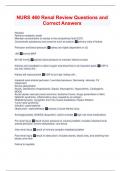
NURS 460 Renal Review Questions and Correct Ans wers Filtration Remove metabolic waste Maintain concentration of solutes in the extracellular fluid (ECF) Concentrate substances and conserve such as sodium ✅primary roles of kidney Perfusion and blood pressure ✅kidney are highly dependent on (2) >65 ✅normal MAP 80-180 mmhg ✅systolic blood pressure to maintain kidney function Kidneys will vasodilator to allow oxygen and blood flow to all important parts ✅If BP is too low, kidney will... Kidney will vasoconstrict ✅If BP is too high, kidney will... Impaired renal arterial perfusion: Low blood pressure, Narrowing - stenosis, CV impairment Severe dehydration Shock: Distributive (Anaphylactic, Sepsis, Neurogenic), Hypovolemic, Cardiogenic, MODS Acute tubular necrosis (most common): Ischemia Toxins - drugs (prescribed or illicit) Nephritic syndrome - inflammatory injury caused by an antigen Rhabdomyolysis - myoglobin from the muscle breakdown impairs filtration Tumor lysis syndrome Infection - pyelonephritis Obstruction - nephrolithiasis ✅causes of acute kidney injury Aminoglycosides , NSAIDS (ibuprofen), iodine contrast ✅high risk renal medications Pre renal injury ✅result of poor pressure or volume problem; includes impaired renal arterial perfusion, severe dehydration, and shock Intra renal injury ✅result of immune complex mediated problem Post renal injury ✅result of obstruction; includes stones, blood clots, and anything that blocks urine flow Failure to regulate: - Volume (usually gain) - Blood pressure - Acid-base balance Failure to eliminate: - Toxins - Electrolytes ✅acute impairment of the kidneys leads to... R- risk of renal dysfunction - increased Scr > 1.5 x baseline I- injury to the kidney - increased Scr > 2 x baseline F- failure of kidney function - increased Scr > 3 x baseline or > 4mg/ dl L- loss of kidney function - need for RRT > 4 weeks E- end-stage kidney disease - need for RRT > 3 months ✅diagnosis and classification for acute kidney injury (RIFLE) 4 ✅If Scr is great than ___ indicates kidney failure 1. Oliguria 2. Diuresis 3. Recovery ✅stages of AKI Stage 1: oliguria ✅Begins within 24 hours of insult to kidneys Increased BUN and creatinine Fluid overload Hyperkalemia Metabolic acidosis Mild hyponatremia, increased phosphate, decreased calcium Higher specific gravity Stage 2: diuresis ✅Gradual return of normal function Increase in urine output Still increase rise in BUN and creatinine Hypokalemia Hypovolemia Lasts 7 -10 days Stage 3: recovery ✅Lab work stabilizes Lasts 3 -12 months <30ml/hr over 2 hour period <500 ml/day <0.5ml/kg/hr for 6 hrs ✅diminished urine output I/O Daily weight ✅volume measurement
Vista previa 2 fuera de 8 páginas
Examen
NURS 460 Renal Review Questions and Correct Answers
Vista previa 2 fuera de 8 páginas
Filtration Remove metabolic waste Maintain concentration of solutes in the extracellular fluid (ECF) Concentrate substances and conserve such as sodium primary roles of kidney Perfusion and blood pressure kidney are highly dependent on (2) 65 normal MAP 80-180 mmhg systolic blood pressure to maintain kidney function Kidneys will vasodilator to allow oxygen and blood flow to all important parts If BP is too low, kidney will... Kidney will vasoconstrict If BP is too high, kidney will... Impaired renal arterial perfusion: Low blood pressure, Narrowing- stenosis, CV impairment Severe dehydration Shock: Distributive (Anaphylactic, Sepsis, Neurogenic), Hypovolemic, Cardiogenic, MODS Acute tubular necrosis (most common): Ischemia Toxins- drugs (prescribed or illicit) Nephritic syndrome- inflammatory injury caused by an antigen Rhabdomyolysis- myoglobin from the muscle breakdown impairs filtration Tumor lysis syndrome Infection- pyelonephritis Obstruction- nephrolithiasis causes of acute kidney injury Aminoglycosides, NSAIDS (ibuprofen), iodine contrast high risk renal medications Pre renal injury result of poor pressure or volume problem; includes impaired renal arterial perfusion, severe dehydration, and shock Intra renal injury result of immune complex mediated problem Post renal injury result of obstruction; includes stones, blood clots, and anything that blocks urine flow Failure to regulate
Vista previa del contenido
Información del documento
- Subido en
- 2 de agosto de 2024
- Número de páginas
- 8
- Escrito en
- 2024/2025
- Tipo
- Examen
- Contiene
- Preguntas y respuestas
$10.49
¿Documento equivocado? Cámbialo gratis
Dentro de los 14 días posteriores a la compra y antes de descargarlo, puedes elegir otro documento. Puedes gastar el importe de nuevo.
Escrito por estudiantes que aprobaron
Inmediatamente disponible después del pago
Leer en línea o como PDF

Los indicadores de reputación están sujetos a la cantidad de artículos vendidos por una tarifa y las reseñas que ha recibido por esos documentos. Hay tres niveles: Bronce, Plata y Oro. Cuanto mayor reputación, más podrás confiar en la calidad del trabajo del vendedor.
Disponible en paquete
Package deal
Comprehensive NURS 460 Q&A Bundle
