

NUR 460 Exam 1 Study Questions and Correct Answers Identify the three components of the Institute for Healthcare Improvement's Triple Aim. ✅Related to access, quality, and cost of care. Explain how following, leading, and managing are similar and different. ✅Following: Each member contributes optimally, but still listens and follows a peer who is leading or managing. Leading: The use of individual traits and abilities in relationship with others, and the ability to act rapidly in an emerging situation. Key traits: articulating a vision, seeing possibilities, and and communicating effectively. Managing: Is the ability to plan, direct, control, and evaluate others in situations where the outcomes are known. Key traits: Ability to identify recurring issues, persistent and vigilant behavior, communication that remain esprit de corps. Identify the five domains for leading, managing, and following. ✅1. Deepening self awareness and encouraging others to do the same 2. Managing emotions in self and others 3. Motivating others and self 4. Being empathetic 5. Fostering and handling relationships Define emotional intelligence. ✅Characterized by social skills, interpersonal competence, psychological maturity, and emotional awareness that helps people to harmonize to increase their value in the workplace. Compare and contrast the different types of leadership theories. ✅1. Transformational Theory - The process in which the leader attends to the needs and motives of of followers, so the interaction raises to higher levels of motivation. Encourages follower creativity. 2. Hierarchy of Needs - Motivated by hierarchy or human needs. (food, water, air) 3. Two -Factor Theory - Hygiene factors such as working conditions, salary, status, and security motivate workers by meeting safety and security needs. Motivation factors include (achievement, recognition, satisfaction of work) 4. Expectancy Theory - Individuals perceived needs impact their behavior. Motivated behavior is increased if there is a positive relationship with good performance and outcomes or rewards. 5. OB Modification - Operant approach, ABC model, 3 step model. Antecedent analysis, Behavioral analysis, and Consequence. Explain the different principles of systems thinking theory. ✅1. Thinking of the "BIG PICTURE" - looks past the individual assignment and comprehends the needs of all units and residents. 2. Balancing Short term and Long term Objectives - recognizes the consequences of action taken today and the long term effects of the organization or patient care. How to balance decision making. 3. Recognizing Dynamic, Complex, and Interdependent nature of systems - All things are connected. Patients, families, cost of care, communities. 4. Using Measurable vs. Non measurable data system - Perspective is important, objective and subjective data align with each other to produce a better work and care environment. Explain the different leadership tasks identified by Gardner. ✅1. Envisioning goals - Establishing a shared vision, visioning patient outcomes. 2. Affirming values - Connecting thoughts and inner driving forces that give purpose. 3. Motivating - Inspiring patients and families to achieve their vision. energizes what we value. 4. Managing - Determining routines and practices that offer structure. Priority setting, decision making, and 5. Achieving workable unity - assisting patient and families at achieving optimal functioning. Resolve conflict. 6. Developing trust - Being clear and direct with patient, and honest at all times. Keeping promises. 7. Explaining - Teaching and interpreting information to promote well -being. Willingness to explain and repeat. 8. Serving as a Symbol - Representing the nursing profession positively, and honoring values and beliefs. 9. Representing the group - Active participation, MAGNET status. 10. Renewing - Generate energy within. Providing self care to enhance the ability to care for staff, patients etc. Identify organizations that belong to the primary, secondary, and tertiary care parts of the healthcare spectrum. ✅Primary - Ambulatory care centers, physicians offices, preferred providers orgs, nursing centers, independent providers orgs, health maintenance orgs, school health clinics. Secondary - Home health care, ambulatory care services, nursing centers. Tertiary -Home health care, ling term care facilities, rehab facilities, skilled nursing facilities, assisted living/retirement homes. Explain the different types of ownership that exist for health care organizations. ✅Ownership establishes the organizations legal, business, and mission -related imperative. There are 3 types: Public - provide care under the support of the state, federal, and local government. Non-Profit - Required to serve regardless if they can pay or not. Is controlled by trustees and is a "voluntary" agency. For-profit(investor owned) - Operate with the intent of earning a profit. Explain the difference between HMO, PPO, and fee -for-service. ✅HMO - A configuration of health care agencies that provide basic and supplemental health maintenance and treatment to voluntary rolless who prepay a fixed periodic amount. Must offer inpatient and outpatient services. PPO - Operates similar to IPA's, but a contract is worked out with physicians and fees are discounted from their usual and customary charge, in return they are given prompt payment. Fee-for-service (IPA) - Physician is paid for care per visit, prepaid plan plan to deliver care to enrolled members. Explain the the structure and purpose of community services, subacute facilities, home health organizations, long -term care and residential facilities, hospices, nurse -owned and nurse -organized services. ✅Community Services - Focused on the community. The control of infectious agent within the community and preventive services. Money from the federal, state, and local government. Subacute - Discharge patients earlier, initially was used for patient fresh out of surgery.
Vista previa 3 fuera de 16 páginas
Examen
NUR 460 Exam 1 Study Questions and Correct Answers
Vista previa 3 fuera de 16 páginas
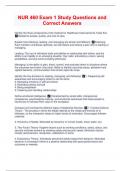
Identify the three components of the Institute for Healthcare Improvement's Triple Aim. Related to access, quality, and cost of care. Explain how following, leading, and managing are similar and different. Following: Each member contributes optimally, but still listens and follows a peer who is leading or managing. Leading: The use of individual traits and abilities in relationship with others, and the ability to act rapidly in an emerging situation. Key traits: articulating a vision, seeing possibilities, and and communicating effectively. Managing: Is the ability to plan, direct, control, and evaluate others in situations where the outcomes are known. Key traits: Ability to identify recurring issues, persistent and vigilant behavior, communication that remain esprit de corps. Identify the five domains for leading, managing, and following. 1. Deepening self awareness and encouraging others to do the same 2. Managing emotions in self and others 3. Motivating others and self 4. Being empathetic 5. Fostering and handling relationships Define emotional intelligence. Characterized by social skills, interpersonal competence, psychological maturity, and emotional awareness that helps people to harmonize to increase their value in the workplace. Compare and contrast the different types of leadership theories. 1. Transformational Theory - The process in which the leader attends to the needs and motives of of followers, so the interaction raises to higher levels of motivation. Encourages follower creativity. 2. Hierarchy of Needs- Motivated by hierarchy or human needs. (food, water, air) 3. Two-Factor Theory- Hygiene factors such as working conditions, salary, status, and security motivate workers by meeting safety and security needs. Motivation factors include (achievement, recognition, satisfaction of work) 4. Expectancy Theory- Individuals perceived needs impact their behavior. Motivated behavior is increased if there is a positive relationship with good performance and outcomes or rewards.
Vista previa del contenido
Información del documento
- Subido en
- 2 de agosto de 2024
- Número de páginas
- 16
- Escrito en
- 2024/2025
- Tipo
- Examen
- Contiene
- Preguntas y respuestas
$11.49
¿Documento equivocado? Cámbialo gratis
Dentro de los 14 días posteriores a la compra y antes de descargarlo, puedes elegir otro documento. Puedes gastar el importe de nuevo.
Escrito por estudiantes que aprobaron
Inmediatamente disponible después del pago
Leer en línea o como PDF

Los indicadores de reputación están sujetos a la cantidad de artículos vendidos por una tarifa y las reseñas que ha recibido por esos documentos. Hay tres niveles: Bronce, Plata y Oro. Cuanto mayor reputación, más podrás confiar en la calidad del trabajo del vendedor.
Disponible en paquete
Package deal
Comprehensive NURS 460 Q&A Bundle
