

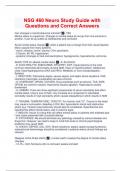
NSG 460 Neuro Study Guide with Questions and Correct A nswers Can changes in mental status be minimal? ✅- YES Mental status is a spectrum. Changes in mental status do not go from one extreme to another, it can be as subtle as restlessness and confusion Acute mental status change ✅- when a patient has a change from their usual baseline Many causes from many systems - neuro: infection, tumor, trauma, CVA, psychiatric - CV/pulm: MI, PE, hypotension - systemic (changes in fluid and electrolytes): hypoglycemia, hyponatremia, ammonia AEIOU TIPS for altered mental status ✅- A: ALCOHOL - E: ELECTROLYTE, ENDOCRINE, EPILEPSY, ECP. Hypernatremia is the most common electrolyte abnormality causing AMS. Hypo or hyperthyroidism. Addisonian crisis. Hypo/hyperglycemia (DKA and HHS). Metabolic or toxic encephalopathy. Epilepsy - I: INFECTION. Particularly sepsis, severe sepsis, and septic shock situations. CNS infections (meningitis, encephalitis) are also common - O: OVERDOSE, OPIOID, OXYGEN. Drug overdoses such as benzos, TCA, SSRI, OPIOID are common causes. Hypoxemia causes agitation. Hypercapnia causes drowsiness - U: UREMIA. There are three significant components of serum osmolarity that affect mental status. Urea is one of them. Any increase of a component in calculated osmolality results in high osmolarity which causes disequilibrium which results in AMS - T: TRAUMA, TEMPERATURE, TOXICITY. For toxicity, look "O". Trauma to the head may cause a concussion, bleeding or DAI. But, hypovolemic shock and obstructive shock (e.g. Tension pneumothorax) should also be considered. Hyperthermia and hypothermia affect mental status, esp in extreme ages. - I: INSULIN. Insulin is a drug that can affect mental status in patients with diabetes type I and cases presented with a suicidal attempt - P: PSYCHOSIS. We should eliminate any pathology caused by various disease and drugs first. However , we need to keep in mind that acute or chronic psychological problems may cause AMS. - S: SHOCK, SEPSIS, SOL, SAH. Shock situations, sepsis, space -occupying lesions, subarachnoid hemorrhage should be considered in patients where clinical findings are relevant. Glasgow Coma Scale (GCS) ✅- a scale used to assess the degree of mental status changes - 14-15 = mild. Someone who is confused, awake and alert - 9-13= moderate - 8 or less = severe. Typically call them comatose (varying degrees of this) Criteria for GCS ✅EYE OPENING (4) - spontaneous = 4 - to voice = 3 - to touch = 2 - none = 1 VERBAL RESPONSE (5) - oriented = 5 - confused = 4 - inappropriate = 3 - incoherent = 2 - none = 1 MOTOR RESPONSE (6) - follows commands (6) - localizes pain (5) - withdraws from pain (4) - decorticate (3) - decerebrate (2) - none (1) Cranial nerves responsible for cardinal signs of gaze ✅- III: oculomotor - IV: trochlear - VI: abducens Cranial nerves ✅- O: olfactory. Smell - O: optic. Sight - O: oculomotor. Eye movement - T: trochlear. Eye movement - T: trigeminal: face sensation and chewing - A: abducens. Eye movement - F: facial. Face sensation - A: auditory/vestibulocochlear. Hearing - G: glossopharyngeal. Throat sensation, taste and swallowing - V: Vagus. Movement , GAG REFLEX!! (protective mechanism) - A: accessory. Neck movement - H: hypoglossal. Tongue movement Pupils ✅- controlled by cranial nerve 3 - used to assess problems with neuro impacted pt - REACTIVITY IS MORE IMPORTANT What is more important with pupils, the size or reactivity ✅- REACTIVITY
Vista previa 2 fuera de 10 páginas
Examen
NSG 460 Neuro Study Guide with Questions and Correct Answers
Vista previa 2 fuera de 10 páginas
Can changes in mental status be minimal? - YES Mental status is a spectrum. Changes in mental status do not go from one extreme to another, it can be as subtle as restlessness and confusion Acute mental status change - when a patient has a change from their usual baseline Many causes from many systems - neuro: infection, tumor, trauma, CVA, psychiatric - CV/pulm: MI, PE, hypotension - systemic (changes in fluid and electrolytes): hypoglycemia, hyponatremia, ammonia AEIOU TIPS for altered mental status - A: ALCOHOL - E: ELECTROLYTE, ENDOCRINE, EPILEPSY, ECP. Hypernatremia is the most common electrolyte abnormality causing AMS. Hypo or hyperthyroidism. Addisonian crisis. Hypo/hyperglycemia (DKA and HHS). Metabolic or toxic encephalopathy. Epilepsy - I: INFECTION. Particularly sepsis, severe sepsis, and septic shock situations. CNS infections (meningitis, encephalitis) are also common - O: OVERDOSE, OPIOID, OXYGEN. Drug overdoses such as benzos, TCA, SSRI, OPIOID are common causes. Hypoxemia causes agitation. Hypercapnia causes drowsiness - U: UREMIA. There are three significant components of serum osmolarity that affect mental status. Urea is one of them. Any increase of a component in calculated osmolality results in high osmolarity which causes disequilibrium which results in AMS - T: TRAUMA, TEMPERATURE, TOXICITY. For toxicity, look "O". Trauma to the head may cause a concussion, bleeding or DAI. But, hypovolemic shock and obstructive shock (e.g. Tension pneumothorax) should also be considered. Hyperthermia and hypothermia affect mental status, esp in extreme ages. - I: INSULIN. Insulin is a drug that can affect mental status in patients with diabetes type I and cases presented with a suicidal attempt - P: PSYCHOSIS. We should eliminate any pathology caused by various disease and drugs first. However, we need to keep in mind that acute or chronic psychological problems may cause AMS. - S: SHOCK, SEPSIS, SOL, SAH. Shock situations, sepsis, space-occupying lesions, subarachnoid hemorrhage should be considered in patients where clinical findings are relevant. Glasgow Coma Scale (GCS) - a scale used to assess the degree of mental status changes - 14-15 = mild. Someone who is confused, awake and alert - 9-13= moderate - 8 or less = severe. Typically call them comatose (varying degrees of this) Criteria for GCS EYE OPENING (4)
Vista previa del contenido
Información del documento
- Subido en
- 2 de agosto de 2024
- Número de páginas
- 10
- Escrito en
- 2024/2025
- Tipo
- Examen
- Contiene
- Preguntas y respuestas
$10.49
¿Documento equivocado? Cámbialo gratis
Dentro de los 14 días posteriores a la compra y antes de descargarlo, puedes elegir otro documento. Puedes gastar el importe de nuevo.
Escrito por estudiantes que aprobaron
Inmediatamente disponible después del pago
Leer en línea o como PDF

Los indicadores de reputación están sujetos a la cantidad de artículos vendidos por una tarifa y las reseñas que ha recibido por esos documentos. Hay tres niveles: Bronce, Plata y Oro. Cuanto mayor reputación, más podrás confiar en la calidad del trabajo del vendedor.
Disponible en paquete
Package deal
Comprehensive NURS 460 Q&A Bundle
