

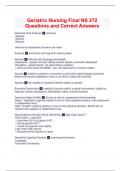
Geriatric Nursing Final NS 272 Questions a nd Correct Answers Dementia Core Features ✅-Amnesia -Aphasia -Apraxia -Agnosia -Need to be assessed if concerns are noted Amnesia ✅-short -term and long -term memory loses Aphasia ✅-difficulty with language and speech -Expressive - speech not fluid, halting manner speech, frustrated, depressed -Receptive - speak fluently, not responding to question + Obvious when doing the MMSE - can not repeat/name a common object Apraxia ✅-Inability to perform a movement or task when asked despite having the desire and physical capability to carry it out (ADLs, eating with utensils) Agnosia ✅-the inability to recognize familiar objects or people Executive Dysfunction ✅-Inability to function well in a social environment, inability to organize oneself, calculations, disinhibited, violent, control emotions Dementia (Major & Mild) ✅-Course is chronic, progressive and irreversible -Major: "significant" cognitive decline in one or more cognitive domains, with impairment in independent living -Mild: "modest" cognitive decline in one or more cognitive domains - deficits do not interfere with capacity of independent living Neurocognitive Disorder (NCD) (Dementia) ✅-Age major factor*** -Early onset: < age of 60 + Less than 5% of all cases of AD + Strong genetic link*** + Tends to progress more rapidly -Late onset: after age 60 + Represents the majority of cases Dementia Cognitive Domains ✅-Learning and memory -Language -Executive Functioning -Complex Attention -Perceptual Motor -Social Cognition 10 Early Signs and Symptoms of AD ✅-Memory loss that disrupts daily life. -Challenges in planning or solving problems. -Difficulty completing familiar tasks at home, at work or at leisure -Confusion with time or place. -Trouble understanding visual images and spatial relationships. -New problems with words in speaking or writing. -Misplacing things and losing the ability to retrace steps. -Decreased or poor judgment. -Withdrawal from work or social activities. -Changes in mood and personality. Mini Mental State Exam ✅-Screening for cognitive impairment -Limitations of the MMSE + patient education level to low or very high Delirium Risk Factors ✅-Use of physical restraints -Indwelling bladder catheter -Polypharmacy -Pain -Dehydration -Electrolyte imbalances (NA+ and K+) -Immobilization -Post- operative -general anesthesia -Environment - noisy -Lack of sleep Azotemia ✅-an elevation of blood urea nitrogen (BUN) and serum creatinine levels. The reference range for BUN is 8 -20 mg/dL, and the normal range for serum creatinine is 0.7 -1.4 mg/dL. Delirium Nursing Interventions ✅-Orientation to reality - -Sleep -enhancement -Vision & Hearing - be sure glasses and hearing aids are in use. -Dehydration -Ambulation, whenever possible -Quiet calm environment - use calm voice, calm music -Pain management -Elimination of unnecessary medications -D/C urinary catheter -Consistent caregivers -Family interaction
Vista previa 2 fuera de 10 páginas
Examen
Geriatric Nursing Final NS 272 Questions and Correct Answers
Vista previa 2 fuera de 10 páginas
Dementia Core Features -Amnesia -Aphasia -Apraxia -Agnosia -Need to be assessed if concerns are noted Amnesia -short-term and long-term memory loses Aphasia -difficulty with language and speech -Expressive - speech not fluid, halting manner speech, frustrated, depressed -Receptive - speak fluently, not responding to question + Obvious when doing the MMSE - can not repeat/name a common object Apraxia -Inability to perform a movement or task when asked despite having the desire and physical capability to carry it out (ADLs, eating with utensils) Agnosia -the inability to recognize familiar objects or people Executive Dysfunction -Inability to function well in a social environment, inability to organize oneself, calculations, disinhibited, violent, control emotions Dementia (Major & Mild) -Course is chronic, progressive and irreversible -Major: "significant" cognitive decline in one or more cognitive domains, with impairment in independent living -Mild: "modest" cognitive decline in one or more cognitive domains- deficits do not interfere with capacity of independent living Neurocognitive Disorder (NCD) (Dementia) -Age major factor*** -Early onset: age of 60 + Less than 5% of all cases of AD + Strong genetic link*** + Tends to progress more rapidly -Late onset: after age 60 + Represents the majority of cases Dementia Cognitive Domains -Learning and memory -Language -Executive Functioning
Vista previa del contenido
Información del documento
- Subido en
- 1 de agosto de 2024
- Número de páginas
- 10
- Escrito en
- 2024/2025
- Tipo
- Examen
- Contiene
- Preguntas y respuestas
$9.99
¿Documento equivocado? Cámbialo gratis
Dentro de los 14 días posteriores a la compra y antes de descargarlo, puedes elegir otro documento. Puedes gastar el importe de nuevo.
Escrito por estudiantes que aprobaron
Inmediatamente disponible después del pago
Leer en línea o como PDF

Los indicadores de reputación están sujetos a la cantidad de artículos vendidos por una tarifa y las reseñas que ha recibido por esos documentos. Hay tres niveles: Bronce, Plata y Oro. Cuanto mayor reputación, más podrás confiar en la calidad del trabajo del vendedor.
Disponible en paquete
Package deal
NURS 272 Q&A Bundle
