● A01 Minority influence
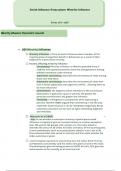
Minority influence: A form of social influence when members of the
majority group change their beliefs or behaviours as a result of their
exposure to a persuasive minority.
Factors affecting minority influence
- Consistency: Minority influence is effective provided there is
stability and expressed position over time and agreement among
different members of the minority
- synchronic consistency: describes the consistency of ideas among
those who hold them.
- Diachronic consistency: describes the consistency of ideas over
time it forces opposition into cognitive conflict , allowing them to
be more influenced
- Commitment: The degree to which members of the minority are
dedicated to a particular cause or activity. The greater the
perceived commitment, the greater the influence
- Flexibility: A willingness to compromise when expressing a
position. Nemeth (1986) argued that consistency is not the only
important factor because it can be interpreted negatively. Being
extremely consistent can be seen as rigid, unbending, dogmatic
and inflexible.
Moscovici et al (1969) -
- Aim: To see whether a consistent minority of participants could
influence a majority to give an incorrect answer in a colour perception
task. 192 women (32 groups of 6) women at a time were asked to
estimate the colour of 36 slides. All slides were blue. Of the 6 participants,
2 were confederates and 4 were participants asked to view a set of 36
blue-coloured slides that varied in intensity and then state whether the
slides were blue or green.
-were first given eye tests to ensure they were not colour blind. The two
confederates consistently said the slides were green on 2/3 of the trials.
The participants gave the wrong answer on 8.42% of trials, 32% gave the
same answer as the minority on at least one trial
Minority influence: A form of social influence when members of the
majority group change their beliefs or behaviours as a result of their
exposure to a persuasive minority.
Factors affecting minority influence
- Consistency: Minority influence is effective provided there is
stability and expressed position over time and agreement among
different members of the minority
- synchronic consistency: describes the consistency of ideas among
those who hold them.
- Diachronic consistency: describes the consistency of ideas over
time it forces opposition into cognitive conflict , allowing them to
be more influenced
- Commitment: The degree to which members of the minority are
dedicated to a particular cause or activity. The greater the
perceived commitment, the greater the influence
- Flexibility: A willingness to compromise when expressing a
position. Nemeth (1986) argued that consistency is not the only
important factor because it can be interpreted negatively. Being
extremely consistent can be seen as rigid, unbending, dogmatic
and inflexible.
Moscovici et al (1969) -
- Aim: To see whether a consistent minority of participants could
influence a majority to give an incorrect answer in a colour perception
task. 192 women (32 groups of 6) women at a time were asked to
estimate the colour of 36 slides. All slides were blue. Of the 6 participants,
2 were confederates and 4 were participants asked to view a set of 36
blue-coloured slides that varied in intensity and then state whether the
slides were blue or green.
-were first given eye tests to ensure they were not colour blind. The two
confederates consistently said the slides were green on 2/3 of the trials.
The participants gave the wrong answer on 8.42% of trials, 32% gave the
same answer as the minority on at least one trial