Physics – Key Topic 2
4.2 Electricity
4.2.1 Current, potential difference and resistance
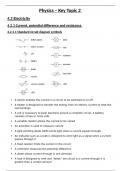
4.2.1.1 Standard circuit diagram symbols
A switch enables the current in a circuit to be switched on or off
A heater is designed to transfer the energy from an electric current to heat the
surroundings
A cell is necessary to push electrons around a complete circuit. A battery
consists of two or more cells
A variable resistor allows the current to be varied
An ammeter is used to measure current
A light emitting diode (LED) emits light when a current passes through
An indicator such as a bulb is designed to emit light as a signal when a current
passes through it
A fixed resistor limits the current in the circuit
A voltmeter measures the potential difference
A diode allows current through in one direction
A fuse is designed to melt and “break” the circuit is a current through it is
greater than a certain amount
, An LDR has low resistance in bright light
A thermistor has low resistance when warm
4.2.1.2 Electrical charge and current
For electrical charge to flow through a closed circuit, the circuit must include a source
of potential difference
- Potential difference is the driving force that pushes charge around
- Resistance in the circuit is anything that slows the flow down
Electric current is a flow of electrical charge. The size of the electric current is the rate
of flow of electrical charge.
- charge flow = current x time (Q=IT) (C = A x s)
A current has the same value at any point in a single closed loop
4.2.1.3 Current, resistance and potential difference
The current through a component depends on both the resistance of the component
and the potential difference across the component. The greater the resistance of the
component, the smaller the current for a given potential difference across the
component
Potential difference = current x resistance (V=IR) (V = I x )
4.2.1.4 Resistors
Resistance is caused by electron colliding with the positive ions in the lattice
structure. It causes them to slow down and so reduces the current
The current through an ohmic conductor (at a constant temperature) is directly
proportional to the potential difference across the resistor. This means that the
resistance remains constant as the current changes
The resistance of components such as lamps, diodes, thermistors and LDRs is not
constant; it changes with the current through the component
4.2 Electricity
4.2.1 Current, potential difference and resistance
4.2.1.1 Standard circuit diagram symbols
A switch enables the current in a circuit to be switched on or off
A heater is designed to transfer the energy from an electric current to heat the
surroundings
A cell is necessary to push electrons around a complete circuit. A battery
consists of two or more cells
A variable resistor allows the current to be varied
An ammeter is used to measure current
A light emitting diode (LED) emits light when a current passes through
An indicator such as a bulb is designed to emit light as a signal when a current
passes through it
A fixed resistor limits the current in the circuit
A voltmeter measures the potential difference
A diode allows current through in one direction
A fuse is designed to melt and “break” the circuit is a current through it is
greater than a certain amount
, An LDR has low resistance in bright light
A thermistor has low resistance when warm
4.2.1.2 Electrical charge and current
For electrical charge to flow through a closed circuit, the circuit must include a source
of potential difference
- Potential difference is the driving force that pushes charge around
- Resistance in the circuit is anything that slows the flow down
Electric current is a flow of electrical charge. The size of the electric current is the rate
of flow of electrical charge.
- charge flow = current x time (Q=IT) (C = A x s)
A current has the same value at any point in a single closed loop
4.2.1.3 Current, resistance and potential difference
The current through a component depends on both the resistance of the component
and the potential difference across the component. The greater the resistance of the
component, the smaller the current for a given potential difference across the
component
Potential difference = current x resistance (V=IR) (V = I x )
4.2.1.4 Resistors
Resistance is caused by electron colliding with the positive ions in the lattice
structure. It causes them to slow down and so reduces the current
The current through an ohmic conductor (at a constant temperature) is directly
proportional to the potential difference across the resistor. This means that the
resistance remains constant as the current changes
The resistance of components such as lamps, diodes, thermistors and LDRs is not
constant; it changes with the current through the component