23
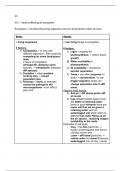
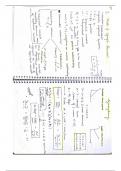
23.1 - factors affecting an ecosystem
Ecosystem = all interacting living organisms and non living factors within an area
Biotic Abiotic
= living organisms = non living things in ecosystem
3 factors: 6 factors:
1) Competition = in area with 1) Light = required for
different organisms , they would be
photosynthesis → affect plant
competing for same food/space/
mate growth
- 2 types of competition: 2) Water availability =
intraspecific (between same photosynthesis
species) + interspecific (between 3) 02 availability = needed for
diff species) aerobic respiration
2) Predation = when predator 4) Temp = can affect enzymes in
hunting prey → impact
body → denaturation / or can
population size
3) Diseases = biotic as diseases trigger migration which can
caused by pathogens aka change population size in diff
microorganisms →can affect areas
pop size Adaphic (soil) factors
5) Soil ph = diff plants prefer diff
ph levels
6) type of soil (certain types of soil
are better at retaining water
which is good however there are
some soil that are so good at
retaining water such as
waterlogged soil which refers to
soil that has water filling up all
the air spaces , reducing oxygen
availability to the roots
Examples of soil types
- Clay = has fine particles →
easily waterlogged and forms
clumps when wet
- Loam = diff sized particles →
retains water but doesn't become
waterlogged (mix of clay + sand)
, - sandy= course well separated
particles that allow free draining -
sandy soil does not retain water
and is easily eroded
23.2 - trophic levels and biomass
1/03/23
Trophic levels
= stages in the food chain
- Producers = plants that produce food in first place by photosynthesis to make
glucose (first trophic level) e.g. algae
- Primary consumers = eat producers , usually herbivores (some of energy
transferred to PC)
- Secondary consumers = eat primary consumers (usually is carnivore but can
be herbivore)
- Tertiary consumers = eat secondary consumers
- Producer would be a plant but other examples chemoautotrophic = bacteria that
can generate own bacteria
- Carnivore = eat only other animals
- Herbivore = eat only plants
- Omnivore = eat both plant + animal
Producers → primary consumers →secondary consumers → tertiary
- Food chain can be represented by pyramid which represents the number of
organisms at each of the trophic levels ALSO can show the biomass of each
level
Biomass
23.1 - factors affecting an ecosystem
Ecosystem = all interacting living organisms and non living factors within an area
Biotic Abiotic
= living organisms = non living things in ecosystem
3 factors: 6 factors:
1) Competition = in area with 1) Light = required for
different organisms , they would be
photosynthesis → affect plant
competing for same food/space/
mate growth
- 2 types of competition: 2) Water availability =
intraspecific (between same photosynthesis
species) + interspecific (between 3) 02 availability = needed for
diff species) aerobic respiration
2) Predation = when predator 4) Temp = can affect enzymes in
hunting prey → impact
body → denaturation / or can
population size
3) Diseases = biotic as diseases trigger migration which can
caused by pathogens aka change population size in diff
microorganisms →can affect areas
pop size Adaphic (soil) factors
5) Soil ph = diff plants prefer diff
ph levels
6) type of soil (certain types of soil
are better at retaining water
which is good however there are
some soil that are so good at
retaining water such as
waterlogged soil which refers to
soil that has water filling up all
the air spaces , reducing oxygen
availability to the roots
Examples of soil types
- Clay = has fine particles →
easily waterlogged and forms
clumps when wet
- Loam = diff sized particles →
retains water but doesn't become
waterlogged (mix of clay + sand)
, - sandy= course well separated
particles that allow free draining -
sandy soil does not retain water
and is easily eroded
23.2 - trophic levels and biomass
1/03/23
Trophic levels
= stages in the food chain
- Producers = plants that produce food in first place by photosynthesis to make
glucose (first trophic level) e.g. algae
- Primary consumers = eat producers , usually herbivores (some of energy
transferred to PC)
- Secondary consumers = eat primary consumers (usually is carnivore but can
be herbivore)
- Tertiary consumers = eat secondary consumers
- Producer would be a plant but other examples chemoautotrophic = bacteria that
can generate own bacteria
- Carnivore = eat only other animals
- Herbivore = eat only plants
- Omnivore = eat both plant + animal
Producers → primary consumers →secondary consumers → tertiary
- Food chain can be represented by pyramid which represents the number of
organisms at each of the trophic levels ALSO can show the biomass of each
level
Biomass