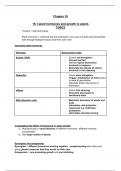
Chapter 16
16.1 plant hormones and growth in plants
7/09/23
- Tropism = light and gravity
- Plant hormones = chemical that are produced in one area of a plant and transported
both through transport tissues and from cell to cell
Important plant hormones
Hormone Some known roles
Auxins ( IAA) - Control cell elongation
- Prevent leaf fall
- Maintain apical dominance
- Involved in tropisms
- Stimulate the release of ethene
- Involved in fruit ripening
Gibberllin - Cause stem elongation
- Trigger mobilisation of food stored
in seed at germination
- Stimulate pollen tube grown in
fertilisation
ethene - Cause fruit ripening
- Promotes abscission in
deciduous trees
ABA (abscisic acid) - Maintains dormancy of seeds and
buds
- stimulates cold protective
responses e.g. antifreeze
production
- stimulates stomatal closing
Investigating the effect of hormones on plant growth
1) Hydroponically in serial dilutions of different hormones / different hormone
concentration
2) Use large number of plants
Synergism and antagonism
Synergism = different hormones working together , complementing each other and
giving greater response that they would on their own
Antagonism = one promoting growth and one inhibiting
, Stages:
1) Seed germination - gibberellins stimulate production of digestive enzymes
to release glucose from food stores ( starch broken down from food stores
by enzyme) e.g. amylase breaks down starch → maltose/ other simple
sugars used in respiration for energy ( energy needed 4 growth → seedling
growth and to break out of seed coat)
Experimental evidence for role of gibberellins in seed germination
- Mutant varieties of seeds have been bred which lacks the gene which enable
production of gibberellins → seeds do not germinate
- If gibberellin biosynthesis inhibitors are applied to seeds → not germinate as
they cant make gibberellins needed to break dormancy . If gibberellin inhibition
removed then seed germinates
2) Cell elongation - auxins
- Meristematic cells produce auxin → diffuse towards zone of elongation down a
conc gradient through transport tissue
- Auxin binds to a receptor on a cell surface membrane ( in the zone of elongation)
which opens protein channels on plasma membranes that specifically allow
hydrogen ions to enter the cell. ( hydrogen ions are always out of a cell in this
area)
- Hydrogen ions decrease ph level → cellulose become more flexible ( water
moving into cell and expanding without burst . small vacuoles start forming to
store those extra water) ( auxin still attached)
- Eventually cell elongates + becomes bigger + full large permanent vacuole
- As cell matures , there is less auxin around and also enzymes that break auxin
down
- Since no auxin activating and opening protein channel → protein channel
closes to prevent further entry of hydrogen ions → ph rises back to normal
level → cell wall rigid and no longer flexible cell
16.1 plant hormones and growth in plants
7/09/23
- Tropism = light and gravity
- Plant hormones = chemical that are produced in one area of a plant and transported
both through transport tissues and from cell to cell
Important plant hormones
Hormone Some known roles
Auxins ( IAA) - Control cell elongation
- Prevent leaf fall
- Maintain apical dominance
- Involved in tropisms
- Stimulate the release of ethene
- Involved in fruit ripening
Gibberllin - Cause stem elongation
- Trigger mobilisation of food stored
in seed at germination
- Stimulate pollen tube grown in
fertilisation
ethene - Cause fruit ripening
- Promotes abscission in
deciduous trees
ABA (abscisic acid) - Maintains dormancy of seeds and
buds
- stimulates cold protective
responses e.g. antifreeze
production
- stimulates stomatal closing
Investigating the effect of hormones on plant growth
1) Hydroponically in serial dilutions of different hormones / different hormone
concentration
2) Use large number of plants
Synergism and antagonism
Synergism = different hormones working together , complementing each other and
giving greater response that they would on their own
Antagonism = one promoting growth and one inhibiting
, Stages:
1) Seed germination - gibberellins stimulate production of digestive enzymes
to release glucose from food stores ( starch broken down from food stores
by enzyme) e.g. amylase breaks down starch → maltose/ other simple
sugars used in respiration for energy ( energy needed 4 growth → seedling
growth and to break out of seed coat)
Experimental evidence for role of gibberellins in seed germination
- Mutant varieties of seeds have been bred which lacks the gene which enable
production of gibberellins → seeds do not germinate
- If gibberellin biosynthesis inhibitors are applied to seeds → not germinate as
they cant make gibberellins needed to break dormancy . If gibberellin inhibition
removed then seed germinates
2) Cell elongation - auxins
- Meristematic cells produce auxin → diffuse towards zone of elongation down a
conc gradient through transport tissue
- Auxin binds to a receptor on a cell surface membrane ( in the zone of elongation)
which opens protein channels on plasma membranes that specifically allow
hydrogen ions to enter the cell. ( hydrogen ions are always out of a cell in this
area)
- Hydrogen ions decrease ph level → cellulose become more flexible ( water
moving into cell and expanding without burst . small vacuoles start forming to
store those extra water) ( auxin still attached)
- Eventually cell elongates + becomes bigger + full large permanent vacuole
- As cell matures , there is less auxin around and also enzymes that break auxin
down
- Since no auxin activating and opening protein channel → protein channel
closes to prevent further entry of hydrogen ions → ph rises back to normal
level → cell wall rigid and no longer flexible cell