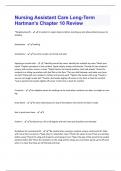
Nursing Assistant Care Long-Term Hartman's Chapter 10 Review Questions And Answers With Verified Solutions Graded A+
*Dangling benefit - A resident to regain balance before standing up and allows blood pressure to stabilize. Ambulation - walking Ambulatory - one who can get out of bed and walk Applying a transfer belt - *Identify yourself by name. Identify the resident by name *Wash your hands *Explain procedure to the resident. Speak clearly, slowly, and directly *Provide for the resident's privacy with curtain, screen, or door *Adjust bed to the lowest position. Lock bed wheels *Assist the resident to a sitting up position with feet flat on the floor *Put non-skid footwear and make sure laces are tied *Place belt over resident's clothes and around waist *Tighten the buckle until snug *Check to see are not caught under belt *Position the buckle slightly off-center in the front or back for comfort *Last is position the buckle slightly off-center in the front or back for comfort Crustches - An adaptive device for walking can be used when residents can bear no weight on one leg Draw Sheet - An extra sheet placed on top of the bottom sheet when the bed is made feet in quad cane have - 4 Fowler's - Positioned at a 45 to 60 degree with the head and shoulders are elevated Guidelines for mechanical lift - *Be careful when moving a resident using a mechanical lift. Safer with more than one person *Keep chair or wheelchair close *Check the valves to see if they are working before using *Check the sling and straps for any fraying or tear *Open the legs of the stand to the widest position before left *Once the resident is in the sling and the straps are connected, pump up the lift only when it is clear that they are off the bed and chair.Guidelines for proper body mechanics - * Assess the load (weight) *Think ahead, plan, and communicate *Check your base of support and be sure you have a firm footing *Face what you are lifting. Feet should always face the direction you are moving. *Back straight *Begin in a squatting position and lift with legs *Tighten your stomach *Keep objects close *Push if possible How often should bedbound residents be repositioned - Every two hours Lateral - Lying on either side Logrolling necessary - In case of neck or back problems, spinal cord injures, or back or hip surgeries Moves first - Stronger side One benefit of using toilet rather than a bedpan or urinal - Empties more efficiently, bare weight on legs Positioning - Act of helping resident into positions that promote comfort and good health Prone - Lying on their stomach Purpose of canes - help with balance Shearing - Rubbing or friction that results from the skin moving one way and bone underneath remained fixed or moving in opposite directions Sims' - Lying on their left side with lower arm behind and upper knee bent Supine - Lying on their backwalker - bear some weight on the legs Wheelchair - Always lock wheelchair before helping a resident into wheelchair When may stretchers be used for residents - Serious injuries or illness and/or when a person cannot or should not walk
Escuela, estudio y materia
- Institución
- Nursing Assistant Care Long-Term Hartman\'s Chapter
- Grado
- Nursing Assistant Care Long-Term Hartman\'s Chapter
Información del documento
- Subido en
- 30 de julio de 2024
- Número de páginas
- 3
- Escrito en
- 2023/2024
- Tipo
- Examen
- Contiene
- Preguntas y respuestas
Temas
-
nursing assistant care long term hartmans chapter

Documento también disponible en un lote