RMIN 4000 Test 1 Brown UGA Questions And Answers With Verified Solutions Graded A+
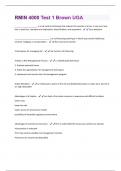
_______ _____________ is a risk control technique that reduces the severity of a loss. it can occur preloss or post-loss. examples are duplication, diversification, and separation - Loss reduction __________________ _____________ is a risk financing technique in which you transfer liability by contract, hedging, or incorporation. - Non-Insurance transfer. 2 techniques for managing risk - risk control, risk financing 4 Steps in Risk Management Process - 1. Identify potential losses 2. Evaluate potential losses 3. Select the appropriate risk management techniques 4. Implement and monitor the risk management program Active Retention - an individual is aware of the risk and deliberately plans to retain all or part of it; ex: high deductible Advantages of a Captive - can help a firm when insurance is expensive and difficult to obtain lower costs lower tax rate easier access to reinsurance market possibility of favorable regulatory enviornment advantages of commercial insurance - firm is indemnified for losses;can continue to operate •Uncertainty is reduced• Firm may receive valuable risk management services Premiums are income-tax deductibleadvantages of non-insurance transfer - Can transfer some losses that are not insurable Less expensive Can transfer loss to someone who is in a better position to control losses Advantages of Retention - -save on loss costs -save on expenses -encourage loss prevention -increase cash flow adverse selection - the situation in which one party to a transaction takes advantage of knowing more than the other party to the transaction areas of emphasis for commercial insurance - tion of insurance coverage's tion of an insurer. 3.Negotiation of terms. 4.Dissemination of information concerning insurance coverages. 5.Periodic review of the insurance program asymmetric information - a situation in which one side of the market has more reliable information than the other side Benefits of Risk Management - -Enables firm to attain its pre-loss and post-loss objectives more easily -A risk management program can reduce a firm's cost of risk -Reduction in pure loss exposures allows a firm to enact an enterprise risk management program to treat both pure and speculative loss exposures -Society benefits because both direct and indirect losses are reduced captive insurer - an insurer owned by a parent firm for the purpose of insuring the parent firm's loss exposuresCasualty Insurance - refers to insurance that covers whatever is not covered by fire, marine, and life insurance Chance of Loss Must be Calculable - must be able to calculate the frequency and severity Characteristics of an ideally insurable risk - 1. Large number of exposure units 2. Accidental and unintentional loss 3. Determinable and measurable loss 4. No catastrophic loss 5. Calculable chance of loss 6. Economically feasible premium
Escuela, estudio y materia
- Institución
- RMIN 4000 Brown UGA
- Grado
- RMIN 4000 Brown UGA
Información del documento
- Subido en
- 28 de julio de 2024
- Número de páginas
- 10
- Escrito en
- 2023/2024
- Tipo
- Examen
- Contiene
- Preguntas y respuestas
Temas
-
rmin 4000 test 1 brown uga

Documento también disponible en un lote