Samenvatting Policy Analysis
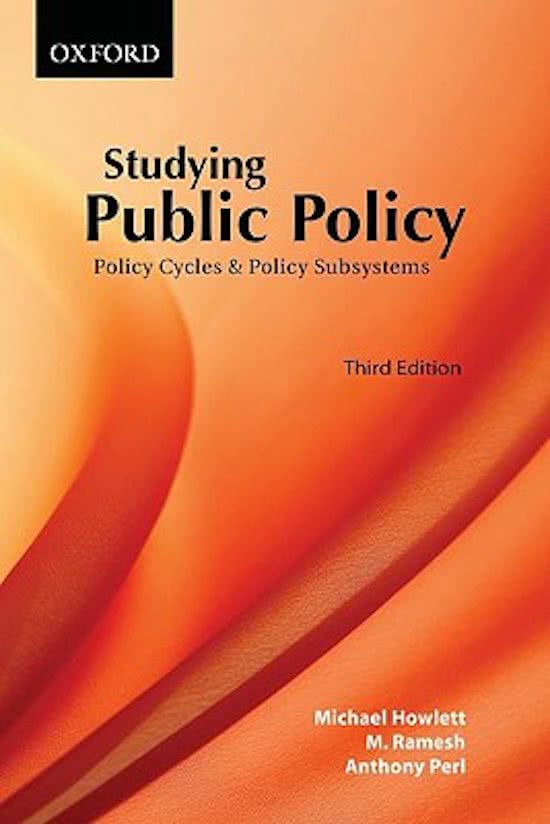
Howlett M., Ramesh M. & Perl, A. (2020, Fourth editi on) Studying public policy. Principles and
processes. Oxford, University Press. (Dr. Ellen Fobé)
About the course: Outline, planning, evaluation and assignment
Aims
Students will acquire the necessary knowledge to understand, analyse, explain and illustrate – in
a scientific and critical way – the formation, implementation, and evaluation of policies
In addition to the theoretical knowledge, the course will offer the students concrete illustrations
of policy analysis (in praxis and in research) via the guest lectures, additional texts and
discussions in class
To apply theoretical knowledge with practical examples
Course material: Coursebook, slides, class recordings + Extra texts, illustrations, guest lecture
material (slides, docs) etc.
Student evaluation
1. Submission of portfolio assignment
Portfolio (5pts): To be submitted 2x during semester
! No portfolio submission = NA for the entire course !
= Mastering the content of the course (and illustrating this)
Check Ultra for instructions, details, examples, Q&A
Portfolio
Register a policy sector of your choice by Friday 23 February (Illustrate it with a link!)
Is split up in 2 parts:
o Part 1: Based on sessions 5, 6, 7 Deadline 15.04
o Part 2: Based on sessions 8, 9, 10 Deadline 13.05
Consists of 2 entries for each session = 12 entries total
o Part 1: 2x entry for session 5; 2x session 6; 2x session 7
o Part 2: 2x entry for session 8; 2x session 9, 2x session 10
2. Written exam
Exam (15pts)
Combines theory, insights, application, Multiple Choice questions
Part 1: Meta-Analysis of Policy (Making): Methods and Approaches (Macro-approach)
Overview of existing theoretical and philosophical approaches of public policy analysis
Session 1: The development of public policy analysis and the policy sciences
Introduction – Intro to the course/to public policy analysis, actors, cycle model
Public policy
Governments make Public policy ≠ Politics; Policy
Studying public policy
o Why are certain decisions taken at certain times and not others?
o How do policy decisions add up into policy regimes or mixes? Are those decisions in
contrast incompatible or contradictory?
o Do decisions result in recognizable patterns, or can we merely discern (quasi)random
accumulations of multiple decisions in the past?
o What actors are involved in public policies, what do these policy actors do, why and what
difference do they make?
Public policy includes healthcare access, environmental protection, education funding, economic
growth, social welfare, security measures, technology regulation, immigration management…
1
, o Examples of ‘Public Policy’: Security, defense policies, health care (for the elderly), preventing
COVID, dealing with all sorts of crises, agricultural policies, education, energy, climate, transport…
o Policy sectors and areas to illustrate certain theories and concepts
Public policy analysis…
o Analysis OF policy: Descriptive, theoretical and policy sciences
Real life situations which we analyse
o Analysis FOR policy: Applied, prescriptive and policy analysis
Public policy analysis = A relatively new discipline in society (in general; Both academically & professionally)
Academic discipline
o Multi-disciplinary o Mapping (= het in kaart brengen)
o Multi-method of contexts, alternatives and
o Problem-oriented effects
Harold Lasswell = Considered as the founder of the academic policy analysis
Daniel Lerner & Harold Lasswell: The Policy Sciences (1951)
o The "policy sciences" are defined as "the disciplines concerned with explaining the policy making
and policy executing process, and with locating data and providing interpretations which are
relevant to the policy problems of a given period" (p. 14) - De "policy sciences" w gedefinieerd als
"de disciplines die zich bezighouden met het verklaren vh beleidsvormings- en uitvoeringsproces,
en met het lokaliseren vn gegevens en het verstrekken vn interpretaties die relevant zijn vr de
beleidsproblemen v/e bep periode"
o The term "policy“ is used "to designate the most important choices made either in organized or
private life" (p. 5) - De term "beleid" w gebruikt "om de belangrijkste keuzes aan te duiden die w
gemaakt, zowel in georganiseerd als privéleven"
Definitions of policy Defining public policy is a challenge!
A few examples of definitions:
o Public policy is ‘anything a government chooses to do or not to do’ (Thomas Dye – 1972)
Specifies that the primary agent of public policymaking is a government
Clarifies that private decisions by business, social groups, or individuals are not in
themselves public policies
Only governments can make authoritative decisions on behalf of citizens, that is,
ones backed up by legitimate sanctions for transgressors in event of
noncompliance - Beslissingen die w ondersteund door legitieme sancties vr overtreders
in geval vn niet-naleving
Public policymaking involves a fundamental choice on the part of governments
to either do something or to do nothing about a problem and that this decision is
made by elected politicians and other government officials
So, also the things that the governments ignore to do, like climate
change, (the decision not to take actions against the) migrant crisis…
A conscious choice/decision by government, so government actions and
decisions often yield unintended consequences (for example: The black market
with the regulation of the tobacco consumption)
o Public policy as “a set of interrelated decisions taken by a political actor or group of
actors concerning the selection of goals and the means of achieving them within a
specified situation where those decisions should, in principle, be within the power of
those actors to achieve.” (William Jenkins – 1978)
‘The same definition as Dye, but with more words’
A problem-oriented process
Goal-oriented behavior
Recognizes, in a way that Dye’s doesn’t, that limitations on a government’s
ability to think and act can constrain the decision options being considered and
2
, can advance or undermine the success of policy-making efforts - Beperkingen op
het vermogen v/e overheid om te denken en handelen, de besluitopties die w
overwogen kunnen beperken, en het succes vn beleidsinspanningen kunnen bevorderen
of ondermijnen
o A purposive course of action followed by an actor or set of actors in dealing with a
problem or matter of concern for the population (James Anderson – 1975)
Distinction between a problem and a matter of concern
Very clear positivist vision
Actors & Institutions (in the policy process)
For example: Agriculture policies Who are
the actors there? < The European Union
(mainly the Commission), Agriculture or
Farmer Organizations…
Actors
o Elected politicians
o Administrative officials
Power to make policy Role as
policy adviser/analyst/worker … As stakeholder or as target group … Capable/not to
influence policy makers (pm)
o Political parties, and their study centers
o Interest groups, NGOs
o Research organisations, academic institutes, think tanks
o Mass media
o (Voters/Citizens/Individuals…)
The policy cycle model
A problem-solving model of the policy process
Advantages
o Helps to reduce complexity
o Mapping and clarifying the roles of actors, institutions and ideas/interests
Disadvantages
o Policy is non-systematic, non-linear
o Idiosyncratic problem solving (= eigenzinnige probleemoplossing)
o Stages compressed or skipped (= Fasen ingekort of overgeslagen)
o Causes and
effects
unclear
Stages of the policy cycle
- Disseminating =
Verspreiden of
bekendmaken,
vooral in de
context vn info,
kennis of nieuws
- Estimation =
Inschatting
3
, Stages of the Policy Cycle
and Applied Problem-Solving
(see p. 11)
Studying the public policy
process
The Policy Cycle-Actor
Hourglass (see p. 12)
Agenda-setting: Anyone can play a role, anyone can influence the agenda-setting stage
o For example: Greta Thunberg, a soldier from the US Military…
Policy formulation
Decision-making
Policy implementation
Policy evaluation
o Can be influence by anyone with an interest in the topic
The Need for Public Policy Capacity (see p. 14): Refers to the requirement for adequate resources and
capabilities at individual, organizational, and systemic levels, along with essential skills (analytical,
operational, and political) to effectively formulate and implement public policies
Levels of resources and capabilities: Individual, organizational and systematic
Skills and competences: Analytical, operational and political
Conclusion
1. Common Ideas in Public Policymaking: Shared ideas include recognizing that only governments can
make authoritative decisions on behalf of citizens, and public policy involves a conscious choice by the
government to either act or not on a particular problem, with potential unintended consequences.
2. Policy Studies vs. Policy Analysis: Policy studies focus on theoretical and philosophical approaches,
while policy analysis is more applied and prescriptive. Positivist and post-positivist assumptions color
these activities, influencing the methodologies employed.
3. Usefulness of Policy Cycle Model: The policy cycle model is useful for reducing complexity and
mapping roles but has limitations, including non-systematic and non-linear policy processes,
idiosyncratic problem-solving, and stages being compressed or skipped.
4. Three Components of Public Capacity: Governments, organizations, and policy managers need
individual, organizational, and systemic resources and capabilities. These are related to analytical,
operational, and political skills and competences.
5. Policy Style and Policy Regime: A policy style refers to the way decisions are made and implemented,
while a policy regime is a pattern of related policies. They are related as styles contribute to regime
formation and understanding them is crucial for effective policymaking.
4
Howlett M., Ramesh M. & Perl, A. (2020, Fourth editi on) Studying public policy. Principles and
processes. Oxford, University Press. (Dr. Ellen Fobé)
About the course: Outline, planning, evaluation and assignment
Aims
Students will acquire the necessary knowledge to understand, analyse, explain and illustrate – in
a scientific and critical way – the formation, implementation, and evaluation of policies
In addition to the theoretical knowledge, the course will offer the students concrete illustrations
of policy analysis (in praxis and in research) via the guest lectures, additional texts and
discussions in class
To apply theoretical knowledge with practical examples
Course material: Coursebook, slides, class recordings + Extra texts, illustrations, guest lecture
material (slides, docs) etc.
Student evaluation
1. Submission of portfolio assignment
Portfolio (5pts): To be submitted 2x during semester
! No portfolio submission = NA for the entire course !
= Mastering the content of the course (and illustrating this)
Check Ultra for instructions, details, examples, Q&A
Portfolio
Register a policy sector of your choice by Friday 23 February (Illustrate it with a link!)
Is split up in 2 parts:
o Part 1: Based on sessions 5, 6, 7 Deadline 15.04
o Part 2: Based on sessions 8, 9, 10 Deadline 13.05
Consists of 2 entries for each session = 12 entries total
o Part 1: 2x entry for session 5; 2x session 6; 2x session 7
o Part 2: 2x entry for session 8; 2x session 9, 2x session 10
2. Written exam
Exam (15pts)
Combines theory, insights, application, Multiple Choice questions
Part 1: Meta-Analysis of Policy (Making): Methods and Approaches (Macro-approach)
Overview of existing theoretical and philosophical approaches of public policy analysis
Session 1: The development of public policy analysis and the policy sciences
Introduction – Intro to the course/to public policy analysis, actors, cycle model
Public policy
Governments make Public policy ≠ Politics; Policy
Studying public policy
o Why are certain decisions taken at certain times and not others?
o How do policy decisions add up into policy regimes or mixes? Are those decisions in
contrast incompatible or contradictory?
o Do decisions result in recognizable patterns, or can we merely discern (quasi)random
accumulations of multiple decisions in the past?
o What actors are involved in public policies, what do these policy actors do, why and what
difference do they make?
Public policy includes healthcare access, environmental protection, education funding, economic
growth, social welfare, security measures, technology regulation, immigration management…
1
, o Examples of ‘Public Policy’: Security, defense policies, health care (for the elderly), preventing
COVID, dealing with all sorts of crises, agricultural policies, education, energy, climate, transport…
o Policy sectors and areas to illustrate certain theories and concepts
Public policy analysis…
o Analysis OF policy: Descriptive, theoretical and policy sciences
Real life situations which we analyse
o Analysis FOR policy: Applied, prescriptive and policy analysis
Public policy analysis = A relatively new discipline in society (in general; Both academically & professionally)
Academic discipline
o Multi-disciplinary o Mapping (= het in kaart brengen)
o Multi-method of contexts, alternatives and
o Problem-oriented effects
Harold Lasswell = Considered as the founder of the academic policy analysis
Daniel Lerner & Harold Lasswell: The Policy Sciences (1951)
o The "policy sciences" are defined as "the disciplines concerned with explaining the policy making
and policy executing process, and with locating data and providing interpretations which are
relevant to the policy problems of a given period" (p. 14) - De "policy sciences" w gedefinieerd als
"de disciplines die zich bezighouden met het verklaren vh beleidsvormings- en uitvoeringsproces,
en met het lokaliseren vn gegevens en het verstrekken vn interpretaties die relevant zijn vr de
beleidsproblemen v/e bep periode"
o The term "policy“ is used "to designate the most important choices made either in organized or
private life" (p. 5) - De term "beleid" w gebruikt "om de belangrijkste keuzes aan te duiden die w
gemaakt, zowel in georganiseerd als privéleven"
Definitions of policy Defining public policy is a challenge!
A few examples of definitions:
o Public policy is ‘anything a government chooses to do or not to do’ (Thomas Dye – 1972)
Specifies that the primary agent of public policymaking is a government
Clarifies that private decisions by business, social groups, or individuals are not in
themselves public policies
Only governments can make authoritative decisions on behalf of citizens, that is,
ones backed up by legitimate sanctions for transgressors in event of
noncompliance - Beslissingen die w ondersteund door legitieme sancties vr overtreders
in geval vn niet-naleving
Public policymaking involves a fundamental choice on the part of governments
to either do something or to do nothing about a problem and that this decision is
made by elected politicians and other government officials
So, also the things that the governments ignore to do, like climate
change, (the decision not to take actions against the) migrant crisis…
A conscious choice/decision by government, so government actions and
decisions often yield unintended consequences (for example: The black market
with the regulation of the tobacco consumption)
o Public policy as “a set of interrelated decisions taken by a political actor or group of
actors concerning the selection of goals and the means of achieving them within a
specified situation where those decisions should, in principle, be within the power of
those actors to achieve.” (William Jenkins – 1978)
‘The same definition as Dye, but with more words’
A problem-oriented process
Goal-oriented behavior
Recognizes, in a way that Dye’s doesn’t, that limitations on a government’s
ability to think and act can constrain the decision options being considered and
2
, can advance or undermine the success of policy-making efforts - Beperkingen op
het vermogen v/e overheid om te denken en handelen, de besluitopties die w
overwogen kunnen beperken, en het succes vn beleidsinspanningen kunnen bevorderen
of ondermijnen
o A purposive course of action followed by an actor or set of actors in dealing with a
problem or matter of concern for the population (James Anderson – 1975)
Distinction between a problem and a matter of concern
Very clear positivist vision
Actors & Institutions (in the policy process)
For example: Agriculture policies Who are
the actors there? < The European Union
(mainly the Commission), Agriculture or
Farmer Organizations…
Actors
o Elected politicians
o Administrative officials
Power to make policy Role as
policy adviser/analyst/worker … As stakeholder or as target group … Capable/not to
influence policy makers (pm)
o Political parties, and their study centers
o Interest groups, NGOs
o Research organisations, academic institutes, think tanks
o Mass media
o (Voters/Citizens/Individuals…)
The policy cycle model
A problem-solving model of the policy process
Advantages
o Helps to reduce complexity
o Mapping and clarifying the roles of actors, institutions and ideas/interests
Disadvantages
o Policy is non-systematic, non-linear
o Idiosyncratic problem solving (= eigenzinnige probleemoplossing)
o Stages compressed or skipped (= Fasen ingekort of overgeslagen)
o Causes and
effects
unclear
Stages of the policy cycle
- Disseminating =
Verspreiden of
bekendmaken,
vooral in de
context vn info,
kennis of nieuws
- Estimation =
Inschatting
3
, Stages of the Policy Cycle
and Applied Problem-Solving
(see p. 11)
Studying the public policy
process
The Policy Cycle-Actor
Hourglass (see p. 12)
Agenda-setting: Anyone can play a role, anyone can influence the agenda-setting stage
o For example: Greta Thunberg, a soldier from the US Military…
Policy formulation
Decision-making
Policy implementation
Policy evaluation
o Can be influence by anyone with an interest in the topic
The Need for Public Policy Capacity (see p. 14): Refers to the requirement for adequate resources and
capabilities at individual, organizational, and systemic levels, along with essential skills (analytical,
operational, and political) to effectively formulate and implement public policies
Levels of resources and capabilities: Individual, organizational and systematic
Skills and competences: Analytical, operational and political
Conclusion
1. Common Ideas in Public Policymaking: Shared ideas include recognizing that only governments can
make authoritative decisions on behalf of citizens, and public policy involves a conscious choice by the
government to either act or not on a particular problem, with potential unintended consequences.
2. Policy Studies vs. Policy Analysis: Policy studies focus on theoretical and philosophical approaches,
while policy analysis is more applied and prescriptive. Positivist and post-positivist assumptions color
these activities, influencing the methodologies employed.
3. Usefulness of Policy Cycle Model: The policy cycle model is useful for reducing complexity and
mapping roles but has limitations, including non-systematic and non-linear policy processes,
idiosyncratic problem-solving, and stages being compressed or skipped.
4. Three Components of Public Capacity: Governments, organizations, and policy managers need
individual, organizational, and systemic resources and capabilities. These are related to analytical,
operational, and political skills and competences.
5. Policy Style and Policy Regime: A policy style refers to the way decisions are made and implemented,
while a policy regime is a pattern of related policies. They are related as styles contribute to regime
formation and understanding them is crucial for effective policymaking.
4