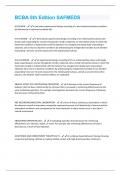
BCBA 5th Edition SAFMEDS A-B DESIGN - a two phase experimental design consisting of a pre -treatment baseline condition (A) followed by a treatment condition (B). A-B-A DESIGN - A three -phase experimental design consisting of an initial baseline phase until steady state responding (or counter -therapeutic trend) is obtained; an intervention phase in which the treatment condition is implemented until the behavior has changed and ste ady state responding is obtained, and a return to baseline conditions by withdrawing the independent variable to see whether responding "reverses" to levels observed in the initial baseline phase. A-B-A-B DESIGN - an experimental design consisting of (1) an initial baseline phase until steady state responding (or counter -therapeutic trend) is obtained, (2) an initial intervention phase in which the treatment variable is implemented until the behavior has changed and steady state responding is obtained, (3) a return to baseline conditions by withdrawing the independent variable to see whether responding "reverses" to levels observed in the initial baseline phase, and (4) a second intervention phase to see whether initi al treatment effects are replicated. ABATIVE EFFECT (OF A MOTIVATING OPERATION) - A decrease in the current frequency of behavior that has been reinforced by the stimulus that is increased in reinforcing effectiveness by the same motivating operation. For example, food ingestion decreases the current frequency of behavior that has been reinforced by food. ABC RECORDING/ANECDOTAL OBSERVATION - a form of direct, continuous observation in which the observer records a descriptive, temporally sequenced account of all behavior(s) of interest and the antecedent conditions and consequences for those behaviors as those events occur in the client's natur al environment ABOLISHING OPERATION (AO) - A motivating operation that decreases the reinforcing effectiveness of a stimulus, object, or event. For example, the reinforcing effectiveness of food is decreases as a result of food ingestion. ACCEPTANCE AND COMMITMENT THEARPY (ACT) - An evidence -based behavior therapy focusing on general well -being, defined as making reliable contact with high -priority positive reinforcers. ACCURACY (OF MEASUREMENT) - The extent to which observed values, the data produced by measuring an event, match the true state, or true values, of the event as it exists in nature ADAPTED ALTERNATING TREATMENTS DESIGN - A variation of the multielement design for comparing the efficiency of instructional procedures. The comparison phase of the design features the alternating application of two (usually) or more different teaching methods, each method applied to different b ut equivalent sets of instructional items. All items are topographically different members of the same response or skill class, such as reading printed words, defining vocabulary terms, spelling words, answering math problems, and stating history facts. ADD -IN COMPONENT ANALYSIS - A method for conducting a component analysis in which components are assessed individually or in combination before the complete treatment package is presented. This method can identify sufficient components. Sequence and floor or ceiling effects may mask the effects of components added in toward the end of the analysis. ADJUNCTIVE BEHAVIOR/SCHEDULE -INDUCED BEHAVIOR - Behavior that occurs as a collateral effect of a schedule of periodic reinforcement for other behavior; time -filling or interim activities that are induced by schedules of reinforcement during times when reinforcement is unlikely to be delivered. AFFIRMATION OF THE CONSEQUENT - A three -step form of reasoning that begins with a true antecedent -consequent (if -A-then -B) statement and proceeds as follows: (1) If A is true, then B is true; (2) B is found to be true; (3) therefore, A is true. Although other factors could be responsible for the truthfulness of A, a sound experiment affirms several if -A-then -B possibilities, each one reducing the likelihood of factors other than the independent variable being responsible for the observed changes in behavior. ALTERNATING TREATMENTS DESIGN - multi -element design ALTERNATIVE SCHEDULE (ALT) - Provides reinforcement when the response requirements of any of two or more simultaneously available component schedules are met. ANTECEDENT - An environmental condition or stimulus change existing or occurring prior to a behavior of interest. ANTECEDENT EXERCISE - An antecedent intervention, implemented independently of occurrences of the problem behavior, that usually has clients engage in some effortful form of aerobic activity (e.g. walking, jogging dancing, calisthenics, roller skating). Has been used in the tre atment of many maladaptive behaviors such as self -injurious behavior (SIB), aggression, and diverse behaviors such as inappropriate vocalizations, repetitive movements, talking -out, out -of-seat, and stereotypic behaviors ANTECEDENT INTERVENTION - A behavior change strategy that manipulates antecedent stimuli based on (a) motivating operations (evocative and abative effects), (b) stimulus control (differential availability of reinforcement), and (c) contingency -independent interventions (e.g. protec tive equipment, and restraint). ANTECEDENT STIMULUS CLASS - A set of stimuli that share a common relationship. all stimuli in an antecedent stimulus class evoke the same operant behavior, or elicit the same respondent behavior Applied Behavior Analysis (ABA) - The science in which tactics derived from the principles of behavior are applied to improve socially significant behavior and experimentation is used to identify the variables responsible for the improvement in behavior. ARBITRARILY APPLICABLE RELATIONAL RESPONDING (AARR) - forming new stimulus classes with little or no reinforced practice ARBITRARY RELATIONS - Stimuli to which people respond in interlocked ways, not because of physical similarity, but because social -verbal reinforcement contingencies teach people to respond to them in this way. ARBITRARY STIMULUS CLASS - antecedent stimuli that evoke the same response but do not resemble each other in physical form or share a relational aspect such as bigger or under (e.g., peanuts, cheese, coconut milk, and chicken breasts are members of this if they evoke the response "s ources of protein" ARTIFACT - an outcome or result that appears to exist because of the way it is measured but in fact does not correspond to what actually occurred ASCENDING BASELINE - A data path that shows an increasing trend in the response measure over time. AUDIENCE - Anyone who functions as a discriminative stimulus evoking verbal behavior. AUTOCLITIC - This relation involves two interlocking levels of verbal behavior emitted in one utterance. One level is a primary response (e.g., "The ice is solid"), while the other type is the secondary autoclitic response (e.g., adding "I think").Benefits the listener by providing additional information regarding the primary response. AUTOCLITIC FRAME - Provide structure among verbal operants in terms of order, agreement, grouping, and composition of larger units of verbal behavior such as sentences. This helps speakers generate novel utterances. For example, experience with the frame "the girl's (ball, d og, coat) may enable a child to say "the girl's hat" without prior teaching AUTOCLITIC MAND - This involves supplemental control by an MO related to some aspect of the Speaker's primary verbal response, (e.g., "Believe me, they are wrong.") enjoins a Listener to take some specific action regarding the primary response, and the subsequent behavior i s reinforced by that action. AUTOCLITIC TACT - This is controlled by some nonverbal feature of the primary response or its controlling variables, and the response informs the listener of that feature. This behavior is reinforced by listeners who provide generalized reinforcement. AUTOMATIC CONTINGENCIES - Skinner (1957) used "automatic" to identify circumstances in which behavior is evoked, shaped, maintained, or weakened by environmental variables occurring without direct manipulation by other people. All behavioral principles (e.g., reinforcement, extincti on, punishment) can affect our behavior automatically. AUTOMATIC PUNISHMENT - Punishment that occurs independent of the social mediation by others (i.e., a response product serves as a punisher independent of the social environment). AUTOMATIC REINFORCEMENT - reinforcement that occurs independent of the social mediation of others (e.g. scratching an insect bite relieves the itch) AUTOMATICITY (OF REINFORCEMENT) - Refers to the fact that behavior is modified by its consequences irrespective of the person's awareness; a person does not have to recognize or verbalize
Examen
BCBA 5th Edition SAFMEDS Questions And Answers With Verified Solutions Graded A+
Puntuación
Vendido
-
Páginas
64
Grado
A+
Subido en
27-07-2024
Escrito en
2023/2024
A-B DESIGN - a two phase experimental design consisting of a pre-treatment baseline condition (A) followed by a treatment condition (B). A-B-A DESIGN - A three-phase experimental design consisting of an initial baseline phase until steady state responding (or counter-therapeutic trend) is obtained; an intervention phase in which the treatment condition is implemented until the behavior has changed and steady state responding is obtained, and a return to baseline conditions by withdrawing the independent variable to see whether responding "reverses" to levels observed in the initial baseline phase. A-B-A-B DESIGN - an experimental design consisting of (1) an initial baseline phase until steady state responding (or counter-therapeutic trend) is obtained, (2) an initial intervention phase in which the treatment variable is implemented until the behavior has changed and steady state responding is obtained, (3) a return to baseline conditions by withdrawing the independent variable to see whether responding "reverses" to levels observed in the initial baseline phase, and (4) a second intervention phase to see whether initial treatment effects are replicated. ABATIVE EFFECT (OF A MOTIVATING OPERATION) - A decrease in the current frequency of behavior that has been reinforced by the stimulus that is increased in reinforcing effectiveness by the same motivating operation. For example, food ingestion decreases the current frequency of behavior that has been reinforced by food. ABC RECORDING/ANECDOTAL OBSERVATION - a form of direct, continuous observation in which the observer records a descriptive, temporally sequenced account of all behavior(s) of interest and the antecedent conditions and consequences for those behaviors as those events occur in the client's natural environment ABOLISHING OPERATION (AO) - A motivating operation that decreases the reinforcing effectiveness of a stimulus, object, or event. For example, the reinforcing effectiveness of food is decreases as a result of food ingestion. ACCEPTANCE AND COMMITMENT THEARPY (ACT) - An evidence-based behavior therapy focusing on general well-being, defined as making reliable contact with high-priority positive reinforcers.ACCURACY (OF MEASUREMENT) - The extent to which observed values, the data produced by measuring an event, match the true state, or true values, of the event as it exists in nature ADAPTED ALTERNATING TREATMENTS DESIGN - A variation of the multielement design for comparing the efficiency of instructional procedures. The comparison phase of the design features the alternating application of two (usually) or more different teaching methods, each method applied to different but equivalent sets of instructional items. All items are topographically different members of the same response or skill class, such as reading printed words, defining vocabulary terms, spelling words, answering math problems, and stating history facts. ADD-IN COMPONENT ANALYSIS - A method for conducting a component analysis in which components are assessed individually or in combination before the complete treatment package is presented. This method can identify sufficient components. Sequence and floor or ceiling effects may mask the effects of components added in toward the end of the analysis. ADJUNCTIVE BEHAVIOR/SCHEDULE-INDUCED BEHAVIOR - Behavior that occurs as a collateral effect of a schedule of periodic reinforcement for other behavior; time-filling or interim activities that are induced by schedules of reinforcement during times when reinforcement is unlikely to be delivered. AFFIRMATION OF THE CONSEQUENT - A three-step form of reasoning that begins with a true antecedent-consequent (if-A-then-B) statement and proceeds as follows: (1) If A is true, then B is true; (2) B is found to be true; (3) therefore, A is true. Although other factors could be responsible for the truthfulness of A, a sound experiment affirms several if-A-then-B possibilities, each one reducing the likelihood of factors other than the independent variable being responsible for the observed changes in behavior. ALTERNATING TREATMENTS DESIGN - multi-element design ALTERNATIVE SCHEDULE (ALT) - Provides reinforcement when the response requirements of any of two or more simultaneously available component schedules are met. ANTECEDENT - An environmental condition or stimulus change existing or occurring prior to a behavior of interest.ANTECEDENT EXERCISE - An antecedent intervention, implemented independently of occurrences of the problem behavior, that usually has clients engage in some effortful form of aerobic activity (e.g. walking, jogging dancing, calisthenics, roller skating). Has been used in the treatment of many maladaptive behaviors such as self-injurious behavior (SIB), aggression, and diverse behaviors such as inappropriate vocalizations, repetitive movements, talking-out, out-of-seat, and stereotypic behaviors
Mostrar más
Leer menos
Institución
BCBA 5th Edition SAFMEDS
Grado
BCBA 5th Edition SAFMEDS
Ups! No podemos cargar tu documento ahora. Inténtalo de nuevo o contacta con soporte.
Escuela, estudio y materia
- Institución
- BCBA 5th Edition SAFMEDS
- Grado
- BCBA 5th Edition SAFMEDS
Información del documento
- Subido en
- 27 de julio de 2024
- Número de páginas
- 64
- Escrito en
- 2023/2024
- Tipo
- Examen
- Contiene
- Preguntas y respuestas
Temas
-
bcba 5th edition safmeds
Vista previa del contenido
$8.49
Accede al documento completo:
100% de satisfacción garantizada
Inmediatamente disponible después del pago
Tanto en línea como en PDF
No estas atado a nada

Documento también disponible en un lote
Package deal
SAFMEDS Complete Package Deal With Verified Study Solutions Rated A+
9
2024
$ 76.41
Más información