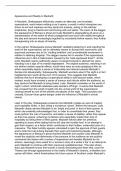
How is Macbeth presented?
In Macbeth, Shakespeare initially protects the protagonist as a brave military hero.
However, Macbeth then performs a series of immoral wrongdoings, including the
murder of King Duncan and usurping his position on the throne. By the end of the
play, Macbeth’s prowess reappears as we witness him bravely combating the
entirety of an army, although these attempts equate to those of a desperate tyrant
rather than a heroic and powerful leader. Though Macbeth rarely evinces positive
heroism, as a protagonist of a tragedy, he can be interpreted as being a tragic hero
with multiple prominent flaws who undergoes a reversal of fortune.
In the extract, Shakespeare presents Macbeth as a military hero, defiantly preparing
for battle. Macbeth finds comfort in the witches words, directly referencing them as if
to convince himself of their veracity and proclaiming that he cannot ‘taint with fear’
while being reassured by their promising words, hence amplifying his sheer devotion
and compliance within the witches words, despite acknowledging their equivocal
nature. This suggests that he sees fear as unbefitting of a military hero, while
simultaneously depicting how he believes in his own invincibility amplified through
the support of the witches. He then contrasts his courage with the disloyal thanes
and their soft-living English allies, suggesting that, as he can never ‘shake with fear’,
he is a bold hero compared to them, thus proving to be ironic as he is ultimately led
to his own downfall, while the protagonists ultimately overrule and take Macbeth’s
place. To specify, he labels them as ‘cream-faced loons’ in an attempt to insult their
masculinity and amplify his own self pride and strength. This insult presents Macbeth
nor as a hero or a good leader but as a tyrannous, angry fool, apparently fixating on
his servant’s pale face and disbelieving his legitimate message, rather than thinking
clearly and behaving with an established sense of morality and bravery that we may
expect from a true hero. Therefore, the audience interprets Shakespeare attempt as
dramatic irony as an attempt to further ridicule Macbeth, who reverted the natural
predisposed laws of the hierarchy to fulfil selfish desires.
At the start of the play, Shakespeare introduces Macbeth via the Captain’s
breathless praise of his heroism. The Captain amplifies the quintessential skills and
agility required to fulfil the extent of violence that Macbeth demonstrated. To specify,
he explains how Macbeth ‘unseamed him from the nave to th’chaps’ and ‘carved out
his passage’ which creates a slight disturbing, yet manly image of violence. Both
lines displaying a sense of agility and expertise, Macbeth’s initial reputability and
heroism is amplified, as within the depths of the Jacobean era, acts of murder
addressed towards the monarchy would be deemed as condemnable and
disreputable yet acts of violence resolved around a basis of loyalty to one’s country
were more accepted. The captain contrasts the ‘rebel’s whore’, being Macdonald,
with the ‘brave Macbeth’, whose sword ‘smoked with bloody execution’. This
utilisation of imagery combines both the liquidity of blood and a raging fire to suggest
that the blood of the rebels seemed to burn and tarnish Macbeth’s sword, serving as
a prominent representation of his heroism. The captain recounts how Macbeth and
Banquo redouble their efforts and shed much more blood once the battle has been
renewed as if, he wonders, to ‘memorize another Golgotha’. The allusion to the
Crucifixion perhaps suggests that, for the Captain, Macbeth is solely an
accomplished hero, as Jesus is to a Christian audience. Although, the audience may
naturally struggle to identify Macbeth with Jesus, identifying him instead with the
In Macbeth, Shakespeare initially protects the protagonist as a brave military hero.
However, Macbeth then performs a series of immoral wrongdoings, including the
murder of King Duncan and usurping his position on the throne. By the end of the
play, Macbeth’s prowess reappears as we witness him bravely combating the
entirety of an army, although these attempts equate to those of a desperate tyrant
rather than a heroic and powerful leader. Though Macbeth rarely evinces positive
heroism, as a protagonist of a tragedy, he can be interpreted as being a tragic hero
with multiple prominent flaws who undergoes a reversal of fortune.
In the extract, Shakespeare presents Macbeth as a military hero, defiantly preparing
for battle. Macbeth finds comfort in the witches words, directly referencing them as if
to convince himself of their veracity and proclaiming that he cannot ‘taint with fear’
while being reassured by their promising words, hence amplifying his sheer devotion
and compliance within the witches words, despite acknowledging their equivocal
nature. This suggests that he sees fear as unbefitting of a military hero, while
simultaneously depicting how he believes in his own invincibility amplified through
the support of the witches. He then contrasts his courage with the disloyal thanes
and their soft-living English allies, suggesting that, as he can never ‘shake with fear’,
he is a bold hero compared to them, thus proving to be ironic as he is ultimately led
to his own downfall, while the protagonists ultimately overrule and take Macbeth’s
place. To specify, he labels them as ‘cream-faced loons’ in an attempt to insult their
masculinity and amplify his own self pride and strength. This insult presents Macbeth
nor as a hero or a good leader but as a tyrannous, angry fool, apparently fixating on
his servant’s pale face and disbelieving his legitimate message, rather than thinking
clearly and behaving with an established sense of morality and bravery that we may
expect from a true hero. Therefore, the audience interprets Shakespeare attempt as
dramatic irony as an attempt to further ridicule Macbeth, who reverted the natural
predisposed laws of the hierarchy to fulfil selfish desires.
At the start of the play, Shakespeare introduces Macbeth via the Captain’s
breathless praise of his heroism. The Captain amplifies the quintessential skills and
agility required to fulfil the extent of violence that Macbeth demonstrated. To specify,
he explains how Macbeth ‘unseamed him from the nave to th’chaps’ and ‘carved out
his passage’ which creates a slight disturbing, yet manly image of violence. Both
lines displaying a sense of agility and expertise, Macbeth’s initial reputability and
heroism is amplified, as within the depths of the Jacobean era, acts of murder
addressed towards the monarchy would be deemed as condemnable and
disreputable yet acts of violence resolved around a basis of loyalty to one’s country
were more accepted. The captain contrasts the ‘rebel’s whore’, being Macdonald,
with the ‘brave Macbeth’, whose sword ‘smoked with bloody execution’. This
utilisation of imagery combines both the liquidity of blood and a raging fire to suggest
that the blood of the rebels seemed to burn and tarnish Macbeth’s sword, serving as
a prominent representation of his heroism. The captain recounts how Macbeth and
Banquo redouble their efforts and shed much more blood once the battle has been
renewed as if, he wonders, to ‘memorize another Golgotha’. The allusion to the
Crucifixion perhaps suggests that, for the Captain, Macbeth is solely an
accomplished hero, as Jesus is to a Christian audience. Although, the audience may
naturally struggle to identify Macbeth with Jesus, identifying him instead with the