ADHD
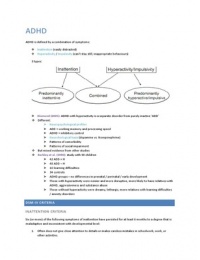
ADHD is defined by a combination of symptoms:
Inattention (easily distracted)
Hyperactivity / Impulsivity (can’t stay still, inappropriate behaviours)
3 types:
Diamond (2005): ADHD with hyperactivity is a separate disorder from purely inactive ‘ADD’
Different:
Neuropsychological profiles
ADD = working memory and processing speed
ADHD = inhibitory control
Neurobiological basis (dopamine vs. Norepinephrine)
Patterns of comorbidity
Patterns of social impairment
But mixed evidence from other studies
Barkley et al. (1990): study with 90 children
42 ADD + H
48 ADD – H
16 learning difficulties
34 controls
ADHD groups – no differences in prenatal / perinatal / early development
Those with hyperactivity were noisier and more disruptive, more likely to have relatives with
ADHD, aggressiveness and substance abuse
Those without hyperactivity were dreamy, lethargic, more relatives with learning difficulties
/ anxiety disorders
DSM-IV CRITERIA
INATTENTION CRITERIA
Six (or more) of the following symptoms of inattention have persisted for at least 6 months to a degree that is
maladaptive and inconsistent with developmental level:
1. Often does not give close attention to details or makes careless mistakes in schoolwork, work, or
other activities.
, 2. Often has trouble keeping attention on tasks or play activities.
3. Often does not seem to listen when spoken to directly.
4. Often does not follow instructions and fails to finish schoolwork, chores, or duties in the workplace
(not due to oppositional behavior or failure to understand instructions).
5. Often has trouble organising activities.
6. Often avoids, dislikes, or doesn't want to do things that take a lot of mental effort for a long period of
time (such as schoolwork or homework).
7. Often loses things needed for tasks and activities (e.g. toys, school assignments, pencils, books, or
tools).
8. Is often easily distracted.
9. Is often forgetful in daily activities.
HYPERACTIVITY / IMPULSIVITY CRITERIA
Six (or more) of the following symptoms of hyperactivity-impulsivity have persisted for at least 6 months to a
degree that is maladaptive and inconsistent with developmental level:
1. Often fidgets with hands or feet or squirms in seat.
2. Often gets up from seat when remaining in seat is expected.
3. Often runs about or climbs when and where it is not appropriate (adolescents or adults may feel very
restless).
4. Often has trouble playing or enjoying leisure activities quietly.
5. Is often "on the go" or often acts as if "driven by a motor".
6. Often talks excessively.
7. Often blurts out answers before questions have been finished.
8. Often has trouble waiting one's turn.
9. Often interrupts or intrudes on others (e.g., butts into conversations or games).
GENERAL CRITERIA
A. Either six (or more) inattention symptoms or six (or more) hyperactivity/ impulsivity symptoms
B. Some hyperactive-impulsive or inattentive symptoms that caused impairment were present before
age 7 years.
C. Persistent not situational: Some impairment from the symptoms is present in two or more settings
(e.g., at school [or work] and at home).
D. Functional impairment: There must be clear evidence of clinically significant impairment in social,
academic, or occupational functioning.
E. The symptoms do not occur exclusively during the course of a Pervasive Developmental Disorder,
Schizophrenia, or other Psychotic Disorder and are not better accounted for by another mental
disorder (e.g., Mood, Disorder, Anxiety Disorder, Dissociative Disorder, or a Personality Disorder)
DEMOGRAPHICS:
Peak onset between the age of 3 and 4
Affects 3-5% of children
Prevalence higher in areas of low SES
Male: female ratio:
- 4:1 for hyperactivity / impulsivity subtype
- 2:1 for inattention subtype
- Girls are more inattentive not hyperactive so is not easily recognised
ADHD is defined by a combination of symptoms:
Inattention (easily distracted)
Hyperactivity / Impulsivity (can’t stay still, inappropriate behaviours)
3 types:
Diamond (2005): ADHD with hyperactivity is a separate disorder from purely inactive ‘ADD’
Different:
Neuropsychological profiles
ADD = working memory and processing speed
ADHD = inhibitory control
Neurobiological basis (dopamine vs. Norepinephrine)
Patterns of comorbidity
Patterns of social impairment
But mixed evidence from other studies
Barkley et al. (1990): study with 90 children
42 ADD + H
48 ADD – H
16 learning difficulties
34 controls
ADHD groups – no differences in prenatal / perinatal / early development
Those with hyperactivity were noisier and more disruptive, more likely to have relatives with
ADHD, aggressiveness and substance abuse
Those without hyperactivity were dreamy, lethargic, more relatives with learning difficulties
/ anxiety disorders
DSM-IV CRITERIA
INATTENTION CRITERIA
Six (or more) of the following symptoms of inattention have persisted for at least 6 months to a degree that is
maladaptive and inconsistent with developmental level:
1. Often does not give close attention to details or makes careless mistakes in schoolwork, work, or
other activities.
, 2. Often has trouble keeping attention on tasks or play activities.
3. Often does not seem to listen when spoken to directly.
4. Often does not follow instructions and fails to finish schoolwork, chores, or duties in the workplace
(not due to oppositional behavior or failure to understand instructions).
5. Often has trouble organising activities.
6. Often avoids, dislikes, or doesn't want to do things that take a lot of mental effort for a long period of
time (such as schoolwork or homework).
7. Often loses things needed for tasks and activities (e.g. toys, school assignments, pencils, books, or
tools).
8. Is often easily distracted.
9. Is often forgetful in daily activities.
HYPERACTIVITY / IMPULSIVITY CRITERIA
Six (or more) of the following symptoms of hyperactivity-impulsivity have persisted for at least 6 months to a
degree that is maladaptive and inconsistent with developmental level:
1. Often fidgets with hands or feet or squirms in seat.
2. Often gets up from seat when remaining in seat is expected.
3. Often runs about or climbs when and where it is not appropriate (adolescents or adults may feel very
restless).
4. Often has trouble playing or enjoying leisure activities quietly.
5. Is often "on the go" or often acts as if "driven by a motor".
6. Often talks excessively.
7. Often blurts out answers before questions have been finished.
8. Often has trouble waiting one's turn.
9. Often interrupts or intrudes on others (e.g., butts into conversations or games).
GENERAL CRITERIA
A. Either six (or more) inattention symptoms or six (or more) hyperactivity/ impulsivity symptoms
B. Some hyperactive-impulsive or inattentive symptoms that caused impairment were present before
age 7 years.
C. Persistent not situational: Some impairment from the symptoms is present in two or more settings
(e.g., at school [or work] and at home).
D. Functional impairment: There must be clear evidence of clinically significant impairment in social,
academic, or occupational functioning.
E. The symptoms do not occur exclusively during the course of a Pervasive Developmental Disorder,
Schizophrenia, or other Psychotic Disorder and are not better accounted for by another mental
disorder (e.g., Mood, Disorder, Anxiety Disorder, Dissociative Disorder, or a Personality Disorder)
DEMOGRAPHICS:
Peak onset between the age of 3 and 4
Affects 3-5% of children
Prevalence higher in areas of low SES
Male: female ratio:
- 4:1 for hyperactivity / impulsivity subtype
- 2:1 for inattention subtype
- Girls are more inattentive not hyperactive so is not easily recognised