INTRODUCTION TO DEVELOPMENTAL
COGNITIVE NEUROPSYCHOLOGY
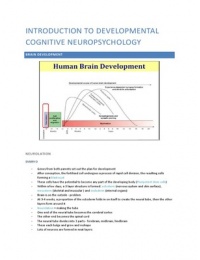
BRAIN DEVELOPMENT
NEUROLATION
EMBRYO
- Genes from both parents set out the plan for development
- After conception, the fertilised cell undergoes a process of rapid cell division, the resulting cells
forming a blastocyst
- These cells have the potential to become any part of the developing body (Pluripotent stem cells)
- Within a few days, a 3 layer structure is formed: ectoderm (nervous system and skin surface),
mesoderm (skeletal and muscular ) and endoderm (internal organs)
- Brain is on the outside - problem
- At 3-4 weeks, a proportion of the ectoderm folds in on itself to create the neural tube, then the other
layers form around it
- Neurolation = making the tube
- One end of the neural tube becomes the cerebral cortex
- The other end becomes the spinal cord
- The neural tube divides into 3 parts - forebrain, midbrain, hindbrain
- These each bulge and grow and reshape
- Lots of neurons are formed in neat layers
, CELL PROFILATION & MIGRATION (2 MONTHS - BIRTH)
PROFILERATION
- Cells are born - split off from other cells
- 24 - 125 embryonic days (4 weeks- 4 months)
- Most cells are born in zones close to the hollows of the neural tube (the hollows will later become
the brain ventricles)
- Stem cells Neuroblasts (neurons) / Glioblasts (glial cells - forming outer space around neurons and
cells forming myelin around the axon of the neurons)
- Common belief that no new neurons are produced in the postnatal period - but a few exceptions
(hippocampus, olfactory bulb)
- If something goes wrong at this stage there are consequences later
MIGRATION
- 40 - 60 embroynic days - 1 ½ - 6 months
- Cells move to the final destination via either passive displacement or active displacement
- Passive: older cells are pushed away by newer cells and stack up in order. E.g. thalamus, parts of the
hippocampus, parts of the brain stem
- Active: newer cells overtake old cells - so opposite order. E.g. cortex and some subcortical areas
- Delicate process - can go wrong - big consequences
CONTINUED GROWTH
- Once neurons have reached their final destination: axon growth, dendrites arborisation, start of cell
communication
- Starts at about 4 months and continues till birth
- Incredibly complex
ERRORS IN PRENATAL DEVELOPMENT
Genes - most prenatal development is determined by genes
Errors in genes will cause errors in development
Environment
- Foetal alcohol syndrome
- Low folic acid could cause the neural tube not to close - causing spinal bifida,
- Sodium valproate (drug to treat epilepsy) could cause risk of autism / low IQ if used in pregnancy
- Hormone levels - stress / testosterone could cause subtle changes in development, but hazy
POST NATAL DEVELOPMENT
MYELINATION
- Myelin is a fatty substance produced by the glial cells that cover the axons of neurons
- Rapid development in the first 3 years but continuing at a slower pace into the second decade
- Important - offers insulation, speeds conduction velocity (within cell communication is electrical -
action potential, will affect speed of information processing )
SYNAPTOGENSIS
- Growing synapses
COGNITIVE NEUROPSYCHOLOGY
BRAIN DEVELOPMENT
NEUROLATION
EMBRYO
- Genes from both parents set out the plan for development
- After conception, the fertilised cell undergoes a process of rapid cell division, the resulting cells
forming a blastocyst
- These cells have the potential to become any part of the developing body (Pluripotent stem cells)
- Within a few days, a 3 layer structure is formed: ectoderm (nervous system and skin surface),
mesoderm (skeletal and muscular ) and endoderm (internal organs)
- Brain is on the outside - problem
- At 3-4 weeks, a proportion of the ectoderm folds in on itself to create the neural tube, then the other
layers form around it
- Neurolation = making the tube
- One end of the neural tube becomes the cerebral cortex
- The other end becomes the spinal cord
- The neural tube divides into 3 parts - forebrain, midbrain, hindbrain
- These each bulge and grow and reshape
- Lots of neurons are formed in neat layers
, CELL PROFILATION & MIGRATION (2 MONTHS - BIRTH)
PROFILERATION
- Cells are born - split off from other cells
- 24 - 125 embryonic days (4 weeks- 4 months)
- Most cells are born in zones close to the hollows of the neural tube (the hollows will later become
the brain ventricles)
- Stem cells Neuroblasts (neurons) / Glioblasts (glial cells - forming outer space around neurons and
cells forming myelin around the axon of the neurons)
- Common belief that no new neurons are produced in the postnatal period - but a few exceptions
(hippocampus, olfactory bulb)
- If something goes wrong at this stage there are consequences later
MIGRATION
- 40 - 60 embroynic days - 1 ½ - 6 months
- Cells move to the final destination via either passive displacement or active displacement
- Passive: older cells are pushed away by newer cells and stack up in order. E.g. thalamus, parts of the
hippocampus, parts of the brain stem
- Active: newer cells overtake old cells - so opposite order. E.g. cortex and some subcortical areas
- Delicate process - can go wrong - big consequences
CONTINUED GROWTH
- Once neurons have reached their final destination: axon growth, dendrites arborisation, start of cell
communication
- Starts at about 4 months and continues till birth
- Incredibly complex
ERRORS IN PRENATAL DEVELOPMENT
Genes - most prenatal development is determined by genes
Errors in genes will cause errors in development
Environment
- Foetal alcohol syndrome
- Low folic acid could cause the neural tube not to close - causing spinal bifida,
- Sodium valproate (drug to treat epilepsy) could cause risk of autism / low IQ if used in pregnancy
- Hormone levels - stress / testosterone could cause subtle changes in development, but hazy
POST NATAL DEVELOPMENT
MYELINATION
- Myelin is a fatty substance produced by the glial cells that cover the axons of neurons
- Rapid development in the first 3 years but continuing at a slower pace into the second decade
- Important - offers insulation, speeds conduction velocity (within cell communication is electrical -
action potential, will affect speed of information processing )
SYNAPTOGENSIS
- Growing synapses