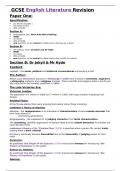
GCSE English Literature Revision
Paper One:
Specification:
1hr 45min (divided: )
64 marks in total
40% of GCSE
Section A:
Shakespeare play: Much Ado About Nothing
TIME?
32 marks
20% of GCSE
one question; on the extract in detail and on the play as a whole
Section B:
19th century novel: Dr Jekyll and Mr Hyde
TIME?
32 marks
20% of GCSE
one question; on the extract in detail and on the novella as a whole
Section B: Dr Jekyll & Mr Hyde
Context:
context - the social, political and historical circumstances surrounding a text
The Author:
Robert Louis Stevenson was born in Edinburgh in 1850 from a family of scientists, engineers,
a philosophy professor and a religious minister. These scientific and religious sides in his life are
also reflected in the novella, published in 1886.
The Late Victorian Era:
Victorian London:
The population of 1 million in 1800 to 6.7 million in 1900, with huge numbers migrating from
Europe.
Societal Fears:
At the fin-de-siècle there were growing fears about many things including:
Lombroso’s Theory of Atavism:
atavism - the reappearance in an individual of characteristics of some remote ancestor that
have been absent in
intervening generations.
physiognomy - the supposed art of judging character from facial characteristics.
The unsettling, dwarfish appearance of Edward Hyde and the violent behaviour he exhibits are
clear atavistic traits.
Lombroso's theory of the ‘Criminal Man’ (1876) is depicted when a person fits certain traits
making them a born criminal.
His theory eventually became discredited due to the immorality of judging people on their
looks.
Darwinism:
He published ’the Origin of the Species’ (1859) that became famous for introducing ‘the
Theory of Evolution’ to the public.
Science vs. Religion:
He published ’the Origin of the Species’ (1859) that became famous for introducing ‘the
Theory of Evolution’ to the public.
Genres:
Paper One:
Specification:
1hr 45min (divided: )
64 marks in total
40% of GCSE
Section A:
Shakespeare play: Much Ado About Nothing
TIME?
32 marks
20% of GCSE
one question; on the extract in detail and on the play as a whole
Section B:
19th century novel: Dr Jekyll and Mr Hyde
TIME?
32 marks
20% of GCSE
one question; on the extract in detail and on the novella as a whole
Section B: Dr Jekyll & Mr Hyde
Context:
context - the social, political and historical circumstances surrounding a text
The Author:
Robert Louis Stevenson was born in Edinburgh in 1850 from a family of scientists, engineers,
a philosophy professor and a religious minister. These scientific and religious sides in his life are
also reflected in the novella, published in 1886.
The Late Victorian Era:
Victorian London:
The population of 1 million in 1800 to 6.7 million in 1900, with huge numbers migrating from
Europe.
Societal Fears:
At the fin-de-siècle there were growing fears about many things including:
Lombroso’s Theory of Atavism:
atavism - the reappearance in an individual of characteristics of some remote ancestor that
have been absent in
intervening generations.
physiognomy - the supposed art of judging character from facial characteristics.
The unsettling, dwarfish appearance of Edward Hyde and the violent behaviour he exhibits are
clear atavistic traits.
Lombroso's theory of the ‘Criminal Man’ (1876) is depicted when a person fits certain traits
making them a born criminal.
His theory eventually became discredited due to the immorality of judging people on their
looks.
Darwinism:
He published ’the Origin of the Species’ (1859) that became famous for introducing ‘the
Theory of Evolution’ to the public.
Science vs. Religion:
He published ’the Origin of the Species’ (1859) that became famous for introducing ‘the
Theory of Evolution’ to the public.
Genres: